Introduction
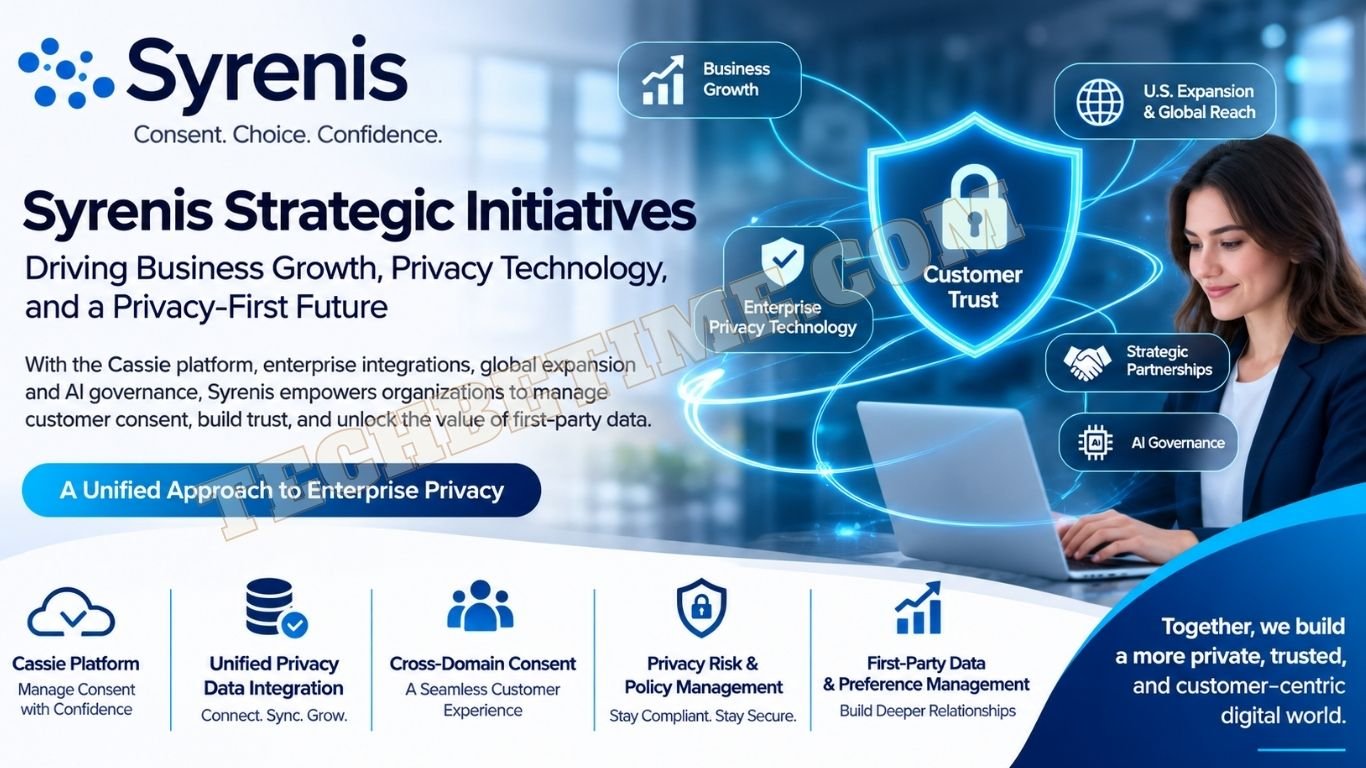
Syrenis strategic initiatives focus on expanding enterprise privacy technology, improving consent and preference management, developing business partnerships, and supporting organizations that handle large volumes of customer data. As companies increasingly operate across multiple websites, applications, marketing platforms, and international markets, managing customer privacy choices has become an important operational challenge.
Syrenis addresses this challenge through technology designed to help organizations collect, manage, and distribute consent and preference information across connected business systems. Its Cassie platform has traditionally been associated with consent and preference management, while the company’s broader strategic direction encompasses enterprise privacy operations, data integration, governance, and international growth.
These developments are important because privacy management is no longer limited to displaying a cookie banner. Businesses must also consider how customer choices are stored, how changes are communicated to other systems, how permission records can be reviewed, and how privacy policies are applied across different markets.
Syrenis’s approach connects these operational needs with commercial growth. Its reported initiatives include expansion into the United States, enterprise sales development, consulting relationships, integration capabilities, and broader consideration of data governance as organizations adopt artificial intelligence.
This article explores the major Syrenis strategic initiatives, explains the role of its consent management technology, examines potential enterprise benefits, and discusses the challenges businesses should evaluate before implementing a privacy platform.
What Are Syrenis Strategic Initiatives?
Syrenis strategic initiatives are the company’s business and technology priorities intended to strengthen its position in enterprise consent management and privacy technology. These initiatives combine commercial expansion with improvements in the ways organizations manage customer permissions, communication preferences, and privacy-related information.
A large enterprise may have several brands, websites, mobile applications, customer relationship management (CRM) systems, and marketing platforms. Each system can store different information about the same customer. Without suitable coordination, a privacy choice recorded in one system may not be reflected in another.
For example, a customer might withdraw permission to receive promotional emails through a preference center. If the marketing platform does not receive the updated choice, the business could continue sending messages the customer no longer wants. This creates a poor customer experience and may introduce compliance risks.
Syrenis’s strategic approach seeks to address such challenges by making consent and preference information easier to manage across an organization’s technology environment. The wider objective is to connect privacy requirements with everyday business operations rather than treating them as isolated legal tasks.
Its strategic areas include platform development, enterprise customer acquisition, international expansion, partnerships, system integrations, and improved privacy governance. Together, these areas can help the company serve organizations with complex data environments.
Main Objectives of Syrenis Strategic Initiatives
The main objectives can be understood through several connected priorities.
First, Syrenis seeks to strengthen its position in the enterprise privacy technology market. Large organizations often need more advanced capabilities than basic cookie consent tools can provide. They may require centralized records, detailed customer preferences, connections to existing systems, and consistent privacy controls across brands and regions.
Second, the company focuses on commercial growth. International expansion and enterprise sales can introduce its technology to additional customers while creating opportunities to work with consulting and implementation partners.
Third, technology development is central to the strategy. Consent records become more useful when connected systems can access current information and apply customer choices appropriately. Integration capabilities, preference centers, APIs, and synchronization are therefore important parts of the wider enterprise proposition.
Finally, privacy governance is becoming increasingly relevant. Organizations need to understand how personal information is collected, why it is processed, which permissions apply, and how privacy decisions can be documented.
These objectives reinforce one another. Better integrations can increase platform value, partnerships can support implementation, and international growth can create demand for flexible privacy management. However, the success of these initiatives depends on product performance, customer adoption, effective implementation, and the ability to respond to changing privacy requirements.
From Traditional Consent Management to Enterprise Privacy Technology
Traditional consent management often begins with a website banner that allows visitors to accept or reject certain cookies and tracking technologies. Although this remains important, it addresses only one part of a much larger privacy challenge.
Enterprise organizations need to manage privacy choices across multiple systems and customer interactions. A customer might update communication preferences on a website, contact customer service to change a subscription, or interact with a mobile application. These interactions need to be handled consistently wherever the relevant preferences apply.
Enterprise privacy technology aims to connect these activities. Instead of treating every website or application as an independent source of consent information, businesses can establish processes for maintaining records, communicating changes, and applying the appropriate rules.
Syrenis’s broader positioning reflects this shift. Consent management remains important, but the value proposition also involves preference management, identity-related records, integration, and privacy operations.
This does not mean that one platform automatically resolves every compliance issue. Organizations still need suitable legal assessments, security controls, policies, and operational oversight. The technology provides infrastructure to help implement those responsibilities.
The distinction is important for companies choosing privacy software. They should assess whether they need a simple cookie management solution or a more comprehensive system capable of supporting customer choices across their enterprise environment.
How Syrenis Addresses Enterprise Data Challenges
Enterprise data challenges often arise because customer information is distributed across different departments and software systems. Marketing may use one platform, customer service another, and the privacy team may maintain separate compliance records. These systems can have different identifiers, formats, update schedules, and access rules.
Syrenis’s consent and preference management approach is designed to help organizations coordinate information about customer choices across connected systems. A centralized record can provide a reference point for determining which permissions have been recorded and whether a customer has subsequently changed them.
Consider an international retailer with several brands. A customer may subscribe to product updates through one brand’s website but later change their preferences through a shared customer account. The retailer needs to determine which preferences apply to each brand, purpose, and communication channel.
A privacy platform can help record these distinctions and make relevant information available to connected systems. APIs, integrations, and data mapping can support the movement of information between the privacy platform and existing business applications.
However, centralization alone is not enough. The organization must establish reliable identity matching, define which systems are authoritative for particular data, test integrations, and monitor failures. Different permissions must also remain distinguishable rather than being combined into one general approval.
When implemented carefully, this approach can improve visibility and reduce inconsistencies. It can also make it easier for privacy, legal, marketing, and technology teams to work from a more consistent understanding of customer choices.
Syrenis and the Cassie Consent Management Platform
The Syrenis Cassie platform is central to understanding the company’s technology strategy. Cassie has been associated with enterprise consent and preference management, helping organizations capture customer choices and make the resulting information available to relevant business systems.
For large organizations, consent management involves more than recording whether someone clicked an acceptance button. Businesses may need to know what the person agreed to, which purpose the permission covered, when the decision occurred, whether the customer later changed it, and which systems must respond to the update.
Cassie is designed to support this broader process. Syrenis’s platform materials describe a model built around collecting privacy decisions, understanding privacy activity across systems, managing rules, synchronizing information, and supporting governance.
Syrenis
+1
For example, a financial services company might manage several types of customer communications, each with different preferences and requirements. A customer could agree to receive account updates while declining promotional messages. A well-configured consent platform should preserve that distinction and make the relevant choice available to the systems responsible for communication.
The platform’s value therefore depends on how well it fits into the company’s wider data environment. Organizations must configure permissions appropriately, connect the required systems, establish reliable identity matching, and test whether changes are applied as expected.
Key Features of the Cassie Platform
Cassie’s strategic relevance comes from the range of consent-related tasks it is intended to support. These capabilities can help organizations manage privacy choices across digital channels rather than maintaining disconnected records in individual applications.
Important areas include consent collection, preference management, records of customer decisions, integration with business systems, and synchronization of updated information. Depending on the implementation, organizations can also use connected privacy workflows to help teams maintain visibility into customer choices.
The integration layer is particularly important. If a company uses separate platforms for its website, customer database, and email marketing, those systems need an agreed method for sharing relevant consent information. Connectors and APIs can help move the information between applications without requiring every team to manage a separate manual process.
Another important capability is configurable data mapping. Different enterprise systems may use different field names, identifiers, and data structures. Mapping helps establish how consent information in one environment corresponds to the fields expected by another.
Organizations evaluating Cassie should verify the current feature set, supported integrations, implementation requirements, security controls, and licensing arrangements directly with Syrenis. Product capabilities can evolve, and a feature’s availability does not guarantee that it will work identically in every customer’s environment.
The most useful evaluation is practical: identify the business systems that need privacy information, define the required workflows, and test whether the platform can support them accurately and reliably.
Consent Records and Customer Permission Management
Consent records document customer decisions and help organizations understand how permissions change over time. A useful record may include the relevant customer or identifier, the purpose of processing, the choice made, a timestamp, the applicable notice or wording, and subsequent changes where supported.
These details matter because consent is not necessarily permanent. A customer may give permission today and withdraw it later. The organization needs a reliable way to identify the latest applicable choice and determine which processes must respond.
For example, imagine that a customer agrees to receive a company’s promotional newsletter. Several months later, the customer unsubscribes. The business should record the updated decision and ensure that relevant marketing workflows apply it. Retaining an earlier record of consent can be useful for understanding the history, but the old permission must not be treated as though the withdrawal never occurred.
A centralized consent management platform can help maintain this history and make relevant records accessible to authorized teams. It can also support internal reviews by making it easier to investigate when a choice was recorded and how the organization processed it.
However, a consent record is not proof that every aspect of data processing is lawful. The organization must still determine whether consent is the appropriate legal basis, whether the permission was validly obtained, and whether the proposed use matches its scope.
Effective permission management therefore combines accurate records, suitable legal analysis, access controls, and tested system workflows.
Preference Centers and Customer Choice
Preference management allows customers to communicate how they want to interact with a business. A preference center can offer more flexibility than a single subscription checkbox by separating communication channels, topics, and other available choices.
For example, an online retailer might allow customers to receive product announcements but decline discount promotions. Another customer may prefer email rather than text messages. A subscription business could let users choose the subjects about which they want to receive updates.
Syrenis presents preference management as a core part of its enterprise offering, with tools intended to help organizations capture and apply customer choices across connected systems.
Syrenis
+1
A well-designed preference center should make the available options easy to understand. It should explain what each choice means, avoid confusing or misleading wording, and make it reasonably straightforward for customers to change their decisions.
Businesses also need to ensure that preference changes reach the systems that use the information. A beautifully designed preference page offers little value if the customer’s updated choices are not reflected in marketing, customer service, or subscription workflows.
Preference centers can also improve the customer experience by giving individuals more control over the frequency and type of communications they receive. The result can be a more transparent relationship between the customer and the organization.
The exact options available will depend on the business, its systems, and applicable legal requirements. Companies should therefore configure preference centers around real customer needs rather than collecting unnecessary information or offering choices that the business cannot reliably honor.
The Role of Cassie in Enterprise Privacy Operations
Enterprise privacy operations involve several departments, including legal, compliance, marketing, information technology, customer service, and data management. Each team may handle a different part of the customer journey, but their decisions can depend on the same underlying privacy information.
Cassie can serve as a technology layer that helps coordinate consent and preference information between these departments and their systems. Instead of requiring every team to maintain an independent interpretation of a customer’s choices, the organization can establish common records and agreed processes for using them.
Consider a customer who asks a company to stop a particular type of marketing communication. Customer service may receive the request, the privacy system may record it, and the marketing platform may need to suppress the customer from a relevant campaign. Each step must work correctly for the final outcome to match the customer’s request.
A connected platform can help make those processes more consistent and easier to review. It can also support internal accountability by clarifying which systems consume privacy data and which teams are responsible for specific workflows.
Nevertheless, technology cannot replace clear ownership. Businesses still need defined responsibilities, appropriate permissions, escalation procedures, monitoring, and staff training. They must also test failure scenarios, such as an unavailable integration or a customer record that cannot be matched confidently.
The strategic benefit of Cassie is therefore not simply the collection of consent. It is the potential to make privacy decisions usable throughout enterprise operations while preserving the controls needed to handle customer information responsibly.
The Shift Toward a Unified Enterprise Privacy Platform
Syrenis’s broader strategic direction involves presenting privacy management as an enterprise-wide operational capability rather than a narrow website compliance function. This positioning reflects a wider business problem: customer choices need to remain consistent across increasingly complicated technology environments.
A basic cookie consent tool may be sufficient for a small website with limited tracking requirements. A multinational enterprise may need to coordinate consent across many domains, brands, mobile applications, customer databases, and marketing systems. It may also need separate rules for different jurisdictions, communication purposes, and categories of information.
A unified platform approach seeks to bring these requirements into a more coordinated structure. Consent, preference management, data integrations, and privacy governance can work together so that customer decisions are not isolated in individual systems.
Syrenis’s current platform messaging describes capabilities for collecting decisions, understanding privacy activity, managing privacy requirements, synchronizing information, and supporting governance across an organization.
Syrenis
+1
The strategic importance of this approach lies in operational consistency. Privacy teams need visibility into how choices are handled, technology teams need reliable interfaces, and marketing teams need accurate preference information before communicating with customers.
A unified platform does not mean that every system must be replaced or every data record stored in one physical database. In many enterprise environments, it is more practical to establish a trusted privacy data layer that communicates with existing applications.
Syrenis’s Brand Repositioning and Platform Development
In 2026, Syrenis announced a brand refresh that brought its messaging under a unified Syrenis identity. The company’s announcement described a repositioning toward a global enterprise privacy technology platform, with a dedicated U.S. go-to-market operation supporting its international growth plans.
Syrenis
+1
From a strategic perspective, a brand repositioning can help communicate a broader product vision to enterprise buyers. Rather than being associated only with cookie compliance, the company can explain how its technology supports consent, preferences, integration, and governance across multiple systems.
This change is particularly relevant when the people evaluating enterprise software have different priorities. A privacy leader may be interested in regulatory controls, a marketing leader in customer preferences, and an IT leader in APIs, architecture, and data synchronization. A unified platform message can explain how those needs relate to one another.
However, a brand refresh is not the same as a technical upgrade. Organizations should distinguish changes in messaging from actual product capabilities, documented performance improvements, and released functionality.
The practical questions remain whether the platform supports the required workflows, integrates with the company’s systems, meets its security expectations, and can be operated at the necessary scale.
For Syrenis, the long-term value of its repositioning will depend on how effectively the broader message is supported by product development, customer outcomes, implementation capabilities, and continued commercial growth.
Combining Consent, Preferences, and Privacy Governance
Consent management, preference management, and privacy governance solve related but distinct problems.
Consent management records and applies permission decisions where consent is required or used. Preference management captures choices about communication and other customer interactions. Privacy governance covers the policies, processes, responsibilities, and records that help an organization manage its wider data protection obligations.
Bringing these areas together can help businesses reduce the gaps between privacy policy and operational practice. For example, a policy may require the company to stop a certain type of communication after a customer withdraws permission. The consent system records the change, integration workflows distribute it, and monitoring processes help the organization identify failures.
Syrenis’s platform materials describe both consent and preference management and a broader risk-and-policy offering that includes privacy notices, policy management, and rights-related workflows.
Syrenis
+2
This broader model can be useful for organizations that need to coordinate privacy activities across multiple teams. It can also provide a more consistent basis for internal reporting and reviews.
The important limitation is that connected technology does not automatically establish good governance. Companies still need to determine which laws apply, define legitimate processing purposes, maintain accurate documentation, and assign responsibility for compliance decisions.
A successful implementation connects technology to these operating procedures. It should make the correct action easier to carry out, provide useful records of what happened, and help teams identify problems before they create significant customer or regulatory consequences.
Why Enterprise Customers Need Connected Privacy Solutions
Enterprise customers need connected privacy solutions because their technology environments are rarely simple. A global company may use different applications in each region, operate several consumer brands, and rely on external service providers for marketing, analytics, and customer support.
Without coordination, each system may develop its own understanding of customer permissions. This can lead to inconsistent communication, duplicated work, unclear records, and difficulty responding to privacy requests.
A connected solution can help establish common privacy signals that relevant systems can consume. For instance, when a customer changes a marketing preference, the update can be communicated to the appropriate campaign platform and customer database, subject to the company’s configured rules.
Connected privacy data can also help teams understand why a workflow should or should not proceed. A system might check whether a particular communication is permitted for a customer and purpose before activating the relevant process.
For enterprise buyers, the objective is not integration for its own sake. It is to ensure that the correct customer choice reaches the correct system, at the correct time, and is interpreted appropriately.
Businesses should therefore map their data flows before choosing a platform. They should identify authoritative records, customer identifiers, integration dependencies, and situations in which permissions differ by brand, region, or purpose.
This preparation helps establish realistic implementation goals and reduces the risk of assuming that a centralized privacy platform can resolve underlying data-quality problems automatically.
Global Growth and U.S. Expansion Strategy
International growth is a significant part of Syrenis’s publicly described business direction. The company has stated that it expanded its international footprint by launching U.S. operations to support enterprise customers across North America. Its 2026 brand announcement also identifies the United States, United Kingdom, and Europe as important markets for its growth strategy.
Syrenis
+1
The U.S. market presents opportunities for enterprise privacy technology because businesses operate under a changing landscape of state privacy laws, sector-specific requirements, and differing expectations around personal information. Organizations with customers across multiple states may need configurable processes rather than one uniform workflow for every interaction.
For a privacy technology provider, expansion can mean more than opening an office. It may involve developing local sales relationships, providing customer support, building consulting partnerships, and understanding the requirements of regional enterprise buyers.
Syrenis’s broader strategy also aligns with organizations that operate across several countries. International businesses must consider how their privacy operations function across different legal environments while maintaining consistent internal processes.
However, the existence of a local office does not itself establish market share or commercial success. Buyers and observers should distinguish the company’s announced expansion plans from independently demonstrated results, such as customer growth, revenue, or adoption.
Syrenis’s Expansion Into the U.S. Market
Syrenis’s official company information says Adam Binks became CEO in February 2025 and led the company’s next phase of growth, including the launch of U.S. operations and a new office supporting North American enterprise customers. Its 2026 brand announcement identifies Atlanta as the base for its dedicated U.S. go-to-market operation and lists an Austin office as well.
Syrenis
+1
The commercial rationale is understandable. North America is home to many large businesses with complex customer-data environments. These organizations may need consent management that connects with existing CRM platforms, marketing tools, customer accounts, and internal privacy processes.
A local presence can make it easier for a vendor to develop relationships with customers, coordinate demonstrations, support sales discussions, and work with regional partners. It may also help a company better understand the requirements and procurement expectations of enterprise buyers.
For Syrenis, the U.S. expansion forms part of its effort to position itself as a global enterprise privacy technology provider. The company’s platform is intended to address consent and preference management across systems and jurisdictions, which is relevant to organizations operating across state and national boundaries.
Still, buyers should evaluate the actual service arrangements available to them, including support coverage, implementation resources, contractual terms, data hosting, and regional requirements. A local commercial presence should be considered alongside technical capability and delivery quality.
Managing Different Privacy Regulations
Privacy regulation is not uniform across the United States or internationally. California, for example, has the California Consumer Privacy Act (CCPA), as amended by the California Privacy Rights Act (CPRA). Other states have adopted their own privacy laws, while the European Union’s General Data Protection Regulation (GDPR) establishes a different legal framework.
These laws do not all impose identical obligations. Depending on the jurisdiction and circumstances, requirements may concern notice, access and deletion rights, targeted advertising, sensitive personal information, opt-out mechanisms, consent, or data sharing.
For businesses operating across multiple jurisdictions, privacy operations must reflect the rules that apply to each activity. A single universal setting may not be sufficient when different laws, processing purposes, and customer circumstances require different treatment.
A configurable privacy platform can help organizations apply appropriate rules and maintain relevant records. It can also help distribute changes to customer preferences across connected systems.
However, software does not decide every legal question automatically. Organizations need qualified legal and privacy professionals to determine which obligations apply, how they should be implemented, and how exceptions should be handled.
A sound strategy combines legal interpretation with technology configuration, documentation, staff training, and periodic reviews. This allows companies to adapt their privacy processes as laws and business activities change.
Target Industries: Finance, Healthcare, Retail, Media, and Technology
Enterprise privacy technology can be relevant across industries that manage substantial customer information, although each sector has different requirements.
Financial services: Banks, insurers, and investment businesses may manage customer accounts, service communications, marketing permissions, and data shared with approved service providers. Consent and preference systems can help distinguish between different communication purposes, but financial institutions must also account for sector-specific legal and security requirements.
Healthcare: Healthcare organizations may handle sensitive personal information and operate patient portals, appointment systems, and communications platforms. Privacy management must be aligned with applicable healthcare and data protection rules. A general consent platform should not be assumed to satisfy every specialized requirement.
Retail and e-commerce: Retailers may manage loyalty programs, online stores, mobile applications, and promotional campaigns. Preference centers can help customers select the communications they want, while integrations can help marketing systems apply those choices.
Media and technology: Publishers, streaming services, software companies, and digital platforms may use multiple websites, subscription systems, analytics tools, and customer accounts. Connected consent management can help coordinate privacy choices across those environments.
The common requirement is operational consistency. Each organization needs a system that fits its actual data flows, legal obligations, customer expectations, and technical architecture rather than relying on a generic solution without configuration.
Opportunities for International Enterprise Growth
International growth can create opportunities for Syrenis if it can demonstrate that its technology addresses real enterprise problems across different markets. Multinational businesses may prefer solutions that can support multiple brands, jurisdictions, and technology systems without requiring a completely separate privacy workflow for every region.
Partnerships can also help an enterprise software provider expand its reach. Consulting firms and implementation specialists may already have relationships with organizations that need help redesigning privacy processes. A technology provider can complement that expertise with software for collecting, managing, and distributing consent information.
Another opportunity comes from the growing importance of connected customer data. As companies add digital channels and AI-enabled services, they need clearer records of data permissions and more reliable processes for applying customer choices.
Yet international growth brings its own demands. Vendors must understand regional procurement expectations, data protection obligations, customer support requirements, and implementation practices. They must also avoid overpromising that a single platform can solve every privacy challenge.
For Syrenis, sustainable expansion will depend on product fit, reliable integrations, effective partnerships, customer satisfaction, and the ability to show measurable value. Market presence is an important step, but long-term success requires evidence that customers can deploy and maintain the technology effectively.
Enterprise Sales and Commercial Growth Strategy
Enterprise software sales differ from selling a simple consumer application. A large organization may need several departments to approve a purchase, including legal, privacy, information security, IT, marketing, procurement, and finance. Each department evaluates the technology from a different perspective.
Syrenis’s commercial strategy is connected to its positioning as an enterprise privacy technology provider. Its official company materials describe leadership focused on international growth and a platform designed for complex enterprise environments.
Syrenis
+1
A potential customer may begin by looking for a solution to a specific problem, such as inconsistent cookie consent or disconnected marketing preferences. During the evaluation, the organization may discover related needs involving data integrations, policy management, identity matching, and privacy reporting.
This creates an opportunity for a vendor to demonstrate broader value. However, enterprise sales require evidence, not just a wide list of features. Buyers need to understand implementation costs, integration effort, security controls, support arrangements, and expected outcomes.
Commercial growth also depends on the customer experience after purchase. A platform that is difficult to implement or maintain may fail to deliver its promised benefits, even if its feature set appears suitable.
For Syrenis, a sustainable enterprise growth strategy therefore involves matching the product to customer needs, supporting complex implementations, developing partner relationships, and maintaining the technical capabilities required by large organizations.
Building Enterprise Customer Relationships
Enterprise customer relationships often continue long after the initial software purchase. Privacy platforms may become connected to customer databases, marketing systems, websites, and internal compliance workflows. Replacing or substantially changing such a platform can require considerable planning.
For that reason, enterprise buyers typically consider the vendor’s long-term capabilities as well as the product itself. They may evaluate technical support, implementation expertise, product development, service reliability, and the vendor’s ability to respond to changing requirements.
Syrenis can build customer relationships by helping organizations understand their privacy workflows and identifying where the platform can improve consistency. This requires more than demonstrating a consent banner. A useful demonstration might show how a preference change is recorded, communicated to another system, and reflected in the relevant customer interaction.
Clear implementation planning is equally important. Customers should understand which systems will be connected, which data will be transferred, how identifiers will be matched, and how the solution will be tested.
Long-term relationships also benefit from measurable service objectives. Organizations might monitor the accuracy of preference synchronization, the time needed to process requests, the number of integration failures, or the effort required to produce privacy records.
These measures help both the customer and the vendor assess whether the platform is delivering practical value. Strong relationships are built through reliable delivery, transparent communication, and a shared understanding of responsibilities.
Improving Sales Processes and Market Reach
Enterprise sales processes can be lengthy because privacy technology affects several business functions. A prospect may need an initial demonstration, a technical review, a privacy assessment, a security evaluation, procurement approval, and a deployment plan before making a decision.
A more effective sales process identifies the customer’s main problem early and connects the proposed solution to that requirement. For example, a business struggling with disconnected consent records may need a demonstration of integration and synchronization rather than a general presentation about privacy.
Syrenis’s expansion strategy and partner model can support market reach by helping the company engage enterprise buyers through direct sales and suitable commercial relationships. Its published partner program describes resources such as sales enablement, technical training, certification, co-branded marketing, and joint go-to-market planning.
Syrenis
Such resources can help partners explain the product and identify relevant customer opportunities. They can also support a more consistent approach to demonstrations and implementation planning.
However, reducing sales friction should not mean skipping technical or legal checks. Enterprise privacy systems need careful evaluation because errors can affect customer communications and compliance processes.
A strong commercial process helps customers understand both the platform’s capabilities and its limitations. It also sets realistic expectations about integration work, data preparation, implementation timelines, and ongoing administration.
Supporting Complex Enterprise Implementations
Implementing enterprise consent technology involves more than installing software. An organization must understand its existing data flows, decide which systems are authoritative, identify the customer records that need to be matched, and define how privacy choices should be applied.
A typical implementation may begin with discovery and system mapping. The project team identifies websites, applications, marketing tools, CRM platforms, and other systems that collect or use customer data. It then documents the relevant consent and preference requirements.
The next stage involves configuring the platform, connecting systems, mapping data fields, and establishing synchronization rules. Testing should cover normal situations as well as exceptions, such as duplicate customer identities, missing identifiers, delayed updates, and failed integrations.
Training is another important component. Privacy and legal teams need to understand how records and rules are managed, while IT teams need to understand integration monitoring and troubleshooting. Marketing and customer service teams must know how customer choices affect their workflows.
A phased rollout can reduce risk. An organization might begin with a limited set of systems, verify that records and updates are handled correctly, and then expand to additional brands or regions.
This structured approach helps businesses avoid assuming that a platform will automatically resolve legacy data problems. Effective implementation combines technology, data quality, legal review, operational ownership, and continuous monitoring.
Strategic Partnerships and Business Collaborations
Partnerships can help privacy technology companies combine software capabilities with consulting, implementation, and industry expertise. This is particularly relevant to enterprise privacy projects because organizations may need assistance with legal interpretation, system architecture, process design, employee training, and ongoing governance.
Syrenis’s partnership approach includes a published partner program that describes revenue-sharing models, sales resources, training, certification, and joint marketing opportunities.
Syrenis
A consulting partner may help a business identify its privacy obligations and design the processes needed to manage them. A technology provider can then supply tools for recording customer choices and making relevant information available across connected systems.
This division of responsibilities can be useful for organizations that lack sufficient internal resources to design and implement a comprehensive privacy program. It can also help technology providers reach customers through established consulting relationships.
However, partnerships require clear boundaries. The customer should know which organization is responsible for legal advice, technical configuration, data migration, integration support, and ongoing maintenance.
The scope of each relationship also matters. A published collaboration or shared resource does not necessarily establish a broad, exclusive, or global commercial partnership. Claims about partners should therefore reflect the specific relationship that has been publicly documented.
Syrenis and The Data Privacy Group
Syrenis announced a strategic alliance with The Data Privacy Group (DPG) on August 6, 2025. The announcement described a collaboration combining Syrenis’s consent management technology with DPG’s privacy program consulting and implementation expertise, initially focusing on clients in the United Kingdom, European Union, and North America.
PR Newswire
+1
The relationship illustrates how software and professional services can complement one another. An enterprise may understand that it needs better consent management but still require help identifying the relevant systems, defining internal responsibilities, and translating privacy requirements into practical workflows.
DPG’s consulting role can support the design and implementation of privacy programs, while Syrenis provides technology for managing consent and preferences. Together, these capabilities can help organizations connect privacy policies with operational processes.
For example, a multinational company might need to review how customer preferences are collected across its websites and marketing systems. A consulting engagement could help identify process gaps and define the required controls. The technology implementation could then connect relevant systems and support more consistent handling of customer choices.
The alliance may also be relevant to organizations that want a combination of strategic advice and practical implementation assistance rather than purchasing software in isolation.
Its actual value for a particular customer will depend on the scope of services offered, the expertise available, and the quality of implementation. Businesses should clarify deliverables, responsibilities, support arrangements, and contractual terms before engaging either provider.
Syrenis and KPMG Collaboration
The supplied research describes Syrenis developing a dedicated KPMG resource hub following a workshop and product demonstration. The material reportedly covered consent management, progressive profiling, and ways to evaluate the value of consent programs.
These topics are relevant to enterprise consulting because organizations often need help understanding how privacy technology fits into broader customer-data and marketing strategies.
Progressive profiling, for instance, involves collecting useful information gradually instead of requiring customers to complete a long form at their first interaction. When designed appropriately, this can make data collection more manageable while allowing customers to understand what information they are providing.
Measuring the value of a consent program is another important topic. A business might assess whether preference changes are applied correctly, whether customer communication becomes more consistent, or whether privacy operations require less manual effort. Such measurements should be tied to defined objectives rather than assuming that every privacy investment will produce a particular financial return.
The available information about the KPMG resource hub should be described carefully. A workshop, demonstration, or dedicated collection of materials does not by itself confirm a broad formal commercial partnership covering all KPMG operations.
Organizations interested in this relationship should verify the specific collaboration, its current status, and the services actually available. This distinction is important for accurate reporting and for buyers assessing potential implementation partners.
Syrenis and Myna
The supplied research also describes a relationship between Syrenis and Myna, identified as a U.S.-based privacy consulting firm. The relationship fits the general model of combining privacy expertise with enterprise consent technology.
A consulting firm may help an organization evaluate its privacy processes, understand operational gaps, and plan implementation. A technology provider can offer the software and integration capabilities needed to put those processes into practice.
For example, a business may need to connect consent records with customer systems while reviewing its procedures for handling changes to communication preferences. Consulting expertise can help define the process and responsibilities, while the platform can help distribute the relevant information to connected applications.
However, the detailed scope, terms, and current status of the reported Syrenis–Myna relationship are not sufficiently established by the information available here to support broader claims about exclusivity, scale, or commercial outcomes.
Readers should therefore treat the relationship as a reported collaboration requiring additional confirmation before drawing conclusions about its exact significance.
This cautious approach does not diminish the potential value of partnerships. It recognizes that enterprise buyers need reliable information about who provides a service, what is included, and which organization is accountable for each part of an implementation.
How Partnerships Support Syrenis’s Growth
Partnerships can support Syrenis’s growth by increasing market reach, complementing internal capabilities, and helping customers implement privacy technology more effectively.
A specialist software provider may have strong technical capabilities but limited resources to deliver every consulting service a global enterprise requires. Partnerships can help bridge that gap by connecting customers with organizations experienced in privacy strategy, regulatory interpretation, or implementation.
The model can also create commercial opportunities. Consulting firms may encounter customers who need consent management software, while technology providers can refer customers to specialists for services outside their own core offering.
For enterprise buyers, the main benefit is access to complementary expertise. A well-coordinated project can combine policy design, system integration, customer experience improvements, and operational training.
Nevertheless, partnerships work best when responsibilities are clearly defined. Customers should know who owns the implementation plan, who handles technical issues, who provides legal advice, and who remains responsible for ongoing system maintenance.
The relationship should also be evaluated on delivery quality rather than the number of partner logos or announcements. Successful collaborations depend on communication, technical compatibility, clear contracts, and the ability to meet agreed project objectives.
For Syrenis, partnerships are therefore a potential growth mechanism as well as a way to strengthen customer implementation. Their long-term contribution will depend on how effectively the relationships translate into useful, reliable outcomes for enterprise organizations.
Enterprise Integrations and Connected Privacy Data
Integrations are a central part of Syrenis’s enterprise strategy because consent and preference information must reach the systems that rely on it. A company may collect customer choices through a website, manage customer records in a CRM, send communications through a marketing platform, and analyze activity through separate analytics tools.
If these systems do not share relevant updates, the organization may end up with conflicting records. One application may show that a customer has opted out, while another continues to treat the person as eligible for a particular communication.
Syrenis’s official integration page states that its platform supports more than 350 integrations. It describes pre-built connectors, configurable data mapping, synchronization, and flexible integration options intended to connect privacy information with CRM, marketing, analytics, and operational systems.
Syrenis
+1
This can be useful for enterprises that want to improve privacy data flows without replacing every application in their technology stack.
However, the number of available integrations does not establish that every connector supports every workflow or configuration. Organizations should check compatibility with their specific software versions, data models, and technical requirements.
The real objective is dependable data movement: customer choices should be recorded accurately, transferred securely, and applied correctly by the systems that need them.
Connecting Consent With CRM and Marketing Platforms
Customer relationship management systems hold information used to manage customer interactions, while marketing platforms coordinate campaigns, subscriptions, and communications. Both may need access to relevant consent and preference data.
Connecting these systems with a consent management platform can help businesses apply customer choices more consistently. For example, when a customer withdraws permission for a particular marketing activity, the updated status can be made available to the relevant campaign workflow.
This can reduce reliance on manual exports, repeated data entry, or separate lists maintained by different teams. It can also help prevent situations where an old customer preference remains active in one system after it has changed elsewhere.
Syrenis’s integration materials describe connecting privacy information with CRM, marketing, analytics, and other operational tools.
Syrenis
+1
Still, an integration must be designed carefully. A customer may have different permissions for different purposes or communication channels. The integration should preserve those distinctions instead of translating all preferences into one generic opt-in or opt-out field.
Identity matching is also important. If the same person has multiple records, the business needs reliable rules for determining which records belong together and which permissions apply.
Before deployment, teams should test how updates are handled, how failures are reported, and whether marketing workflows check the correct permission before sending communications. These steps make integration a practical privacy control rather than merely a technical connection.
Real-Time Preference Synchronization
Real-time synchronization aims to make updated customer choices available to connected systems promptly. This matters because consent and preferences can change at any time, and a delay may affect how a business uses customer information.
Imagine that a customer updates their communication preferences through a preference center. The privacy platform records the new choice, and a connected marketing system needs to receive it before selecting recipients for a relevant campaign.
A well-designed synchronization process can reduce the time during which connected systems hold outdated information. Syrenis’s API and connector materials describe support for real-time calls, updates, and more timely synchronization of privacy data.
Syrenis
+1
However, the phrase “real time” should not be interpreted as a guarantee that every update will instantly reach every system under all conditions. Performance depends on architecture, network availability, integration design, system load, and error handling.
Businesses should determine what update speed their workflows require and test it under realistic conditions. They should also establish monitoring and recovery procedures for situations in which a system is unavailable or a message fails to process.
Where a delayed update could cause an unwanted communication or other material problem, organizations may need additional safeguards. For example, a campaign workflow might check the latest available permission before sending a message rather than relying solely on an older synchronized copy.
The goal is to reduce inconsistency while making sure the organization can detect and correct failures.
API Connectivity and Data Mapping
An application programming interface (API) allows software systems to exchange information through defined requests and responses. In privacy management, APIs can support workflows that retrieve consent information, submit customer choices, or communicate changes between systems.
Syrenis describes its API approach as supporting real-time calls, flexible endpoints, data updates, and developer control over privacy data flows.
Syrenis
Data mapping is equally important. One system might represent a marketing preference with a field called email_marketing_status, while another uses a different field or structure. Mapping defines how the information should move between those systems and what transformations, if any, are required.
A reliable integration must also preserve meaning. A permission granted for service notifications should not accidentally be interpreted as permission for promotional messages. Similarly, a preference that applies to one brand should not automatically be treated as applying to every brand without an appropriate rule.
Security must be considered throughout the process. APIs should use suitable authentication, access restrictions, transport protection, and logging. Organizations should limit access to the information each system actually needs.
Technical teams should document field mappings, update rules, error handling, and ownership. They should also test unusual cases, such as missing identifiers, duplicate records, invalid values, and changes that arrive out of order.
When these elements are managed properly, APIs and mapping can help integrate privacy data into existing enterprise workflows without forcing every application to adopt an identical internal structure.
Benefits of Integrating Existing Enterprise Systems
Integrating existing systems can help businesses coordinate privacy information without undertaking a complete technology replacement. Large organizations often have established CRM platforms, marketing applications, customer portals, and internal databases that remain necessary for daily operations.
A connected consent layer can allow these systems to exchange relevant privacy information while retaining their specialized functions. This can reduce fragmented records and make it easier for teams to apply customer choices consistently.
Integration may also improve operational efficiency. If updates are distributed automatically, staff may spend less time exporting lists, correcting records, and manually checking whether a customer has changed a preference.
Another potential benefit is better visibility. When integrations are documented and monitored, teams can identify which systems receive privacy updates and investigate where a process failed.
These advantages depend on implementation quality. A poorly configured integration can spread incorrect data just as easily as a well-designed integration can distribute accurate information.
Businesses should therefore assess the reliability of their data sources, the quality of customer identifiers, the security of connections, and the procedures used to handle failed updates.
They should also consider ongoing maintenance. Software versions change, APIs evolve, and business processes are updated. Integrations need monitoring and periodic testing to remain reliable.
The strongest approach is to treat privacy data integration as a continuing operational responsibility rather than a one-time technical project.
Cross-Domain Consent and Customer Experience
Cross-domain consent is relevant to organizations that operate multiple websites or digital properties. A company may own several brands, regional websites, customer portals, or online services, and visitors may encounter more than one of them during a single customer journey.
Without a coordinated approach, users may repeatedly be asked to make similar privacy choices. This can create frustration, especially when the websites belong to the same organization but do not recognize previous decisions.
Syrenis offers cross-domain consent capabilities intended to help connected websites manage consent choices across approved domains. The exact behavior depends on configuration, identity recognition, consent scope, and applicable privacy requirements.
The strategic objective is to make privacy interactions more consistent while preserving meaningful customer choice. A visitor should not need to repeat an unnecessary action simply because they moved between related websites, but the organization must not assume that permission for one purpose or domain automatically covers every other activity.
Cross-domain consent is therefore both a technical and a governance issue. Businesses must define which domains are connected, which choices can be shared, and how different policies or purposes are handled.
How Cross-Domain Consent Works
In a cross-domain consent setup, an organization configures related websites so that relevant consent information can be recognized or communicated between them.
For example, a company may operate separate websites for its main brand, customer support, and product information. If the sites are part of an approved consent arrangement, a visitor’s existing choice may be recognized when moving between them rather than prompting the visitor to make the same decision again.
The underlying implementation depends on the platform, the way users are identified, browser restrictions, and the website architecture. Cookies are generally scoped by domain, so a cookie set on one domain is not automatically available to an unrelated domain. Cross-domain behavior therefore requires an appropriate technical mechanism rather than assuming ordinary browser cookies will be shared.
A consent management platform may coordinate records through configured services or other supported mechanisms. The organization must then decide which choices can be reused and under what conditions.
This is important because two websites may use different tracking technologies or process information for different purposes. A decision made on one site should not be applied more broadly than its actual scope allows.
Businesses should test cross-domain behavior across supported browsers and devices, confirm that choices are accurately recognized, and verify that visitors can update or withdraw applicable permissions.
The aim is a smoother experience without compromising transparency or the validity of the underlying consent.
Managing Consent Across Multiple Brands and Websites
Multi-brand organizations often have a more complicated privacy environment than businesses operating a single website. Different brands may have their own marketing teams, customer databases, policies, and communication channels, even when they belong to the same corporate group.
A coordinated consent strategy can help the organization determine which customer choices apply across its digital properties. However, centralization should not automatically mean that every brand shares all customer information or treats every permission identically.
For example, a customer may agree to receive promotional messages from one retailer but not from a related brand. The business needs to preserve that distinction unless the customer has made an appropriate choice that clearly covers both.
A well-designed cross-domain approach should define the relationship between each website, the purposes covered by consent, the identifiers used to recognize visitors, and the rules for sharing information.
It should also explain the arrangement clearly to customers. If a business intends to use a shared consent record across several brands, its privacy information and interface should accurately communicate the relevant choices.
Operationally, organizations should maintain a record of which domains participate in the arrangement and test whether changes propagate correctly. New websites, acquisitions, and changes to tracking technologies can require the configuration to be reviewed.
These steps help businesses improve consistency while avoiding the assumption that a corporate relationship alone makes all privacy choices interchangeable.
Improving Privacy Experiences Without Weakening Compliance
A good privacy experience gives people meaningful choices without unnecessary complexity. Repeated consent prompts can be frustrating, but eliminating prompts is not automatically an improvement if users no longer understand what they are agreeing to.
Cross-domain consent can reduce repetition where a previous choice remains applicable. Preference centers can also allow users to review or change their decisions without searching through multiple websites.
However, convenience must be balanced with transparency. A consent choice should be clear about its purpose, and users should be able to make different decisions where the underlying activities differ.
Businesses should also distinguish between consent for cookies and other tracking technologies, marketing preferences, and permissions for different forms of personal data processing. These concepts may overlap, but they are not interchangeable.
A practical evaluation should ask whether the interface communicates the choice clearly, whether the saved record reflects what the user selected, and whether the relevant systems follow that decision.
Organizations should test scenarios in which a visitor rejects optional tracking, later changes their mind, or visits another connected website. They should also verify that required functionality continues to work appropriately.
The objective is to reduce unnecessary friction while keeping privacy choices accurate, understandable, and enforceable throughout the customer journey.
Enterprise Scale, Performance, and Reliability
Enterprise consent systems must handle more than the occasional visitor interaction. A multinational organization may have millions of customer records, many digital properties, multiple brands, and frequent changes to customer preferences.
The system needs to store relevant information, process updates, support queries, and communicate changes to connected applications. It must also maintain reliable access to the data needed for operational decisions.
Syrenis’s public platform messaging emphasizes scalability, resilience, configurable integrations, and support for complex regulated environments.
Syrenis
+1
The supplied research also includes reported claims of support for up to 350 million data subjects and processing capacity of up to 50,000 record requests per second. These figures should be treated as reported performance claims, not independently verified guarantees for every workload.
Technical performance is important, but raw capacity is only one part of enterprise readiness. Organizations must also consider uptime, data consistency, recovery procedures, security, access controls, and how the platform behaves when an integration fails.
Supporting Large Customer Databases
Large customer databases introduce challenges involving storage, identity resolution, duplicate records, update frequency, and access to accurate information.
An individual might interact with a business through several channels, creating multiple records across different systems. The organization needs suitable identifiers and matching rules to determine which records relate to the same person without accidentally combining information belonging to different individuals.
Consent management adds another layer because permissions may differ by purpose, channel, brand, or jurisdiction. A customer might allow one kind of communication while declining another, and those choices may change over time.
A scalable privacy platform should support the organization’s required data volumes while maintaining the distinctions that make each record meaningful. It should also provide a clear way to investigate updates and identify inconsistencies.
When assessing a platform such as Syrenis, businesses should evaluate real workloads rather than relying only on headline data volumes. Important questions include how quickly common queries complete, how updates behave during peak demand, how the system handles duplicate identifiers, and what happens when downstream services are unavailable.
The organization should also determine whether performance claims apply to its intended deployment and configuration.
Scalability is ultimately about maintaining correct and reliable behavior as the environment grows, not merely storing a large number of records.
Performance and Consent Synchronization
Performance affects how quickly a privacy system can respond to requests and distribute changes. In an enterprise environment, even a brief delay can matter if several applications rely on the same customer preference.
For example, a customer may withdraw permission for a particular marketing activity shortly before a campaign is scheduled. The business needs its workflows to recognize the change and apply the appropriate suppression rules.
The relevant performance measures include request latency, processing throughput, update propagation time, error rates, and recovery after failures. These measures provide more practical information than a single maximum request figure.
Syrenis describes its platform as supporting real-time data flows and synchronization through APIs and connector services.
Syrenis
+1
Organizations should still verify how those capabilities perform in their own architecture. A fast privacy platform cannot guarantee an end-to-end update if the marketing system processes changes slowly or an integration is unavailable.
A robust design may therefore include retries, monitoring, reconciliation jobs, and checks before sensitive workflows execute. These controls can help identify records that have not been synchronized as expected.
Testing should include peak demand, delayed messages, duplicate updates, and temporary service interruptions. Businesses should also define acceptable recovery times and establish clear ownership for resolving failures.
The objective is not simply fast processing. It is timely, accurate, and dependable handling of customer privacy choices across the entire system.
Reliability, Security, and Technical Evaluation
Privacy information needs appropriate protection because it can reveal customer choices, communication interests, and aspects of how an individual interacts with a business.
Security evaluation should consider authentication, access controls, encryption, logging, data retention, vulnerability management, and incident response. Organizations should also determine how the vendor handles data hosting, backups, service continuity, and recovery.
Reliability is equally important. If a consent system or integration becomes unavailable, businesses need defined procedures for managing affected workflows. For certain activities, it may be appropriate to pause processing until the system can confirm the required permission or preference.
The architecture should also support monitoring. Teams need to know whether updates are reaching their destinations, whether errors are accumulating, and whether records have become inconsistent.
The reported figures of 350 million data subjects and 50,000 record requests per second should be assessed in context. Buyers should request current technical documentation, performance-test conditions, relevant service commitments, and evidence that the system can meet their workload requirements.
They should also review the vendor’s contractual and security documentation rather than assuming that enterprise positioning alone proves suitability.
A reliable platform is one that combines sufficient capacity with suitable safeguards, transparent operational procedures, and a clear process for responding to failures.
Preference Centers and Progressive Profiling
Preference centers and progressive profiling are related techniques that help businesses collect and manage customer information more thoughtfully.
A preference center lets customers choose how they want to interact with an organization. Progressive profiling involves gathering relevant information gradually instead of asking for everything during the first interaction.
Together, these approaches can help businesses reduce unnecessary friction and improve the quality of customer information. They also support the broader Syrenis strategy of treating consent and preferences as useful operational data rather than isolated records.
For example, an online service might initially ask a new user only for the information necessary to create an account. Later, if the user chooses to receive updates, the service may ask which topics are relevant. The customer can then manage those choices through a preference center.
The important principle is proportionality. Businesses should collect information because it serves a defined purpose, not simply because a form or technology makes it possible.
How Syrenis Preference Centers Work
A preference center provides a dedicated place for customers to view and update the choices supported by a business. Depending on the implementation, these may include communication channels, newsletter topics, promotional categories, or other customer preferences.
Syrenis describes preference management as part of its enterprise offering, with the objective of connecting customer choices to the systems responsible for applying them.
Syrenis
+1
For the customer, the interface should be straightforward. The available options should use understandable language, distinguish between different types of communication, and provide a practical way to save changes.
For the business, the preference center must connect to the relevant data workflows. If a customer changes an email preference, the updated value needs to reach the appropriate marketing or subscription systems. If different preferences apply to different brands or purposes, those distinctions must remain intact.
Authentication and access controls may also be important, particularly where a preference center displays information linked to a customer account.
Organizations should test whether choices are saved correctly, whether users receive clear confirmation, and whether changes propagate to connected systems. They should also establish processes for resolving failed updates.
A preference center is successful when customers can understand and manage their choices and the organization can reliably apply those decisions in its operations.
Progressive Profiling and Customer Data Collection
Progressive profiling is a method of collecting useful customer information over multiple interactions. Rather than asking a visitor to complete a long form immediately, a business requests relevant details when they become useful and appropriate.
For example, a software company might initially collect an email address to create an account. Later, the user may be asked to choose product categories of interest. If the user decides to receive educational material, the company might then ask which topics are most relevant.
This approach can make registration and onboarding more manageable. It may also improve the quality of information because customers can provide details in the context of a clear purpose.
Progressive profiling should not be used as an excuse to collect excessive information. Each requested field should have a defined reason, and the organization should explain how the information will be used where required.
Businesses must also distinguish between providing information and giving consent. Supplying a job title, selecting a product interest, or entering an email address does not automatically authorize every possible use of that information.
A consent management platform can help record relevant permissions and connect preferences with the appropriate systems. The design of the questions, however, remains a business responsibility.
The best approach collects information gradually, respects customer choices, and gives users suitable opportunities to review or update their preferences.
Balancing Personalization With Customer Privacy
Personalization can make communications more useful when businesses understand what customers actually want. A customer interested in a particular product category may prefer relevant updates rather than general promotional messages.
However, personalization can become intrusive if businesses collect too much information or use it in ways customers do not expect. The challenge is to balance relevance with transparency, purpose limitation, and appropriate data protection.
Preference centers can help customers express their interests directly. Progressive profiling can limit the number of questions asked at any one time. Consent records and other privacy controls can help organizations apply the relevant choices to downstream processes.
Businesses should also avoid assuming that every preference permits every form of profiling. A customer selecting a newsletter topic does not necessarily authorize the company to use all available personal information for advertising, analytics, or AI training.
A responsible strategy defines which information is needed, why it is needed, and how long it should be retained. It also provides meaningful choices and makes it possible to change those choices later.
Organizations should monitor whether personalization improves customer experience without increasing complaints, unwanted messages, or unnecessary data collection.
The long-term benefit comes from relevance supported by trust. Customers are more likely to value personalized experiences when they understand the arrangement and feel that their decisions are respected.
Privacy-Led Marketing and First-Party Data
First-party data is information an organization collects directly through its interactions with customers or users. It can include account details, purchases, stated interests, subscription preferences, and other information obtained through the organization’s own channels.
Businesses often use first-party data to understand customer needs and improve communications. However, the ability to collect information does not mean that every potential use is automatically permitted.
Syrenis’s consent and preference management approach is relevant because privacy choices can help determine how customer information should be used in different workflows. When preferences are recorded accurately and connected to marketing systems, organizations can make better-informed decisions about eligible communications.
For example, a customer may choose to receive product updates by email but decline promotional text messages. A properly configured marketing process should respect those distinctions rather than treating the customer as universally subscribed.
Privacy-led marketing therefore involves more than collecting data. It requires understanding the purpose of each activity, identifying the appropriate legal basis, respecting applicable choices, and maintaining controls over the systems that use the information.
Using Customer Preferences in Marketing
Customer preferences can help marketing teams make communication more relevant and avoid sending messages that recipients do not want.
A customer may choose to receive updates about a particular service, prefer a certain communication channel, or reduce the frequency of promotional messages. When these preferences are accurately recorded and available to the relevant marketing systems, teams can use them to shape campaign selection.
For example, a retailer may separate product announcements from discount offers. A customer who chooses product announcements but declines discounts should not be placed into both communication categories simply because the marketing platform stores a single subscription status.
Connected preference management can help preserve this level of detail. It can also support more consistent customer experiences across email, web, and other supported channels.
However, marketing teams need to distinguish between stated preferences and legal permissions. A customer may express interest in a subject without giving permission for every communication or data-processing activity associated with it.
Campaign workflows should therefore apply the appropriate rules for the purpose, channel, and jurisdiction. They should also be tested to ensure that withdrawals and updates are respected.
Useful measures include complaint rates, unsubscribe rates, preference accuracy, and the proportion of relevant customer updates successfully synchronized. These measures can help determine whether privacy-led marketing is working as intended.
Building More Responsible First-Party Data Strategies
A responsible first-party data strategy starts by defining what information the business needs and why it needs it.
Organizations should map the customer interactions through which information is collected, identify the systems that store it, and establish how it may be used. They should also determine which privacy notices, permissions, retention rules, and other legal requirements apply.
Consent and preference management can support this process by making customer decisions more visible and accessible. Preference centers can capture stated interests, while integration workflows can help distribute relevant information to systems that use it.
Yet a strong strategy also requires data minimization. Collecting fewer, more relevant fields can reduce unnecessary exposure and simplify governance. Businesses should avoid retaining information indefinitely merely because storage is inexpensive.
Data quality is another consideration. Duplicate records, outdated preferences, and inaccurate identifiers can cause organizations to make incorrect decisions. Regular reviews and suitable correction procedures help reduce these problems.
First-party data should also be protected through appropriate access controls and security measures. The business needs to know who can access the information, for what purpose, and under which conditions it can be shared.
The objective is to build a useful and trustworthy customer-data environment. Consent technology can provide part of the infrastructure, but the overall result depends on sound data practices, clear policies, and ongoing oversight.
Improving Customer Trust Through Permission-Based Engagement
Customer trust develops when a business communicates clearly and respects the choices people make. If customers regularly receive unwanted messages or discover that their stated preferences are ignored, they may lose confidence in the organization.
Permission-based engagement aims to make customer communication more transparent. It gives individuals understandable choices and establishes processes for applying those choices consistently.
Preference centers can help customers control the types of communications they receive. Consent records can help the organization document relevant decisions, while integrations can distribute updates to the systems responsible for marketing and customer service.
Businesses should make it easy for customers to change their preferences or withdraw permission where applicable. They should also avoid using confusing language, making withdrawal unnecessarily difficult, or presenting choices in a misleading way.
Trust also depends on what happens after the customer makes a choice. Organizations need to monitor their systems, investigate complaints, and correct situations where an update has not been applied properly.
Permission-based engagement is not simply a marketing technique. It is an operational commitment to respecting customer expectations and applicable privacy requirements.
When done well, it can help businesses communicate more appropriately while giving customers greater control over their relationship with the organization.
AI Governance and Consent Data
Artificial intelligence is creating new questions about how organizations collect, select, and use information. Businesses may use AI for customer service, recommendations, analytics, content generation, fraud detection, and internal decision support. These activities can involve personal information, making data governance an important consideration.
Syrenis’s broader privacy technology positioning connects consent and data governance with the challenges of responsible data use in an AI-driven environment. Its public company messaging highlights privacy, trust, and responsible data use as relevant to its direction.
Syrenis
+1
Consent records can contribute to this work by helping organizations understand the choices recorded for particular customers and purposes. They may provide evidence relevant to determining whether certain data uses are consistent with the permissions obtained.
However, consent management is not a complete AI governance solution. Whether personal information may be used for an AI activity depends on applicable laws, the nature of the data, the intended purpose, the legal basis, and other relevant requirements.
Organizations may also need data security, model testing, risk assessments, documentation, human oversight, and procedures for addressing harmful or inaccurate outputs.
The Role of Consent Records in AI Governance
Consent records can help organizations investigate whether a particular use of customer data is consistent with the permissions and choices recorded for that individual.
For example, a company might want to use customer information to personalize an AI-powered service. Before doing so, it should determine what information is involved, why it was collected, whether the proposed use is compatible with the original purpose, and which legal requirements apply.
A consent management platform can provide relevant information about recorded choices, including the purpose and timing of a permission where those details are captured. Such records can help privacy and data teams assess whether further review is needed.
However, a recorded permission should not be treated as automatic authorization for every AI application. Permission to receive marketing communications, for instance, does not necessarily authorize the use of personal information to train a machine-learning model.
Organizations must distinguish between different activities, purposes, and legal bases. They should also consider whether a permission remains valid and whether it covers the proposed processing.
For Syrenis, the relevance of consent data to AI governance lies in providing a potential source of evidence within a larger governance process. The platform can help make privacy choices more accessible, but the organization remains responsible for deciding whether the intended AI use is lawful, appropriate, and sufficiently controlled.
Data Provenance, Permissions, and Transparency
Data provenance refers to information about where data originated, how it was collected, and how it has moved or changed through systems. Understanding provenance is important when organizations use personal information for analytics or AI because the source and history of the data may affect whether a proposed use is appropriate.
Consent records can contribute part of this picture. They may show when a customer made a choice, which purpose was presented, and whether the decision later changed. Other systems may be needed to document the source of the information, transformations, access history, and subsequent processing.
For example, an enterprise might combine information from a customer account, a preference center, and a service interaction. Before using the combined information for an AI application, the organization needs to understand the origins of each data category and the rules that govern its use.
Transparency is equally important. Privacy notices and internal documentation should help explain relevant processing activities and provide individuals with information required by applicable law.
Businesses should not assume that a consent record alone proves the complete history of a dataset. A reliable governance process may require data lineage tools, catalogues, access logs, policy records, and technical documentation.
The strategic connection is that consent management can contribute useful information to a broader data-governance framework. Its value increases when the records are accurate, appropriately scoped, and connected with other systems that document how data is collected and used.
Limitations of Consent Management in AI Systems
Consent management addresses an important part of privacy governance, but it cannot answer every question raised by AI.
An organization may have a valid permission record and still need to evaluate whether an AI system is secure, fair, accurate, explainable, and appropriate for its intended purpose. Some activities may also rely on a legal basis other than consent, depending on the jurisdiction and circumstances.
AI systems can introduce additional risks through automated inferences, unexpected combinations of information, biased outputs, or uses that differ from the original context in which data was collected.
For example, a company may have permission to send a customer promotional emails. That permission does not, by itself, resolve whether the company may use the person’s behavioral data to infer sensitive characteristics or make consequential decisions about them.
Organizations need separate processes to evaluate the proposed purpose, legal basis, data sensitivity, potential impact, and technical risks.
They should also examine whether the information is suitable for the model, whether access is restricted appropriately, and whether the AI application requires human review or other safeguards.
Consent technology can help establish a record of customer choices, but it should not be presented as proof that an AI system is compliant or safe. Responsible AI requires a broader governance program that addresses legal, technical, ethical, and operational questions.
Additional Security, Legal, and Human Oversight Requirements
Organizations using AI with personal information should establish controls beyond consent management.
Security measures may include access restrictions, encryption, monitoring, secure development practices, and procedures for responding to incidents. Data governance should define which information can be used, for which purposes, and under whose authority.
Legal and privacy teams may need to assess the relevant legal basis, privacy notices, data protection impact assessments where required, retention periods, and any rules applying to automated decisions. The necessary measures will depend on the system and the jurisdiction.
Human oversight can also be important, particularly when AI outputs influence decisions that materially affect individuals. Review procedures should be proportionate to the risk and should define when a person must examine, challenge, or override an automated result.
Businesses should document their AI use cases and maintain processes for testing systems before deployment and monitoring them afterward. They should also consider how errors, complaints, and unexpected outcomes will be investigated.
Syrenis’s consent and preference capabilities may contribute relevant privacy information to this framework, but they do not replace these wider responsibilities.
The practical lesson is to treat consent records as one input into AI governance rather than a complete solution. Organizations need coordinated privacy, security, legal, data, and technical processes to manage AI responsibly.
Privacy Risk and Policy Management
Enterprise privacy programs involve more than collecting consent. Organizations also need to understand what personal information they process, why they process it, which policies apply, how people can exercise their rights, and how the business documents its decisions.
Syrenis’s published materials describe a broader risk-and-policy offering alongside its consent and integration capabilities. The company’s website references privacy notices, policy management, rights-related workflows, and compliance-oriented records.
Syrenis
+2
This broader direction matters because privacy responsibilities are distributed across business functions. Legal teams may interpret requirements, privacy professionals may coordinate compliance, IT teams manage systems, and operational departments handle customer requests.
A connected governance approach can help make these activities more organized and easier to review. However, the exact capabilities available should be confirmed against current product documentation.
Privacy Risk Assessments and Processing Records
A privacy risk assessment helps an organization identify how a proposed activity may affect personal information and the people associated with it. The process may consider the type of data involved, the purpose of processing, who can access the information, and the potential consequences of misuse or unauthorized disclosure.
Processing records serve a related purpose by documenting relevant information about the organization’s data activities. Depending on applicable requirements, these records may describe processing purposes, categories of individuals and data, recipients, retention periods, and security measures.
These documents can help organizations understand their data environment and identify where additional controls are needed.
For example, a business planning to introduce a new customer analytics platform may need to identify which data will be transferred, why it is required, which vendors will receive it, and how long it will be retained. A risk assessment can help identify issues before the system goes live.
Privacy technology can support documentation and workflow management, but it cannot automatically determine every risk or legal obligation. Staff must supply accurate information and evaluate the circumstances of each activity.
Businesses should also review records when their systems, vendors, purposes, or legal requirements change. Outdated documentation can create a misleading picture of actual operations.
A well-maintained privacy program combines current records, risk-based decision-making, clear ownership, and periodic reviews.
Policy Management Across Different Jurisdictions
Multinational organizations may need to apply different privacy requirements depending on where customers are located, where data is processed, and what activities are taking place.
Policy management helps organizations document applicable requirements, maintain relevant notices, and coordinate internal procedures. A centralized approach can make it easier to identify which policies apply to different parts of the business.
Syrenis’s public risk-and-policy materials describe capabilities related to privacy notices, policy management, jurisdiction monitoring, and governance workflows.
Syrenis
+1
For example, an organization operating in Europe and several U.S. states may need different processes for handling certain consumer rights or marketing activities. It should not assume that one generic policy or consent setting will satisfy every requirement.
A privacy platform can help organize the relevant information and connect it with operational processes. Nevertheless, determining which laws apply requires appropriate legal analysis.
Organizations should establish a process for monitoring regulatory changes, assessing their impact, updating policies, and communicating new requirements to affected teams. They should also maintain a record of important policy versions and the dates on which changes took effect.
Policy management is most effective when documentation is linked to actual business operations. A written rule offers limited protection if the systems and employees responsible for applying it are unaware of the requirement.
Rights Requests and Compliance Documentation
Privacy laws may give individuals rights relating to their personal information, such as requesting access, correction, deletion, or other forms of action where the relevant requirements apply.
Handling these requests can be complicated for large organizations because information may be spread across many databases, applications, vendors, and departments.
A structured rights-request workflow can help record incoming requests, assign responsibility, track progress, document responses, and maintain an audit trail. Syrenis’s published materials include a privacy rights portal as part of its broader risk-and-policy offering.
Syrenis
For example, if a customer submits a request to access personal information, the organization may need to identify relevant records, verify the person’s identity, coordinate with internal teams, and respond within the applicable timeframe.
Technology can help organize these steps, but the organization still needs procedures for determining whether a request is valid, whether an exception applies, and how the response should be delivered.
Documentation is important because it can show how a request was received and handled. However, records should be accurate and protected against unauthorized access.
Businesses should define who can review requests, how complex cases are escalated, and how deadlines are monitored. They should also test whether the workflow reaches the relevant systems and teams.
A well-designed process can reduce confusion and improve accountability while helping organizations respond more consistently to individuals exercising their privacy rights.
Supporting Privacy Audits and Internal Governance
Privacy audits and internal reviews help organizations assess whether their policies and processes are working as intended. These activities may examine consent records, data flows, access controls, privacy notices, retention practices, and procedures for responding to requests.
Centralized records can make reviews more manageable by giving authorized staff a clearer view of relevant decisions and activities. Connected systems may also help organizations identify inconsistencies between documented policies and operational behavior.
For example, an internal review might examine whether a customer’s marketing withdrawal is reflected in the relevant campaign systems. The review could compare the recorded preference with downstream records and investigate any discrepancies.
A platform can support this work by maintaining records and providing information to authorized reviewers. The usefulness of the evidence depends on its accuracy, completeness, and the controls protecting it.
Organizations should establish audit procedures, define who can access records, and document findings and corrective actions. They should also ensure that the review process covers relevant systems rather than relying solely on the central privacy platform.
An audit trail is useful only when it reflects actual events reliably. Missing integration logs, inaccurate timestamps, or incomplete records can limit its value.
Strong internal governance therefore combines technology with clear policies, independent review where appropriate, employee accountability, and a process for correcting identified weaknesses.
Benefits of Syrenis Strategic Initiatives for Enterprises
The potential benefits of Syrenis strategic initiatives come from making consent and preference information more consistent, accessible, and useful across an organization.
For large enterprises, privacy data is often distributed across systems that were designed for different purposes. Centralized consent management and integration can help reduce inconsistencies, improve visibility, and make it easier to apply customer choices.
Syrenis’s published platform materials emphasize connectivity, centralized privacy information, synchronization, and support for complex enterprise environments.
Syrenis
+1
The actual benefits will depend on the organization’s needs, implementation quality, data accuracy, and the way its existing systems are configured. Software alone cannot resolve every underlying privacy or operational problem.
Improved Consent Visibility and Control
Centralized consent management can help organizations understand which customer choices have been recorded and how those choices should be applied.
This visibility can be useful when a company operates many websites, brands, and marketing systems. Instead of relying on separate records maintained by individual departments, the business can establish a more consistent way to access relevant permission information.
For example, a privacy team investigating a customer’s complaint may need to determine when a marketing preference changed and whether the relevant systems received the update. A connected platform can help provide the records and integration information needed for that investigation.
Visibility also supports internal accountability. Organizations can define which systems use privacy information and identify where additional controls or monitoring are required.
However, centralization does not guarantee that every record is accurate. Duplicate customer identities, incomplete integrations, and outdated source data can still cause problems.
Businesses should regularly test their consent workflows, monitor synchronization failures, and confirm that different purposes and preferences remain properly distinguished.
The benefit is greater operational control when centralized records are maintained and applied correctly, not automatic compliance simply because a platform is in place.
Better Coordination Between Enterprise Teams
Privacy management often involves legal, marketing, IT, data, security, and customer service teams. When each department uses different records or procedures, responsibilities can become unclear and updates may be missed.
A connected privacy platform can help establish common information and more consistent workflows. Legal and privacy teams can define requirements, IT teams can implement integrations, and marketing teams can use the appropriate preferences in customer communications.
For example, a new privacy rule may require changes to a marketing workflow. The organization needs to update the policy, configure the relevant systems, test the new behavior, and inform the teams responsible for operating the process.
A coordinated approach can make those dependencies more visible and help teams identify which changes are required.
Technology cannot replace collaboration, however. Businesses still need named owners, documented responsibilities, escalation routes, and appropriate training.
The organization should also ensure that access to privacy information is limited to what each team needs. Greater coordination should not mean unrestricted access to customer records.
When processes and responsibilities are clearly defined, a common privacy data layer can help departments work from consistent information while maintaining appropriate security and accountability.
More Consistent Customer Communication
Customers may interact with a company through email, websites, mobile applications, customer service, and other channels. If each channel uses different preference records, the customer may receive communications that conflict with their stated choices.
Connected preference management can help reduce this problem by making relevant updates available to the systems responsible for communication.
For example, a customer may choose to receive product news by email but decline promotional messages by text. The organization needs its marketing workflows to preserve that distinction across the channels involved.
A preference center can make it easier for customers to express these choices, while integrations help deliver the updated information to relevant systems.
The organization should also consider the customer experience when preferences change. The interface should explain what will happen, provide confirmation where appropriate, and make it possible to review choices later.
Consistency depends on reliable data flows and correctly configured business rules. If an integration fails or the customer identity is matched incorrectly, the wrong preference may still be applied.
Businesses should therefore monitor complaints, unsubscribe handling, synchronization errors, and other indicators of communication quality.
The goal is to make customer interactions more relevant and respectful while ensuring that each communication follows the applicable permissions and requirements.
Stronger Support for Privacy Operations and Governance
A centralized consent and preference system can help privacy teams maintain more consistent records and coordinate activities across the organization.
Relevant records may support internal reviews, customer requests, and investigations into how a particular choice was handled. Connected workflows can also help teams identify where privacy information needs to be updated or reviewed.
When combined with broader policy and rights-management processes, this can contribute to a more organized privacy program.
For example, a company may need to investigate whether its current marketing process follows the documented preference rules. It can review the policy, examine the consent record, and check whether the integration passed the relevant update to the marketing system.
Such a process is easier to manage when responsibilities and records are clearly defined.
Nevertheless, governance depends on more than software. Businesses need accurate documentation, qualified oversight, suitable security, staff training, and regular testing.
They must also review whether their policies reflect current legal requirements and whether operational systems continue to implement them correctly.
The strategic value is the potential to make privacy operations more observable and manageable, helping organizations identify problems and take corrective action.
Challenges and Limitations of Syrenis’s Strategy
Although enterprise privacy technology can improve the management of customer choices, implementation is not always straightforward. Large organizations may have legacy applications, inconsistent customer records, complex data flows, and different privacy requirements across their markets.
Syrenis’s strategic initiatives depend on solving these operational problems effectively. Integration capabilities and centralized records can help, but their effectiveness depends on the quality of the underlying data, the accuracy of configuration, and the reliability of connected systems.
Businesses should also distinguish between product capabilities and guaranteed outcomes. A platform may offer tools for consent management, synchronization, and governance, but the organization must still decide how to configure and operate those tools.
Other challenges include staff training, implementation costs, vendor dependency, changing regulations, and the need to maintain integrations over time.
Integrating Legacy and Modern Systems
Many large organizations use a mixture of older applications and modern cloud-based software. Some systems may have limited APIs, outdated data structures, or custom workflows developed over many years.
Integrating these systems with a consent management platform can require considerable planning. Technical teams must identify relevant data fields, determine how customer identities are matched, and decide how updates should be transmitted.
For example, an older customer database might store communication permissions in a single field, while a newer marketing platform separates email, SMS, and product-specific preferences. A simple field-to-field connection may not preserve the information accurately.
The business may need to redesign its data model, introduce transformation rules, or update the legacy application before a reliable integration can be established.
Testing is essential. Teams should check whether customer changes are recorded correctly, whether updates reach the intended systems, and whether errors are reported clearly.
They should also plan for maintenance because software upgrades and changes to business processes can break previously working integrations.
Syrenis’s integration offering is intended to support different system architectures, but organizations should verify the compatibility of their specific applications and workflows.
Syrenis
+1
A realistic implementation plan should account for technical complexity rather than assuming that a large catalogue of integrations eliminates all development work.
Managing Changing Privacy Regulations
Privacy laws and regulatory interpretations change over time. Businesses operating internationally may need to adjust policies, notices, customer rights procedures, and consent workflows as new requirements take effect.
This can create a continuing operational burden. A company must determine which changes affect its activities, assess the impact on existing systems, and implement appropriate updates.
A privacy platform can help organize records and support configurable workflows, but it cannot replace legal analysis. The organization must establish which rules apply to its customers, activities, and data.
For example, a change to requirements governing targeted advertising may affect the way a company handles opt-out requests or communicates customer choices to advertising systems. Implementing the change may require updates to both privacy policies and technical integrations.
Businesses should maintain a process for monitoring regulatory developments, assigning responsibility for assessments, documenting decisions, and testing resulting changes.
They should also avoid assuming that a setting designed for one jurisdiction automatically satisfies the requirements of another.
The most reliable approach combines privacy technology with legal expertise, change management, staff training, and periodic reviews of operational controls.
Maintaining Data Accuracy and Security
Consent management relies on accurate records. If customer identities are matched incorrectly, a preference is overwritten, or an update fails to reach a connected system, the organization may apply the wrong choice.
Data quality problems can arise from duplicate accounts, outdated contact information, inconsistent field formats, and poorly documented integrations. These problems become more difficult to manage as the number of systems and customer records increases.
Organizations should establish clear rules for identity matching, data validation, record updates, and conflict resolution. They should also monitor whether synchronization processes are working as expected.
Security is equally important. Consent and preference records may be linked to identifiable individuals and should be protected with appropriate access controls, encryption, logging, and retention policies.
The company must also consider vendor access, backup arrangements, incident response, and the handling of data shared with third parties.
A privacy platform can provide technical safeguards, but the organization remains responsible for configuring them appropriately and ensuring that its wider environment is secure.
Regular testing and monitoring can help identify failures before they cause widespread problems. Where an update cannot be applied confidently, the organization should have a defined process for preventing inappropriate processing while the issue is resolved.
Verifying Platform Claims and Implementation Requirements
Enterprise software providers often describe their products through feature lists, integration counts, scalability statements, and performance figures. These details can help buyers understand a platform, but they should be assessed in context.
Syrenis publicly states that its platform supports more than 350 integrations.
Syrenis
+1 The supplied research also includes higher-volume capacity claims that should be checked against current technical documentation.
An integration count does not establish that every connector supports the exact version, workflow, or data model an organization needs. Similarly, a maximum request rate does not necessarily represent the performance a customer will experience in its own environment.
Buyers should request relevant documentation and demonstrations. They should verify integration compatibility, security requirements, data residency options, service commitments, implementation responsibilities, and the availability of ongoing support.
Where performance is important, organizations should evaluate realistic workloads and identify the conditions under which published figures were measured.
Commercial considerations also matter. Businesses should understand licensing, implementation fees, ongoing maintenance, contract terms, and the costs associated with expanding the deployment.
This evidence-based approach helps companies compare vendors fairly and reduces the risk of choosing a solution based on marketing claims rather than operational suitability.
The Future of Syrenis Strategic Initiatives
The direction described in Syrenis’s public materials suggests that the company intends to strengthen its position in enterprise consent and preference management while broadening its role in privacy operations and governance.
Its U.S. expansion, unified brand positioning, integration capabilities, and partnership activity form part of this wider strategy. The company’s platform messaging also emphasizes the need to manage privacy information across complex technology environments.
Syrenis
+2
Several themes are likely to remain important to this strategy: international customer acquisition, integration with enterprise systems, reliable synchronization, privacy governance, and the growing importance of data-use controls as organizations adopt AI.
These are strategic possibilities based on the company’s published direction, not guarantees of future product releases or commercial results.
Future Opportunities in Enterprise Privacy Technology
Enterprise privacy technology has opportunities wherever businesses need to coordinate customer choices across multiple systems and jurisdictions.
Organizations are increasingly connecting digital services, marketing platforms, customer accounts, analytics systems, and AI-enabled applications. These connections create a greater need for clear information about how personal data was collected and which choices apply to its use.
Syrenis is positioned to address part of this challenge through consent and preference management. Its potential opportunity is to help enterprises make privacy information more accessible and operationally useful.
The size of that opportunity will depend on whether customers see measurable value in the platform. Businesses may evaluate whether it improves the accuracy of customer preferences, reduces manual reconciliation, supports privacy reviews, or makes integrations easier to manage.
Competition will also matter. Enterprise buyers may compare multiple privacy vendors, internal development options, and broader governance platforms.
To sustain growth, Syrenis will need to demonstrate technical reliability, a clear product roadmap, effective customer support, and an implementation model suited to complex organizations.
The broader opportunity is not simply to collect more consent records. It is to help enterprises make better decisions about privacy information and apply customer choices consistently throughout their operations.
Expansion of Integrations and Governance Capabilities
Integrations are likely to remain important as organizations adopt new software and update existing systems. Each additional application can introduce another source of customer data, another place where preferences must be applied, or another workflow that requires privacy controls.
Syrenis’s published integration strategy emphasizes pre-built connectors, configurable mapping, and synchronization.
Syrenis
+1
Future value will depend on the quality and relevance of supported connections, not simply their number. Enterprises need integrations that work with their specific systems, preserve the meaning of consent data, and provide dependable error handling.
Broader governance capabilities may also become more relevant as companies seek to coordinate consent records with privacy notices, policy management, and rights-related workflows.
The challenge is maintaining a manageable operating model. More capabilities can create value, but they can also introduce complexity if interfaces, responsibilities, and processes are unclear.
Organizations should therefore prioritize integrations and governance features that address identifiable problems in their environment.
For Syrenis, continued development in these areas could reinforce the company’s broader enterprise positioning. Actual progress should be assessed through released capabilities, documented compatibility, customer evidence, and reliable implementation outcomes.
AI, Data Protection, and Responsible Data Use
AI adoption is increasing the importance of understanding where data originates, what it contains, and how it may be used.
Organizations may need to assess whether personal information can be used for a particular AI purpose, whether the original collection context is compatible with that use, and whether additional legal or technical controls are required.
Consent and preference records can contribute to these assessments when they accurately describe relevant customer choices. However, other information may be necessary, including data lineage, contractual restrictions, retention rules, security controls, and assessments of AI-related risks.
Syrenis’s broader privacy technology positioning provides a potential connection between consent management and this governance challenge. The platform may help make relevant permission information available, but it does not independently resolve every legal, ethical, or technical issue associated with AI.
Organizations should continue to assess the quality and suitability of data, test AI systems, restrict access appropriately, and establish human oversight where required.
The long-term relevance of consent technology to AI governance will depend on how well privacy records connect with broader data-management and risk processes.
The practical objective is to help organizations use data responsibly while maintaining clear records, suitable controls, and respect for individual privacy choices.
Long-Term Enterprise Growth Prospects
Syrenis’s long-term growth prospects depend on its ability to turn its strategic direction into sustainable customer value.
International expansion can increase access to enterprise customers. Partnerships can provide complementary expertise, while integrations can make the platform more useful within existing technology environments. Broader privacy governance capabilities may also help the company address needs beyond basic consent collection.
However, growth depends on execution. The company must maintain product quality, support customer implementations, respond to evolving requirements, and demonstrate that its technology can operate reliably at the required scale.
Customer retention and satisfaction will also matter. Enterprise software becomes more valuable when customers can maintain it, expand its use, and rely on it for important business workflows.
Competition and regulatory change will continue to influence the market. Buyers may expect vendors to offer clearer evidence of security, integration quality, operational performance, and the practical benefits of their solutions.
For these reasons, the most meaningful indicators of long-term success are not announcements alone. They include product improvements, successful deployments, strong customer relationships, effective partnerships, and the ability to deliver measurable results.
Syrenis’s strategic initiatives provide a framework for pursuing those goals, but their ultimate success will depend on implementation and market response.
Frequently Asked Questions About Syrenis Strategic Initiatives
What Are Syrenis Strategic Initiatives?
Syrenis strategic initiatives are the company’s business and technology priorities related to enterprise privacy technology, consent and preference management, international expansion, partnerships, system integration, and privacy governance. Its public positioning emphasizes helping organizations manage customer choices consistently across complex technology environments.
What Is Syrenis?
Syrenis is a privacy technology company focused on enterprise consent and preference management. Its platform is designed to help organizations capture customer choices, maintain relevant records, and connect privacy information with business systems. Its broader published offering also includes integration and risk-and-policy capabilities.
Syrenis
+1
What Is the Cassie Platform?
Cassie is Syrenis’s established consent and preference management platform. It has been used to describe the company’s technology for managing customer permissions and preferences across enterprise systems. Readers should consult Syrenis’s current product documentation for the latest product naming, feature availability, and implementation details.
What Does a Single Source of Truth for Consent Mean?
A single source of truth for consent means maintaining a trusted, consistent record of relevant customer choices so connected systems can apply them appropriately. The record should preserve distinctions between purposes and preferences and reflect subsequent changes. It does not mean that every business application must store all information in one physical database.
Does Syrenis Support Enterprise Integrations?
Yes. Syrenis’s official integration materials state that its platform supports more than 350 integrations and describe connectors, data mapping, APIs, and synchronization.
+1 Organizations should verify whether the specific applications, versions, and workflows they need are supported.
What Is Cross-Domain Consent?
Cross-domain consent helps an organization coordinate applicable consent choices across approved, connected websites. It can reduce repetitive prompts when a previous choice remains valid for the relevant purpose. Correct configuration is essential because different domains, tracking technologies, and processing activities may require different choices.
How Does Syrenis Support First-Party Data?
Syrenis can support first-party data management by helping organizations record customer consent and preferences and make relevant information available to connected systems. Preference centers and progressive profiling can also help businesses collect stated interests more thoughtfully. These capabilities do not automatically authorize every possible use of customer data.
Can Syrenis Help With AI Governance?
Consent and preference records can provide useful information when organizations assess whether a particular use of personal data is consistent with recorded customer choices. However, AI governance also requires appropriate legal analysis, security, data-quality controls, risk assessments, testing, documentation, and human oversight where needed.
Why Is Syrenis Expanding in the United States?
Syrenis has publicly described its U.S. operations as part of its international growth strategy and its effort to support enterprise customers across North America.
+1 The market offers opportunities to serve complex enterprises, although businesses must still account for differing state, federal, and sector-specific requirements.
What Are the Main Benefits of Enterprise Consent Management?
Potential benefits include more consistent customer preferences, improved visibility into consent records, better coordination between business systems, and easier support for privacy reviews. Actual outcomes depend on the platform’s configuration, integration quality, data accuracy, and the organization’s wider privacy program.
Does a Consent Management Platform Guarantee Legal Compliance?
No. A platform can help record and apply customer choices, but legal compliance depends on the circumstances of the processing, applicable laws, suitable policies, security, accurate implementation, and ongoing oversight. Organizations remain responsible for determining their obligations and ensuring that the technology is used appropriately.
Conclusion: Understanding Syrenis Strategic Initiatives
Syrenis strategic initiatives combine enterprise business growth with the development of technology for consent management, preference management, privacy data integration, and governance. The company’s publicly described direction includes U.S. expansion, a unified brand identity, enterprise partnerships, and a broader focus on helping organizations manage privacy information across complex systems.
The Cassie platform remains an important part of Syrenis’s established technology offering. Its consent and preference management capabilities address a practical enterprise challenge: ensuring that customer choices are recorded accurately and communicated to the systems responsible for using that information.
Integrations, cross-domain consent, preference centers, and privacy governance can help organizations coordinate these activities more effectively. Partnerships may also provide complementary expertise for businesses that need assistance with both technology implementation and privacy program design.
AI governance presents a related opportunity, but it is important to recognize the limits of consent technology. Accurate permission records can contribute to responsible data management, yet organizations still need suitable legal analysis, security controls, data governance, and human oversight.
Ultimately, the success of Syrenis’s strategy will depend on its ability to deliver reliable technology, support enterprise customers, maintain useful integrations, and respond to changing business and regulatory requirements.
For companies evaluating enterprise privacy platforms, the most important consideration is whether the solution fits their actual systems, customer journeys, and legal responsibilities. The central idea behind Syrenis’s strategic direction is moving beyond simply collecting consent toward making privacy choices consistent, accessible, and actionable across the enterprise.