Introduction
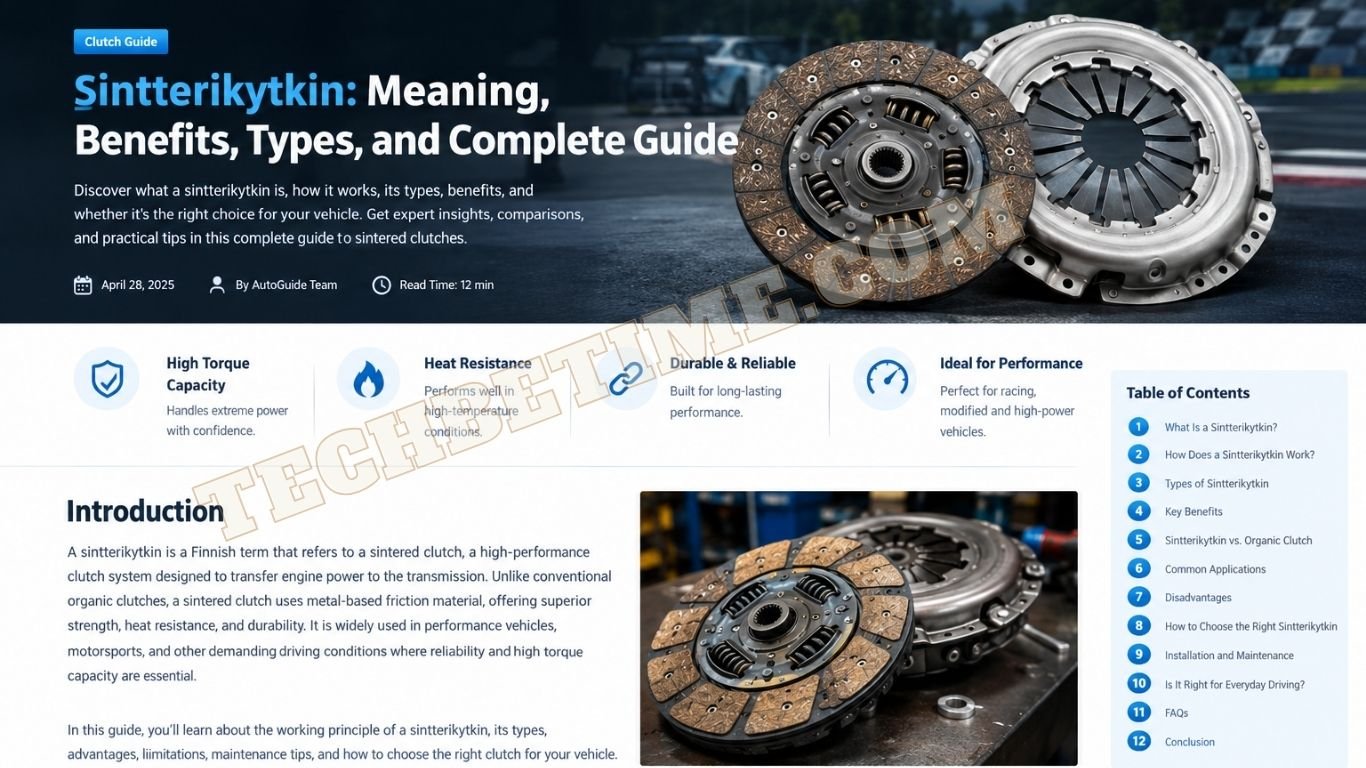
A sintterikytkin, a Finnish term that translates to sintered clutch in English, is a type of clutch that uses friction material manufactured through a sintering process. These clutches are used in selected automotive, motorcycle, motorsport, and industrial applications where the clutch must handle demanding operating conditions. Depending on its design and friction material, a sintered clutch can offer strong engagement, high torque capacity, and resistance to repeated heat exposure.
The clutch is an essential part of a vehicle’s drivetrain. It connects and disconnects the engine from the transmission, allowing the driver to change gears and control how engine power reaches the wheels. Choosing the right clutch becomes especially important when a vehicle produces more torque than its original clutch was designed to handle or operates under repeated high loads.
However, a sintered clutch is not automatically better than every conventional clutch. Some designs can engage abruptly, create additional vibration, and feel less comfortable during everyday driving. Performance also depends on the clutch’s construction, pressure-plate force, friction surface, and compatibility with the vehicle.
This guide explains the meaning of sintterikytkin, how sintered clutches work, the main types available, their advantages and disadvantages, and the factors to consider before purchasing one. Whether you are researching automotive technology or considering a clutch upgrade, understanding these details can help you make an informed decision.
What Is a Sintterikytkin?
Meaning and Definition of Sintterikytkin
The word sintterikytkin is Finnish. It combines the concept of sintering with kytkin, meaning clutch. In automotive discussions, the term generally refers to a clutch that uses sintered friction material to transmit rotational force between the engine and transmission.
A conventional clutch usually relies on a friction disc positioned between the flywheel and pressure plate. When these surfaces press together, friction allows engine torque to pass through the clutch hub and into the transmission. When the clutch is disengaged, the connection is released so the driver can change gears or stop without necessarily switching off the engine.
The key difference between a sintered clutch and a conventional organic clutch is the friction material. Organic clutch discs commonly use formulated friction materials containing fibres, resins, and other ingredients. Sintered clutch materials are made by combining and processing powders, often metallic, into a solid friction component. The exact composition depends on the manufacturer and intended application.
Sintered clutches are frequently associated with motorsport, modified vehicles, and demanding operating conditions. They may be suitable when an ordinary clutch struggles with heat or torque demands. Nevertheless, their performance varies considerably between products. A street-oriented sintered clutch may behave differently from a competition clutch designed for aggressive starts and repeated high-load operation.
Understanding this distinction is important because the term describes a type of clutch construction rather than one universal product. Buyers should examine the specifications of the particular clutch instead of assuming that every sintered model offers identical performance.
What Is Sintering in Clutch Manufacturing?
Sintering is a manufacturing process in which powdered materials are compressed and heated so that their particles bond together. In many applications, the material is heated below its main melting point, although the precise manufacturing process depends on the composition and production method.
For clutch components, manufacturers can use carefully formulated metallic powders, including iron- or copper-based materials, alongside other ingredients designed to achieve particular friction and wear characteristics. The resulting material is engineered to work against a suitable mating surface while transmitting torque and managing heat.
The manufacturing process allows producers to adjust the friction material for a particular operating environment. Factors such as porosity, density, composition, surface characteristics, and bonding methods can affect the final product. These properties influence how the clutch responds to engagement, how much torque it can transmit, and how it behaves under repeated heating.
One important advantage of sintered materials is that appropriately designed formulations can perform well under demanding thermal conditions. This can be valuable in motorsport, where repeated acceleration, gear changes, and high engine loads may produce considerable clutch heat. However, heat resistance is not unlimited. Excessive slipping, unsuitable mating surfaces, incorrect installation, or operation beyond the manufacturer’s limits can still damage a sintered clutch.
Sintering is also used in different industries, so not every sintered component is a clutch component. In automotive applications, the relevant details are the friction material formulation, the clutch’s intended use, and its compatibility with the complete drivetrain.
How Does a Sintterikytkin Work?
Main Components of a Sintered Clutch
A sintered clutch operates using the same basic mechanical principles as other friction clutches. The difference lies mainly in its friction material and design. Understanding the main components makes it easier to see how engine power travels through the drivetrain.
Clutch disc: The clutch disc contains the friction material that contacts the flywheel and pressure plate. In a sintered clutch, this material is manufactured using a sintering process. Some discs have a nearly continuous friction surface, while others use separate friction segments or pucks.
Flywheel: The flywheel is attached to the engine’s crankshaft. It provides a rotating surface against which the clutch disc is clamped. Its condition and compatibility are important because an unsuitable or damaged flywheel can interfere with clutch operation.
Pressure plate: The pressure plate applies clamping force to hold the clutch disc against the flywheel. Its spring mechanism and design influence the amount of torque the clutch can transmit, as well as the pedal effort in many manual-transmission systems.
Clutch hub and springs: The hub connects the clutch disc to the transmission input shaft. Some clutch discs contain springs that help absorb torsional vibration and soften changes in transmitted torque. Other designs use an unsprung hub for particular performance applications.
Release mechanism: Depending on the vehicle, the release mechanism may include a release bearing, fork, hydraulic components, or a cable-operated arrangement. It allows the driver to disengage the clutch.
These components must function as a compatible system. Installing a sintered disc without checking the pressure plate, flywheel, transmission, and release mechanism can lead to poor engagement, premature wear, or mechanical problems.
Step-by-Step Working Principle
The working principle of a sintterikytkin becomes clearer when the clutch is considered in three operating stages.
1. Clutch engaged: When the driver releases the clutch pedal, the pressure plate clamps the friction disc against the flywheel. Friction allows engine rotation to pass through the clutch hub to the transmission input shaft. The transmission then transfers power through the remaining drivetrain components to the wheels.
2. Clutch disengaged: When the driver presses the clutch pedal, the release mechanism acts on the pressure plate’s release system. The clamping force is reduced, allowing the clutch disc to separate sufficiently from the friction surfaces. This interrupts the normal transfer of engine torque and allows a gear change or a stop without stalling the engine in a conventional manual vehicle.
3. Clutch engagement during take-off: When the driver gradually releases the pedal, the friction surfaces begin to contact one another. During this transition, some relative movement occurs between the surfaces, producing heat. Once the clutch is fully engaged, the surfaces rotate together with little or no intended slip.
A sintered clutch follows these same basic principles. Its friction characteristics may, however, produce a different engagement feel from an organic clutch. Some designs are intended to engage quickly and tolerate demanding use, while others are engineered to provide more progressive control.
The driver must still use the clutch appropriately. Repeatedly holding it in a slipping condition creates heat and can accelerate wear, regardless of the friction material.
Why Does a Sintered Clutch Provide Strong Engagement?
A sintered clutch can provide strong engagement because its friction material is engineered for particular friction, temperature, and load requirements. In performance applications, the combination of friction characteristics and pressure-plate clamping force can allow the clutch to transmit substantial torque within a compact assembly.
Torque capacity is not determined by the friction material alone. It also depends on the effective friction radius, the number of working friction surfaces, the clamping force, and the material’s friction coefficient under actual operating conditions. The clutch hub, disc construction, flywheel, and other drivetrain components must also be able to withstand the transmitted loads.
Engagement can feel abrupt when the friction material develops substantial grip over a relatively short period, especially if the disc has segmented friction surfaces. The driver may experience a rapid transition from slipping to fully engaged operation. This can be useful in certain competition settings but inconvenient when parking, reversing, or starting on a hill.
Heat management is another important consideration. During engagement, friction converts some mechanical energy into heat. A suitable sintered formulation may retain useful friction characteristics under demanding temperatures, but the entire clutch assembly must be designed to manage the heat generated.
A stronger-feeling clutch is not necessarily the best clutch. For road use, predictable engagement and comfortable control can matter as much as maximum torque capacity. The correct choice balances engine output, driving conditions, durability, and driver preference.
Types of Sintterikytkin
Full-Face Sintered Clutch
A full-face sintered clutch uses a friction surface that covers most of the intended contact area of the disc. Depending on its construction, the disc may provide a more progressive engagement feel than an otherwise comparable puck-style design.
The larger, more continuous friction surface can help distribute contact across the mating area when the assembly is properly designed and aligned. This may make the clutch easier to modulate during normal starts and low-speed manoeuvres. However, the actual result depends on the friction material, disc geometry, pressure plate, and vehicle setup.
Full-face sintered clutches can be considered for applications that require a combination of performance capability and manageable engagement. They may be available for modified road cars, performance vehicles, and specialised machinery. Not every full-face model is intended for everyday use, and some products are designed specifically for competition.
A useful buying consideration is whether the manufacturer explicitly approves the clutch for street driving, track use, or another operating environment. The advertised torque capacity should also be assessed alongside the clutch’s thermal limits and recommended mating surfaces.
Full-face construction does not automatically guarantee smooth engagement or long service life. Driving technique, installation quality, and vehicle compatibility remain important. Buyers should compare the specifications of individual products rather than selecting a clutch based only on its shape.
Puck-Style Sintered Clutch
A puck-style clutch uses separate friction segments instead of a nearly continuous friction surface. Common configurations include three-puck, four-puck, and six-puck designs, although availability and construction differ between manufacturers.
The segmented design changes how contact occurs between the clutch disc and its mating surfaces. Depending on the material and assembly, a puck-style clutch may provide rapid engagement and be suitable for applications where space, weight, or competition requirements influence the design. It is often associated with high-performance vehicles and motorsport.
However, fewer or smaller contact segments do not automatically mean that a clutch has greater torque capacity. The friction coefficient, total contact design, clamping force, operating temperature, and number of friction interfaces all contribute to performance. Puck count alone is not a reliable measure of strength.
One trade-off is drivability. Some puck-style clutches are harder to modulate at low speeds because engagement can occur more abruptly. This may increase the difficulty of parking, reversing, and moving smoothly in traffic. The effect varies with the clutch’s design and the driver’s experience.
Before purchasing a puck-style sintered clutch, check whether it is suitable for road use and whether the manufacturer specifies a compatible flywheel and pressure plate. A clutch developed for racing may not be an appropriate replacement for a daily-driven vehicle.
Sprung and Unsprung Sintered Clutches
Sintered clutch discs may use either sprung or unsprung hubs. The main difference is whether the hub incorporates springs to absorb some torsional movement between the clutch disc and the transmission input shaft.
A sprung hub can help reduce drivetrain shock and absorb certain engine torque fluctuations. This can improve refinement and reduce the sharpness of engagement in suitable applications. For drivers who use a performance vehicle on public roads, a sprung sintered clutch may offer a useful compromise between stronger friction characteristics and manageable drivability.
An unsprung hub has no equivalent hub-spring mechanism. This simpler arrangement may be selected for particular competition applications, where the clutch must meet specific packaging, response, or durability requirements. However, removing hub springs can transmit more torsional shock to the drivetrain, depending on the complete setup.
The choice between sprung and unsprung designs should not be based on the assumption that one is universally stronger. Hub design must match the engine’s torque characteristics, transmission, flywheel, and intended use. A high-torque engine or a drivetrain with particular vibration characteristics may require careful engineering consideration.
Drivers should also distinguish hub springs from other clutch components. A sprung hub does not replace the pressure plate’s clamping function, and it cannot compensate for an incorrectly specified friction disc.
For everyday use, a compatible sprung design may offer a more comfortable experience. For competition, an unsprung design may be suitable when specifically recommended by the clutch manufacturer and drivetrain specialist.
Wet and Dry Sintered Clutches
Sintered friction materials can be used in both wet and dry clutch systems, but these arrangements are not interchangeable.
A dry clutch operates without being intentionally immersed in lubricating oil. Its friction surfaces are designed to work under dry conditions, and the clutch assembly must manage the heat produced during engagement. Many conventional manual car clutches are dry clutches.
A wet clutch operates with oil present around its friction surfaces. The oil can help carry away heat and lubricate associated components, but it also affects friction behaviour. Wet clutch materials must be formulated for the intended lubricant and operating conditions.
Wet clutches are common in many motorcycles, including designs with multiple clutch plates, as well as in certain transmissions and industrial systems. Some of these applications use sintered friction materials because their characteristics suit the specified duty cycle. The exact design varies by manufacturer.
Using the wrong material can result in slipping, poor engagement, excessive wear, or damage. A friction disc designed for a dry system should not be assumed to work correctly in an oil-immersed clutch, and a wet-clutch component must meet the relevant lubricant and transmission requirements.
When replacing a clutch, follow the vehicle or equipment manufacturer’s specifications. The words sintered, wet, and dry describe different aspects of construction and operation, so they should be evaluated together rather than treated as interchangeable product categories.
Key Benefits of a Sintterikytkin
High Torque Capacity
One of the main reasons to consider a sintered clutch is its potential to transmit high torque in a suitable performance application. Torque describes the rotational force produced by an engine, and the clutch must transfer that force without slipping excessively when fully engaged.
A clutch’s torque capacity depends on several factors. These include the friction material’s coefficient of friction, the pressure plate’s clamping force, the effective radius of the friction surfaces, the number of working surfaces, and the overall construction of the assembly. A sintered friction material may be selected to provide the desired characteristics under the expected operating conditions.
This can be important when an engine has been modified with a turbocharger, supercharger, or other changes that substantially increase torque. The original clutch may no longer provide an adequate operating margin. A correctly specified performance clutch can help address that limitation.
However, buying a sintered clutch without checking the manufacturer’s torque rating is not a reliable upgrade strategy. Engine torque delivery, temperature, launch technique, and intended use all affect real-world performance. A vehicle used for repeated racing launches may impose different demands from one driven on public roads.
The clutch must also be matched to the flywheel, pressure plate, gearbox, and other drivetrain components. Increasing clutch capacity without considering the rest of the system can move stress elsewhere rather than eliminate it.
Heat Resistance
Clutch heat is produced when the friction surfaces move against each other during engagement or slip under load. Repeated starts, aggressive driving, heavy loads, and competition use can create substantial thermal stress.
Certain sintered friction materials are engineered to retain useful friction properties under demanding temperature conditions. This can make them suitable for applications in which an ordinary clutch may struggle with repeated high-load use. The advantage depends on the material formulation and the manufacturer’s design limits.
Heat resistance should not be confused with immunity to overheating. A sintered clutch can still suffer from excessive wear, surface damage, distortion, or changes in friction behaviour if it is operated outside its intended range. The flywheel and pressure plate must also be suitable for the clutch material and thermal demands.
Drivers can help reduce unnecessary heat by avoiding prolonged clutch slipping, using appropriate starting techniques, and following the manufacturer’s recommendations for operation. In motorsport, correct setup and inspection are especially important because repeated high-energy engagement can stress the entire assembly.
When comparing clutches, review documented operating limits and vehicle-specific recommendations rather than relying on general claims that one material is always more heat resistant than another. The most appropriate clutch is the one engineered for the actual temperature, torque, and duty-cycle requirements.
Performance Under Heavy Loads
A sintered clutch may be appropriate for vehicles that experience repeated high loads, rapid acceleration, or demanding operating cycles. Examples include some competition cars, modified performance vehicles, and specialised machinery. The suitability of a particular clutch depends on its rated capacity and intended application.
During a hard acceleration event, the clutch must transfer engine torque while the drivetrain experiences changing loads. If the clutch is underspecified, excessive slip can generate heat and reduce performance. A suitable performance clutch can help maintain the required connection when operating within its design limits.
Nevertheless, heavy-load performance is not determined by friction material alone. The pressure plate, flywheel, clutch hub, transmission, differential, driveshafts, and tyres all influence how power is delivered. A clutch with a higher torque rating cannot make every other drivetrain component stronger.
It is also important to distinguish between continuous load and repeated engagement. A clutch may tolerate sustained torque well but still experience severe thermal stress during repeated launches. Buyers should consider the type of use, not simply the engine’s peak power figure.
For vehicles used both on the road and on the track, a balanced design may be more practical than the most aggressive option available. Consulting the manufacturer’s fitment information or a qualified drivetrain specialist helps ensure that the clutch matches the intended load and operating conditions.
Durability and Consistent Performance
A well-matched sintered clutch can provide reliable service in demanding applications, particularly when its friction material and construction are designed for the expected operating conditions. However, durability is not a fixed property shared by every sintered clutch.
Service life depends on driving habits, torque levels, heat exposure, installation quality, component compatibility, and maintenance. A clutch used mainly under suitable steady-state conditions may experience different wear from one repeatedly subjected to aggressive launches or prolonged slipping.
The condition of the mating surfaces also matters. An incompatible or damaged flywheel can prevent proper contact and cause uneven engagement or premature wear. Incorrect alignment, unsuitable release components, and excessive clutch slip can also affect performance.
Consistency means that the clutch continues to transfer torque predictably within its operating limits. For performance driving, predictable engagement can be as important as maximum capacity. A clutch that suits the engine and driver is generally more useful than an unnecessarily aggressive model that makes ordinary operation difficult.
To evaluate durability, check the manufacturer’s technical documentation, recommended operating conditions, warranty terms, and service guidance. Avoid relying solely on broad advertising statements about extreme strength or long life. Correct selection and installation are essential to achieving dependable performance over time.
Sintterikytkin vs. Organic Clutch
A sintered clutch and an organic clutch perform the same basic job, but their friction materials and typical applications can differ. The best option depends on the vehicle, torque requirements, operating conditions, and the level of comfort the driver expects.
| Feature | Sintered clutch | Organic clutch |
|---|---|---|
| Friction material | Sintered formulation, often metallic | Organic-based friction formulation |
| Typical use | Performance, competition, specialised applications | Everyday driving and many standard vehicles |
| Torque capacity | Can be high in suitable designs | Varies by design; often adequate for standard engines |
| Heat tolerance | Some formulations suit demanding thermal conditions | Depends on the specific material and clutch design |
| Engagement | Can be abrupt in aggressive designs | Often progressive and easier to modulate |
| Driving comfort | May produce more vibration or drivetrain noise | Often better suited to comfortable road use |
| Cost | Varies; performance systems may cost more | Often economical for standard replacement needs |
| Best selection factor | Actual performance requirements | Comfort, compatibility, and normal operating demands |
Which Clutch Is Better for Everyday Driving?
For many standard road vehicles, an organic clutch is a sensible choice because it can provide progressive engagement and comfortable control. This is especially valuable in traffic, during parking, and when starting on an incline. Organic clutches are available in different specifications, so their capacity and durability should still be checked against the vehicle’s requirements.
A sintered clutch may be more appropriate when an engine produces substantially increased torque or when repeated high-load operation exceeds the capabilities of the original clutch. However, a competition-oriented model can be unnecessarily difficult to use in ordinary traffic.
Neither material is automatically superior in every situation. A suitably engineered organic clutch may be ideal for a standard vehicle, while a carefully selected sintered clutch may offer advantages in a demanding performance application. Some vehicles may also benefit from other performance clutch designs that balance torque capacity with road manners.
Before deciding, compare the actual torque rating, engagement characteristics, compatibility, warranty, and intended use of specific products. Material type is only one part of the decision.
Sintterikytkin vs. Ceramic Clutch
Material and Performance Differences
The terms sintered clutch and ceramic clutch are not always mutually exclusive categories. Sintering describes a manufacturing process, while ceramic describes a type of material. Some friction products can contain ceramic or ceramic-based ingredients, and product terminology varies among manufacturers.
In many automotive discussions, a sintered clutch refers to a friction material made by bonding powdered ingredients, often metallic. A clutch marketed as ceramic may use ceramic-based friction compounds or ceramic-containing composite materials. Their performance depends on the complete formulation rather than the name alone.
Both categories include products designed for demanding conditions, but their engagement behaviour, wear characteristics, thermal performance, and compatibility can differ. A clutch that performs well in one vehicle may be unsuitable for another because of differences in torque, flywheel design, gearbox, and intended duty cycle.
For this reason, buyers should not assume that a ceramic clutch always offers higher torque capacity or that every sintered clutch lasts longer. Compare manufacturer specifications and installation requirements for the exact products under consideration.
Which Clutch Is Better for Your Vehicle?
The right clutch depends on the vehicle’s operating needs. A standard passenger car used for commuting may benefit from a progressive clutch that is easy to control at low speeds. A modified vehicle used for track sessions may need a higher-capacity system designed for repeated thermal stress.
When comparing sintered and ceramic-based options, consider the engine’s torque output, the expected temperature range, the frequency of aggressive starts, and the driver’s tolerance for noise and vibration. Also check whether the clutch is approved for street use or intended only for competition.
Budget should include more than the purchase price. Installation, compatible flywheel or pressure-plate requirements, and possible supporting upgrades can affect the total cost.
The most reliable approach is to compare technical specifications and obtain advice from a qualified mechanic or clutch specialist who understands the vehicle. Choose the clutch based on its documented suitability for your application, rather than assuming one material is universally better.
Common Applications of a Sintterikytkin
Racing and Motorsport Vehicles
Motorsport can place significant demands on clutch systems. Rapid acceleration, repeated gear changes, and high engine torque may create operating conditions that differ greatly from ordinary road driving.
A suitable sintered clutch may be used in racing vehicles when its friction material, construction, and torque rating meet the requirements of the competition and drivetrain. Certain designs are intended to engage rapidly and withstand repeated demanding use.
However, a clutch that is appropriate for a race car may be uncomfortable or unsuitable for public roads. Competition vehicles can have different operating priorities, and drivers may accept abrupt engagement in exchange for other performance characteristics.
Clutch choice should reflect the type of motorsport involved. Drag racing, circuit racing, rallying, and other disciplines can impose different loads and thermal demands. The correct design depends on the vehicle setup and the clutch manufacturer’s recommendations.
Modified and High-Power Cars
Engine modifications can change the demands placed on the clutch. Upgrades such as forced induction, engine tuning, or internal engine modifications may increase torque beyond the capacity of the factory clutch.
In such cases, a performance clutch may be worth considering. A sintered model can be one option if its torque rating, engagement behaviour, and compatibility meet the vehicle’s needs.
It is important to select a clutch based on measured or reliably estimated torque rather than horsepower alone. The engine’s torque curve and the way power is delivered can affect clutch demands. Drivers should also consider gearbox strength and other drivetrain components before making an upgrade.
A more aggressive clutch is not always necessary. Some modified road cars can operate successfully with a suitable organic or other performance clutch. The aim should be to provide adequate capacity without sacrificing more comfort than necessary.
Motorcycles and Performance Machinery
Sintered friction materials are also used in certain motorcycle and specialised machinery clutch systems. In motorcycles, the design may include multiple clutch plates operating in a wet or dry arrangement, depending on the model.
The material must be compatible with the intended system. In a wet motorcycle clutch, the friction material must function correctly with the specified oil. Using an unsuitable replacement can affect engagement, shifting, or clutch slip.
Performance machinery may also use sintered friction components where the operating cycle requires specific friction or heat characteristics. However, the suitability of a component depends on its engineering specifications and the machine manufacturer’s requirements.
Owners should use parts specified for the exact vehicle or machine rather than assuming that any sintered friction disc will fit and work correctly.
Heavy-Duty and Specialized Vehicles
Some specialised vehicles and industrial systems operate under demanding loads, frequent engagement cycles, or challenging temperature conditions. Sintered friction materials may be selected for particular applications where their documented properties meet those requirements.
The exact choice depends on the clutch architecture and duty cycle. A clutch designed for industrial equipment cannot automatically be substituted into an automotive drivetrain, even if the friction material appears similar.
Operators should review manufacturer documentation, load ratings, maintenance schedules, and compatibility requirements. Proper inspection and installation are important because clutch failure in heavy-duty machinery can affect both equipment reliability and workplace safety.
Disadvantages of a Sintterikytkin
Abrupt Engagement
One potential disadvantage of a sintered clutch is abrupt engagement. Some performance-oriented designs transfer torque quickly as the friction surfaces meet, leaving the driver with less room to modulate the connection smoothly.
This behaviour can make ordinary driving more difficult. Moving slowly in traffic, reversing into a parking space, and starting on a hill may require more precise pedal control than with a progressive organic clutch.
The effect is not identical across all sintered clutches. Full-face designs, sprung hubs, and street-oriented friction formulations may offer more manageable behaviour than aggressive competition products. Vehicle weight, engine characteristics, pressure-plate force, and the rest of the drivetrain also affect the result.
Drivers should therefore assess the exact clutch model rather than judging every product by the material category. If the vehicle is used mainly for commuting, a clutch specifically designed for road use may be a better fit than a racing-oriented alternative.
Increased Noise and Vibration
Some sintered clutch setups can produce additional drivetrain noise or vibration, particularly when the clutch uses an unsprung hub or aggressive friction design. The degree of change depends on the complete vehicle configuration.
A clutch hub with springs can absorb some torsional fluctuations, whereas an unsprung design may transmit more of those forces into the drivetrain. Other factors, including engine mounts, flywheel type, gearbox design, and the condition of the transmission, can influence the sounds and vibrations experienced by the driver.
Not every noise after a clutch replacement is normal. Grinding, severe vibration, persistent rattling, or a sudden change in pedal behaviour should be inspected by a qualified mechanic. These symptoms may indicate an installation problem, worn component, or incompatible part rather than an unavoidable characteristic of sintered friction material.
Before upgrading, consider whether a small improvement in performance is worth a possible reduction in comfort. Product reviews may help identify common user experiences, but vehicle-specific fitment and technical specifications should carry greater weight.
Higher Costs
A sintered clutch can involve higher total costs when the selected product is a specialised performance system. The price depends on the manufacturer, vehicle, clutch construction, torque rating, and intended application. Not every sintered clutch is more expensive than every organic alternative, so individual products should be compared.
Installation costs can also matter. Some upgrades require a compatible pressure plate, a suitable flywheel, or additional components. A mechanic may need to inspect the existing assembly and confirm that the proposed clutch works with the vehicle’s transmission and release mechanism.
For modified cars, the overall project cost can include related drivetrain work. A higher-capacity clutch may expose limitations in other components if those parts are already near their operating limits.
A practical buying decision should consider the complete cost of ownership rather than the initial price alone. For a standard daily-driven vehicle, a correctly specified replacement clutch may provide all the necessary performance at a lower cost and with better comfort.
Potential Wear on Other Components
A clutch with aggressive engagement characteristics can place additional shock loads on parts of the drivetrain, particularly during hard starts or abrupt engagement. Depending on the vehicle, affected components may include the gearbox, differential, driveshafts, engine mounts, and related connections.
This does not mean that every sintered clutch will damage the drivetrain. Risk depends on torque output, clutch design, vehicle setup, driver behaviour, and the strength and condition of the connected components.
A clutch that is excessively difficult to modulate may encourage harsh engagement, while an unsprung design can transmit more torsional fluctuations than a comparable sprung setup. Repeated high-load launches can increase stress even when the clutch itself is appropriately rated.
To reduce avoidable problems, match the clutch to the complete drivetrain and use it according to the manufacturer’s guidance. A qualified specialist can help identify whether supporting upgrades are needed before installing a higher-capacity clutch.
How to Choose the Right Sintterikytkin
Check Engine Torque and Power
Begin by identifying the engine’s torque output and how the vehicle will be used. Torque is particularly important when assessing clutch capacity because the clutch must transfer rotational force without unwanted slip under the expected load.
If the engine has been modified, use reliable specifications or measurements for its current configuration rather than relying on the original factory figures. Also consider how the engine delivers torque, since the demands of a high-torque engine can differ from those of an engine with a different torque curve.
Check the clutch manufacturer’s stated torque capacity and the conditions under which that rating applies. Do not assume that every product with a similar diameter or friction material has the same capacity.
A suitable operating margin can help accommodate real-world demands, but choosing an unnecessarily aggressive clutch may reduce comfort and increase cost. The goal is to select a clutch that meets the vehicle’s requirements without creating avoidable compromises.
Consider Your Driving Style
Driving style is one of the most important factors in choosing a clutch. A vehicle used primarily for commuting needs predictable engagement and manageable pedal control. A track car or competition vehicle may place more emphasis on torque capacity, thermal performance, and response.
If you drive in heavy traffic, reverse frequently, or regularly park on steep roads, smooth engagement can significantly affect comfort. An aggressive competition clutch may make these routine activities more demanding.
For occasional spirited driving, a street-oriented performance clutch may provide a better balance than a specialised racing model. For repeated competition starts, a more aggressive design may be appropriate if it is compatible with the vehicle and permitted by the applicable rules.
Be realistic about how the vehicle will be used most of the time. Selecting a clutch for rare high-load events can make everyday driving unnecessarily uncomfortable if the upgrade is not properly matched to the actual use case.
Check Vehicle Compatibility
Before buying a sintered clutch, confirm compatibility with the vehicle’s make, model, engine, transmission, and production specifications. Clutch diameter alone is not enough to establish fitment.
Check the flywheel type, pressure-plate design, hub spline dimensions, release bearing, clutch actuation system, and any other manufacturer-specific requirements. Some clutch kits require a particular flywheel surface or a matched pressure plate.
Compatibility also includes the intended operating environment. A wet clutch component must be suitable for the specified lubricant, while a dry clutch disc must be designed for the correct dry-running system.
Use the clutch manufacturer’s fitment catalogue or seek advice from a qualified workshop. An incorrect part can cause engagement problems, premature wear, or damage to other components. Confirm the complete kit contents before installation so that any required supporting parts can be sourced in advance.
Compare Manufacturers and Warranty Terms
When comparing clutch manufacturers, look for clear technical information rather than relying solely on broad performance claims. Useful details include torque capacity, compatible vehicles, intended operating conditions, required mating surfaces, installation instructions, and any break-in requirements.
Warranty terms are also important. Check whether the warranty covers the intended use, because some products designed for competition may have different coverage from street-oriented components. Keep the purchase documentation and installation records where appropriate.
Product support can be valuable if questions arise about fitment, release mechanisms, or compatibility with a modified engine. A reputable supplier should be able to identify the correct product for the vehicle and explain its operating limitations.
Reviews may provide information about real-world engagement, noise, and drivability, but they should not replace technical verification. Two vehicles using the same clutch model may behave differently because of their engines, flywheels, and drivetrain configurations.
Sintterikytkin Installation and Maintenance
Professional Installation
Correct installation is essential for reliable clutch operation. Before fitting a sintered clutch, a mechanic should verify that the parts are compatible and inspect the flywheel, pressure plate, release mechanism, and relevant drivetrain components.
The installer must follow the manufacturer’s alignment and fastening instructions. Incorrect disc alignment, unsuitable fastener torque, contamination of friction surfaces, or an incompatible flywheel can lead to poor engagement and premature failure.
The release system should also be checked to ensure that the clutch can fully engage and disengage. Problems with hydraulics, cables, bearings, or adjustment may affect operation even when the clutch itself is in good condition.
Depending on the vehicle and clutch kit, additional preparation or supporting components may be required. These details should be confirmed before work begins.
After installation, the system should be checked for correct pedal behaviour, smooth disengagement, unusual noises, and signs of slipping. A professional installation does not eliminate every possible problem, but it helps reduce risks associated with incorrect fitment and setup.
Break-In Requirements
Break-in, sometimes called bedding-in, allows the friction surfaces to settle into their intended contact pattern when the manufacturer specifies such a procedure. The required process depends on the clutch material and design.
Some clutch manufacturers recommend a period of moderate use with controlled engagement before the clutch is exposed to maximum loads. Others may specify different procedures for particular products. It is therefore incorrect to assume that every sintered clutch requires the same mileage, number of engagements, or break-in routine.
During any required bedding-in period, follow the instructions supplied with the exact clutch kit. Avoid introducing aggressive launches or unnecessary slipping if the manufacturer advises against them. Excessive heat during early operation may interfere with proper bedding or damage components.
If the instructions are unclear, ask the manufacturer or installer for guidance. Do not substitute generic advice from an unrelated clutch model, because the correct process can vary by material and construction.
Common Maintenance Checks
A sintered clutch does not normally require a separate routine maintenance schedule beyond the vehicle or equipment manufacturer’s recommendations, but regular attention to its operation can help identify problems early.
Watch for clutch slip, which may appear as engine speed rising without a corresponding increase in vehicle speed under load. Other warning signs include difficulty selecting gears, unusual vibration, persistent rattling, burning smells, or changes in clutch-pedal feel.
These symptoms can have several causes. A slipping clutch may result from wear, contamination, inadequate clamping force, or an incorrect setup. Difficulty disengaging may be associated with the release system or hydraulic components. Noise can originate from the clutch, gearbox, or other drivetrain parts.
If symptoms appear, avoid repeatedly testing the clutch under heavy load. Arrange an inspection to identify the cause and prevent further damage. Keeping records of installation, adjustments, and any repairs can also help a mechanic assess changes in performance.
Driving Habits That Can Extend Clutch Life
Good driving habits can reduce unnecessary clutch wear, regardless of friction material. One important practice is to avoid holding the clutch in a slipping condition for longer than necessary. Slip creates heat, and repeated excessive heat can shorten component life.
When starting on a hill, use the vehicle’s recommended hill-start method rather than relying on prolonged clutch slip to hold the car in place. Avoid unnecessary aggressive launches and repeated high-load starts unless the clutch is specifically intended for that use.
In traffic, use the clutch only as needed and avoid resting a foot on the pedal, which can partially load the release mechanism on some systems. Follow the vehicle manufacturer’s guidance for operation and avoid practices that cause excessive heat or mechanical shock.
A sintered clutch should not be treated as indestructible simply because it may be designed for demanding conditions. Appropriate driving, correct installation, and attention to early warning signs remain important for long-term reliability.
Is a Sintterikytkin Suitable for Everyday Driving?
A sintered clutch can be used in some road vehicles, but its suitability depends on the exact design. Street-oriented models may offer a reasonable balance between performance and comfort, while competition-focused versions may be difficult to control during ordinary driving.
Everyday conditions often involve repeated stops, low-speed manoeuvres, reversing, parking, and hill starts. In these situations, progressive engagement and predictable pedal response can be more useful than the highest possible torque rating.
Some sintered clutches engage quickly and may produce additional vibration or noise. This can be acceptable to a driver who prioritises performance, but it may become frustrating during a daily commute. Other models are designed to provide more manageable road manners, so the material category alone does not determine comfort.
If the vehicle has a standard engine and is used mainly for commuting, an original-equipment replacement or suitable organic performance clutch may be the more practical option. If engine modifications have increased torque or the vehicle regularly experiences demanding operating conditions, a correctly rated sintered clutch may be worth considering.
Before purchasing, review the manufacturer’s street-use approval, torque rating, installation requirements, and warranty conditions. The best choice is the clutch that meets the vehicle’s actual needs while maintaining an acceptable balance between performance, cost, and comfort.
Frequently Asked Questions About Sintterikytkin
What Does Sintterikytkin Mean in English?
Sintterikytkin is a Finnish term that generally translates to sintered clutch in English. In automotive contexts, it describes a clutch that uses friction material manufactured through a sintering process.
Is a Sintterikytkin the Same as a Sintered Clutch?
Yes. The Finnish term refers to the same general type of clutch. However, specific designs can differ in friction material, disc shape, hub construction, and intended application.
Is a Sintered Clutch Better Than an Organic Clutch?
Not in every situation. A suitable sintered clutch may offer advantages in demanding performance applications, while an organic clutch is often a good choice for comfortable everyday driving. The best option depends on torque requirements, operating conditions, and compatibility.
Can a Sintterikytkin Be Used in a Daily-Driven Car?
Yes, some models are suitable for road use. However, certain competition-oriented sintered clutches can engage abruptly or create more noise and vibration. Always check the manufacturer’s intended-use recommendations.
Does a Sintered Clutch Handle More Torque?
Some sintered clutches are designed for high torque capacity, but performance varies by product. Clamping force, friction material, clutch dimensions, and the complete assembly all affect torque capacity.
Why Does a Sintered Clutch Engage Suddenly?
Some sintered friction materials provide strong grip as the surfaces contact one another. Segmented friction surfaces and particular clutch designs can make engagement more abrupt, especially at low speeds.
How Long Does a Sintered Clutch Last?
There is no universal lifespan. Service life depends on driving habits, engine torque, heat exposure, installation quality, maintenance, and the clutch’s intended application. Follow the manufacturer’s operating and inspection recommendations.
Does a Sintered Clutch Require Special Maintenance?
Maintenance depends on the vehicle and clutch design. Follow the manufacturer’s guidance, monitor warning signs such as slipping or unusual vibration, and have suspected problems inspected promptly.
Is a Sintered Clutch Suitable for Modified Engines?
It can be, particularly when modifications increase torque beyond the original clutch’s capacity. However, the selected clutch must match the engine’s torque output, transmission, flywheel, pressure plate, and intended driving conditions.
Conclusion
A sintterikytkin, or sintered clutch, is a clutch that uses friction material produced through a sintering process. Depending on its design, it can be suitable for performance vehicles, motorsport, motorcycles, and specialised machinery that require particular friction and thermal characteristics.
Its potential advantages include high torque capacity in suitable configurations, performance under demanding operating conditions, and the ability to retain useful friction properties at elevated temperatures. However, not every sintered clutch offers the same capabilities, and some models can be less comfortable during ordinary driving because of abrupt engagement, noise, or vibration.
Choosing the right clutch requires more than selecting a material. Drivers should consider engine torque, intended use, compatibility, installation requirements, warranty, and the condition of the entire drivetrain. Organic or other street-oriented clutch designs may remain the better option for many standard vehicles.
Ultimately, the best sintterikytkin is one that meets the vehicle’s documented requirements and provides the right balance of performance, reliability, and driving comfort.




One Comment