Introduction
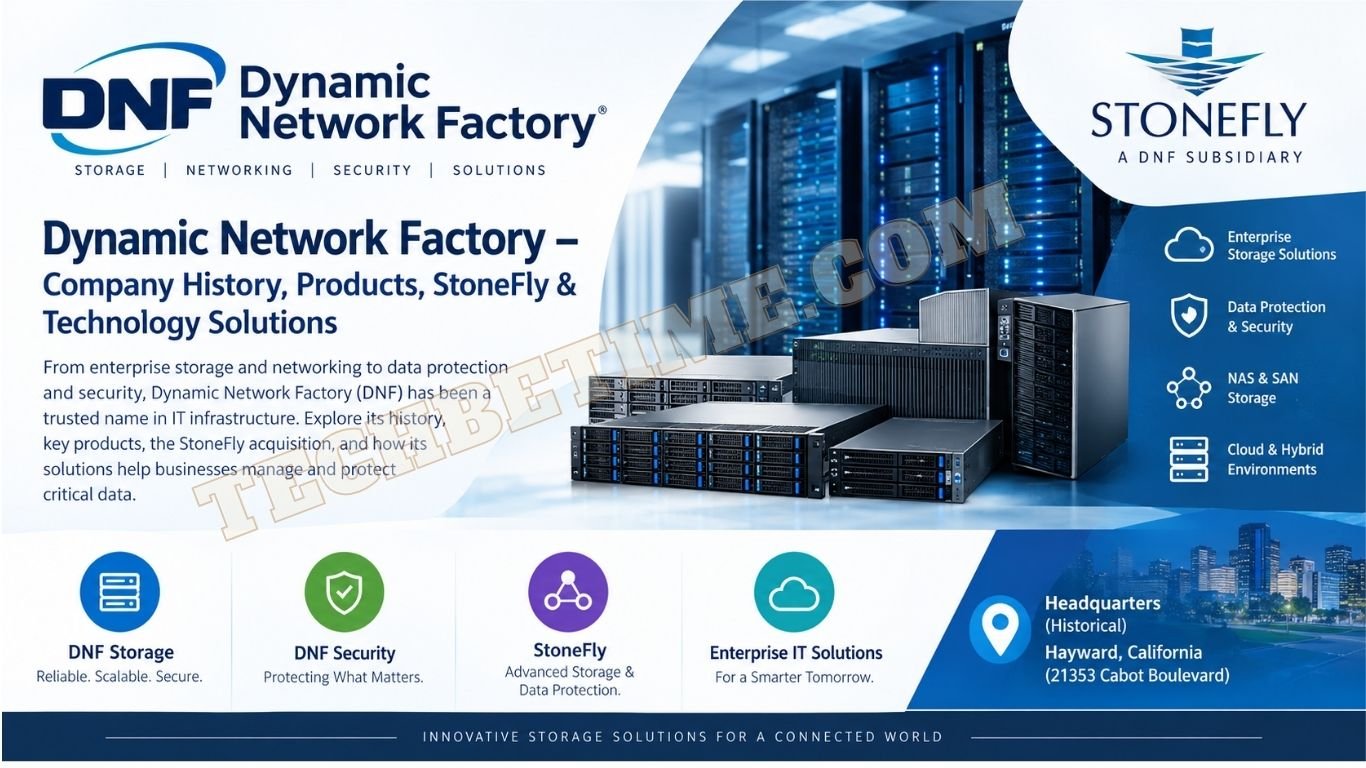
Dynamic Network Factory, Inc. (DNF) is a name associated with the enterprise technology and data-storage industry in the United States. Its historical business activities focused on storage hardware, networking infrastructure, servers, and related solutions designed to help organisations manage growing volumes of digital information. The company became associated with several technology brands and business divisions, including DNF Storage, DNF Security, and StoneFly, Inc.
Enterprise storage has become an essential part of modern business operations. Organisations rely on dependable systems to store financial records, customer information, research data, application files, video recordings, and other critical digital assets. Network-attached storage (NAS), storage area networks (SAN), RAID configurations, and backup infrastructure are among the technologies used to support these requirements.
One important milestone in the Dynamic Network Factory company history was its reported acquisition of StoneFly Networks in 2006. StoneFly subsequently became associated with integrated storage and data-protection technologies, including IP SAN solutions and enterprise backup systems.
However, historical company announcements do not necessarily describe present-day operations. This guide examines Dynamic Network Factory’s background, reported leadership, products, business model, headquarters history, and relationship with StoneFly. It also explains important storage technologies and identifies details that readers should verify before making current purchasing or business decisions.
Dynamic Network Factory Company Overview
Dynamic Network Factory was associated with the enterprise IT infrastructure market, serving organisations that needed dependable storage hardware and related technology solutions. Its historical product portfolio included systems designed to connect servers with storage resources, consolidate business files, and support demanding workloads.
Unlike consumer electronics companies that primarily sell products to individuals, enterprise storage businesses typically work with corporate IT departments, technology resellers, system integrators, and other organisations. Their products must meet practical requirements involving capacity, performance, reliability, compatibility, security, and long-term maintenance.
Dynamic Network Factory’s historical business identity included multiple names and divisions. DNF Storage was associated with enterprise data-storage systems, while DNF Security was linked to video-surveillance storage and related infrastructure. StoneFly became an important associated business following the reported 2006 acquisition.
These names should not automatically be treated as interchangeable. Dynamic Network Factory refers to the company, while the other names describe associated brands, business operations, or product families in historical company information. Their present-day corporate relationships and operational status require independent verification.
What Does DNF Stand For?
DNF stands for Dynamic Network Factory. The abbreviation was used in connection with the company’s enterprise technology operations and associated storage products.
The distinction between a company name and a product brand is important when researching older technology businesses. A manufacturer may operate under a corporate name while selling specialised products through several brands. Those brands can focus on different customers, technical requirements, or industry applications.
For example, DNF Storage was associated with data-storage infrastructure, including NAS and SAN systems. DNF Security was associated with storage requirements for video-surveillance environments. StoneFly, meanwhile, developed a separate identity around enterprise storage and data-protection solutions.
These names may appear together in historical announcements, product references, and business directories. Nevertheless, a shared historical connection does not prove that every associated brand currently operates under the same ownership or management structure.
Anyone researching DNF products should therefore distinguish between the original company, its historical divisions, and the particular manufacturer or service provider responsible for a product today.
When Was Dynamic Network Factory Founded?
The supplied historical company profile identifies 1989 as the beginning of Dynamic Network Factory’s origins, when it reportedly operated as a United States subsidiary of CSK Electronics. It also identifies 1998 as an important transition period when the business shifted its focus toward storage hardware and emerged as an independent, privately held company.
These dates describe different stages rather than necessarily representing a single, uninterrupted corporate history. A business can begin as a subsidiary, change its product strategy, and later operate under an independent corporate structure. Its original formation date and the date of its independence may therefore differ.
The reported move toward storage hardware reflected an important area of enterprise IT demand. As organisations adopted more computer systems, databases, and networked applications, they needed more effective ways to store information and make it available to authorised users. Dedicated storage appliances and network-connected storage systems helped address these requirements.
The company’s reported development illustrates how technology businesses can evolve in response to changing infrastructure needs. However, the exact legal incorporation dates, ownership changes, and corporate registration details should be confirmed through appropriate company records before being presented as independently verified facts.
Who Founded Dynamic Network Factory?
Mo Tahmasebi and Macy Tafreshian are identified in the supplied company profile as key figures associated with Dynamic Network Factory’s founding and leadership.
Mo Tahmasebi is also associated with reported executive leadership of the business. However, historical references to a founder, executive, shareholder, or chief executive do not establish that these roles were identical throughout the company’s history. Formal ownership percentages and the complete original management structure should not be assumed without reliable corporate documentation.
Understanding these distinctions is particularly important when researching privately held technology companies. Public information about private businesses may be less extensive than information available for publicly traded corporations. Leadership biographies, company announcements, archived product materials, and official corporate filings can provide different pieces of the historical record.
Readers researching Mo Tahmasebi or Macy Tafreshian should look for dated sources that establish the context of each person’s role. A company announcement from a particular year, for example, may identify an executive’s position at that time without proving that the same position continues today.
Accordingly, the most accurate approach is to describe these individuals as reported key figures in Dynamic Network Factory’s history and verify any current leadership or ownership claims independently.
What Does Dynamic Network Factory Do?
Dynamic Network Factory’s historical business activities centred on enterprise storage and related IT infrastructure. These technologies help organisations collect, store, retrieve, share, and protect the information required for everyday operations.
A business may need storage for employee documents, accounting software, customer databases, application servers, production systems, research projects, or security-camera recordings. Storing this information across disconnected devices can make administration difficult and increase the risk of data loss. Enterprise storage infrastructure provides more organised ways to manage these resources.
The company’s associated product categories included NAS appliances, SAN systems, RAID-based storage, iSCSI connectivity, and related server infrastructure. These technologies serve different purposes, so choosing an appropriate solution depends on how applications access information and how much performance, capacity, and availability they require.
Network-Attached Storage (NAS)
Network-attached storage, commonly called NAS, is a dedicated storage system connected to a computer network. It allows authorised users and applications to access shared files without relying on a separate storage device attached directly to each computer.
A NAS appliance typically contains storage drives, an operating system, network interfaces, and software for managing users, folders, permissions, and file access. Depending on the configuration, it may support protocols such as SMB or NFS.
Businesses use NAS systems for shared documents, departmental folders, media libraries, project files, archived information, and centralised file management. An educational institution, for example, might use NAS to provide staff with shared resources, while a media company could use it to organise large collections of images and video files.
NAS can simplify administration because an IT team can manage storage capacity and access permissions centrally. Capacity may also be expanded by adding drives or connecting compatible expansion units, depending on the product.
However, NAS is not automatically a complete backup solution. If files are deleted, corrupted, encrypted by ransomware, or affected by a hardware failure, the organisation may still lose access to its information unless suitable backups and recovery procedures are available.
Historical references to DNF NAS products indicate their place within the company’s storage-oriented portfolio. Specific model capabilities, supported protocols, and current availability should be verified using product documentation from a reliable source.
Storage Area Networks (SAN)
A storage area network, or SAN, is a dedicated or logically separated network that provides servers with access to shared block storage. Unlike a conventional file-sharing system, a SAN generally presents storage volumes to servers as block devices that can be used by operating systems and applications.
SAN infrastructure is commonly used in virtualisation platforms, database environments, enterprise applications, and other systems where predictable storage performance and centralised management are important. Technologies may include Fibre Channel, iSCSI, and other supported storage networking approaches.
For example, a company running several virtual machines may use a SAN to provide shared storage to its virtualisation hosts. This arrangement can support features such as centralised provisioning, coordinated administration, and workload mobility when the wider infrastructure is designed appropriately.
The benefits depend on implementation. SAN environments can require specialised networking, compatible host adapters, careful configuration, monitoring, and trained administrators. Performance is influenced by storage media, controller design, network bandwidth, latency, and workload characteristics.
Dynamic Network Factory was historically associated with SAN and IP SAN technologies, while StoneFly became particularly connected with integrated IP SAN storage solutions.
Organisations considering older SAN hardware should assess its compatibility with current operating systems, hypervisors, network equipment, security requirements, and support arrangements. Historical product descriptions alone cannot establish whether a system remains suitable for modern production use.
RAID, iSCSI, and Direct-Attached Storage
Redundant Array of Independent Disks., iSCSI, and direct-attached storage describe different parts of a storage environment.
RAID, or Redundant Array of Independent Disks, combines multiple drives into a logical storage arrangement. Depending on the RAID level, the configuration may improve performance, provide redundancy, or balance usable capacity against fault tolerance. RAID 1 mirrors data, RAID 5 uses distributed parity, and RAID 6 can tolerate the failure of two drives within a suitable configuration.
RAID does not replace backups. It cannot reliably protect against every threat, including accidental deletion, ransomware, fire, or damage affecting the entire system.
iSCSI, short for Internet Small Computer Systems Interface, transports SCSI storage commands over TCP/IP networks. It allows servers to access remote block storage using IP networking rather than requiring a dedicated Fibre Channel fabric. Its performance depends on factors such as network design, latency, congestion, and storage hardware.
Direct-attached storage (DAS) connects storage directly to a computer or server, using an interface such as SAS, SATA, or USB. DAS can be straightforward and cost-effective for a single server, but sharing and central management may require additional software or infrastructure.
These technologies address different needs. An organisation should select them according to its applications, availability requirements, budget, and operational capabilities rather than assuming that one architecture is best for every situation.
Enterprise Servers, Backup, and Data Recovery
Enterprise servers provide computing resources for business applications, databases, virtual machines, file services, and other workloads. Storage infrastructure supplies the capacity needed to hold application data and make it accessible when required.
Backup and disaster recovery address a different but equally important requirement: restoring information and services after a problem. Backups create recoverable copies of data, while disaster recovery planning considers how an organisation will restore systems after events such as equipment failures, cyberattacks, or site outages.
An effective approach usually includes multiple safeguards. These can include scheduled backups, off-site copies, access restrictions, monitoring, documented recovery procedures, and regular restoration tests. Organisations should also define recovery time objectives (RTOs) and recovery point objectives (RPOs) to clarify how quickly systems must return and how much data loss is acceptable.
Storage equipment can contribute to a reliable infrastructure, but reliability depends on the entire system, including network configuration, software, power protection, security controls, and operational procedures.
Historical DNF storage and server offerings should therefore be understood as parts of a broader IT environment rather than standalone guarantees of business continuity.
What Is DNF Storage?
DNF Storage was associated with Dynamic Network Factory’s enterprise storage business. The name appeared in connection with storage appliances and hardware configurations designed for organisations that needed centralised, network-accessible data capacity.
Enterprise storage products differ from ordinary consumer drives because they are often intended to support multiple servers, simultaneous users, business applications, and formal IT management processes. Depending on the design, they may provide redundant power supplies, multiple network connections, RAID configurations, remote administration, or expansion options.
The precise features available depend on the individual model and its configuration. It would be inaccurate to assume that every product associated with DNF Storage included all enterprise-grade capabilities.
Types of DNF Storage Products
Historical descriptions of the DNF Storage product family include several categories of storage hardware:
- NAS appliances: Systems designed to provide shared file storage over a network.
- iSCSI storage systems: Devices that expose block storage to compatible servers through IP networks.
- Rackmount storage systems: Hardware designed for installation in standard equipment racks, often used in server rooms and data centres.
- Tower storage systems: Enclosures that may suit smaller offices or environments without dedicated rack infrastructure.
- RAID storage solutions: Configurations designed to organise multiple drives for performance, redundancy, or a combination of both.
- Modular and clustered storage systems: Architectures that may support expansion or distribute storage functions across multiple components, depending on the design.
These categories explain the range of infrastructure requirements addressed by enterprise storage manufacturers. A small office may prioritise straightforward file sharing, whereas a larger organisation may require high-capacity storage connected to several application servers.
When researching a specific DNF product, readers should identify its exact model, drive compatibility, supported protocols, usable capacity, controller design, warranty, and maintenance options. Without those details, historical product categories provide only a general picture of the company’s offering.
Benefits of Enterprise Storage Solutions
Enterprise storage can help organisations manage data more efficiently by consolidating information into systems that are easier to administer and monitor.
Centralised data management allows administrators to organise shared resources, apply access permissions, and oversee storage utilisation. This can reduce the complexity of maintaining separate copies of business files across numerous computers.
Expandable capacity helps organisations respond to growth. Depending on the architecture, administrators may add drives, expansion enclosures, or additional storage systems as data requirements increase. Expansion limits and compatibility must be checked before a purchase.
Improved information access can support collaboration and business productivity. Shared storage allows authorised users and applications to access the same information through established network services.
Business continuity support comes from combining appropriate storage infrastructure with redundancy, backup, monitoring, and tested recovery procedures. Redundant drives may protect against certain hardware failures, while independent backups address a broader range of data-loss events.
Infrastructure flexibility allows businesses to select different arrangements for file sharing, virtualisation, databases, and archival workloads.
These benefits are not automatic. Poor configuration, insufficient capacity planning, weak security, or inadequate backups can undermine an otherwise capable system. Organisations evaluating historical DNF products should assess their actual requirements and compare them with verified technical specifications.
Who Can Benefit From DNF Storage?
DNF Storage’s historical product categories were relevant to several types of organisations.
Small and medium-sized businesses may need centralised document storage, shared folders, and a manageable way to protect operational data. The right solution depends on staff numbers, file sizes, application requirements, and IT support resources.
Large enterprises often operate multiple application servers, databases, and virtualisation environments. These workloads can require carefully designed storage networks, monitoring, redundancy, and capacity planning.
Educational institutions manage research files, administrative records, learning resources, and departmental documents. Centralised storage can support collaboration, although sensitive information requires appropriate access controls.
Healthcare organisations may need dependable access to administrative records, clinical information, and imaging data. Any solution used for regulated information must meet applicable privacy, security, retention, and compliance requirements.
Government departments may have complex retention, access, and procurement requirements. Storage architecture must align with the organisation’s security policies and relevant regulations.
These examples describe potential applications of enterprise storage technology, not verified current deployments of DNF products in each sector. Present-day suitability depends on product availability, technical support, security updates, and independently confirmed specifications.
What Is DNF Security?
DNF Security was historically associated with physical security technology and video-surveillance storage. Unlike ordinary business file storage, surveillance infrastructure must often record video continuously, manage multiple camera streams, retain footage for defined periods, and make recordings available for investigation or review.
A surveillance system may include network cameras, recording servers, video-management software, storage arrays, monitoring workstations, and network infrastructure. Storage capacity and performance depend on the number of cameras, recording resolution, frame rate, compression method, recording schedule, and required retention period.
For example, a facility with dozens of high-resolution cameras can generate a substantial volume of video data every day. If footage must be retained for several weeks or months, the storage environment needs enough usable capacity to accommodate new recordings while preserving older material according to the organisation’s policies.
DNF Security’s historical association with this market illustrates how enterprise storage technology can support a specialised operational requirement. However, the exact models, service arrangements, and current availability of DNF Security products should be confirmed independently before they are considered for a new installation.
DNF Security Products and Services
The supplied historical outline associates DNF Security with several categories of surveillance technology. These include IP-video storage systems, video-management technology, hybrid video systems, mobile-surveillance platforms, camera-management servers, and customised surveillance solutions.
IP-video storage systems are designed to store footage generated by cameras connected through an IP network. Their suitability depends on throughput, drive configuration, storage capacity, and compatibility with the recording software.
Video-management technology helps operators organise camera feeds, search recorded footage, manage users, and control recording settings. The available functions vary by software platform, and storage equipment alone does not necessarily provide all these features.
Hybrid video environments may combine IP cameras with legacy analogue equipment through compatible recording or conversion hardware. This can help organisations modernise existing installations without immediately replacing every camera.
Mobile-surveillance platforms may support recording in vehicles or other mobile environments. These systems can have additional requirements involving vibration, environmental conditions, intermittent connectivity, and secure transfer of recorded data.
Camera-management servers coordinate relevant recording and administration tasks, while custom surveillance solutions are configured around specific site requirements.
These categories describe potential and historically reported product areas, not a verified list of currently available DNF Security products. Buyers should confirm compatibility with existing cameras, video-management software, storage protocols, retention policies, and the manufacturer’s support arrangements.
Why Is Storage Important for Video Surveillance?
Reliable storage is essential for surveillance because recorded footage may be needed long after the event being investigated. If recordings are incomplete, overwritten too early, corrupted, or inaccessible, a surveillance system may fail to provide the evidence an organisation expects.
The first consideration is capacity. Storage requirements are influenced by camera count, video quality, compression, frame rate, motion-triggered recording, and retention periods. Organisations should estimate expected data generation before selecting a storage platform and include a suitable allowance for growth.
The second consideration is performance. Recording systems must sustain the incoming data rate from active cameras, while operators may need to retrieve several recordings simultaneously. A storage system that cannot handle the combined workload may cause dropped frames or slow playback.
Retention is equally important. A business should establish how long footage must be kept, which recordings require extended retention, and when data should be securely deleted. Legal requirements and internal policies can vary by industry and location.
Security controls also matter. Access permissions, secure administration, monitoring, and suitable backup or replication arrangements can help reduce the risk of unauthorised access and accidental loss.
Finally, organisations should test restoration and playback procedures rather than relying solely on a manufacturer’s stated capacity. Current product compatibility and support must be verified before any historical DNF Security system is deployed.
What Is StoneFly, Inc.?
StoneFly, Inc. is an enterprise technology company associated with data storage, virtualisation, backup, disaster recovery, and related infrastructure solutions. Its current website describes offerings across NAS, SAN, object storage, hyperconverged infrastructure, cloud integration, and data protection. These offerings are relevant to organisations that need to manage large volumes of business information and maintain access to critical systems. <Cite refs={[“turn422767search0″,”turn422767search2”]}/>
StoneFly is particularly associated with IP SAN technology, which allows servers to access block storage through IP networks using protocols such as iSCSI. The company has also expanded its public-facing portfolio to include solutions for backup and disaster recovery, virtualised environments, and modern enterprise storage requirements. <Cite refs={[“turn422767search0″,”turn422767search1”]}/>
For readers researching Dynamic Network Factory, StoneFly matters because historical company announcements identify it as a business acquired by DNF. The relationship connects the DNF name with a wider history of storage engineering and enterprise infrastructure.
It is important, however, to distinguish the historical relationship from any assumptions about present-day corporate ownership. A company’s website can confirm its current product positioning, but legal ownership and corporate structure should be established through reliable, current records.
Dynamic Network Factory’s Acquisition of StoneFly
A historical company announcement states that Dynamic Network Factory completed its acquisition of StoneFly Networks in 2006. The announcement described StoneFly, Inc. as a wholly owned subsidiary of DNF Corporation and highlighted its expertise in integrated IP SAN systems. <Cite refs={[“turn422767search5″,”turn422767search8”]}/>
The acquisition was strategically relevant because iSCSI technology offered a way to connect servers with block storage through standard IP networking. Organisations could use this approach to build storage infrastructure without necessarily deploying a dedicated Fibre Channel network.
StoneFly’s storage expertise complemented DNF’s broader hardware business. Integrated storage solutions can bring together storage controllers, drives, network interfaces, management software, and related components in a system designed for particular workloads.
For enterprise customers, the value of this approach lies in integration and practical deployment. Instead of assembling every component independently, organisations may be able to purchase a configured system designed to work as a complete storage solution. The exact advantages depend on the hardware, software, support arrangements, and workload.
The acquisition announcement is useful historical evidence, but it should not be treated as proof that the same corporate structure remains unchanged in 2026. Readers who need to establish current ownership should consult current corporate records and official company disclosures.
StoneFly’s Main Products and Technologies
StoneFly’s current public product information describes a portfolio covering several enterprise infrastructure categories. These include NAS and SAN storage, object storage, unified storage systems, backup and disaster recovery, hyperconverged appliances, and cloud-related solutions. <Cite refs={[“turn422767search1″,”turn422767search2”]}/>
NAS and SAN storage address file-level and block-level storage requirements. NAS is commonly used for shared files, while SAN systems provide storage volumes to servers and applications.
S3-compatible object storage organises information as objects with associated metadata and identifiers. It can be useful for large data collections, application storage, archives, and compatible backup workflows. S3 compatibility should be checked against the precise APIs and functions required by the intended application.
Unified storage systems combine multiple storage access methods within a common platform. Depending on the product, this may simplify administration for organisations that support several types of workloads.
Backup and disaster recovery solutions help businesses create recoverable copies of data and restore systems after outages or cyber incidents. Immutable storage and air-gapped backup designs can add protection against certain attempts to alter or delete backup data. These features should be evaluated alongside access controls, monitoring, and recovery testing.
Virtualised and cloud-integrated storage supports environments where workloads may run on virtual machines, private infrastructure, or connected cloud services.
These are descriptions of StoneFly’s broader product categories, not evidence that every capability originated with DNF or that every product is available in every configuration.
StoneFly’s Role in Modern Enterprise IT
Modern organisations often operate a mixture of physical servers, virtual machines, cloud services, databases, file systems, and backup platforms. Managing these environments requires storage that can meet different capacity, performance, availability, and protection requirements.
StoneFly’s current product portfolio addresses several of these infrastructure needs through storage appliances, hyperconverged systems, and backup and disaster recovery offerings. Its official materials also describe security features such as immutable storage and air-gapped protection. <Cite refs={[“turn422767search0″,”turn422767search1”]}/>
Virtualisation allows multiple workloads to share physical computing resources. Storage systems supporting these environments need to provide appropriate performance and connectivity while allowing administrators to manage capacity efficiently.
Hybrid IT environments introduce additional considerations. Organisations may need to move information between on-premises systems and cloud services, retain backups for extended periods, or recover workloads at another location after an outage. The best architecture depends on data sensitivity, connectivity, recovery objectives, and operational costs.
Ransomware resilience is another important concern. Isolated backups, immutable retention, restricted administrative access, and tested restoration procedures can help reduce the impact of a successful attack. No single feature guarantees complete protection, so layered security remains important.
StoneFly’s current public presence makes it a useful starting point for researching enterprise storage technology associated with this historical business story. Nevertheless, buyers should evaluate current product documentation, support terms, compatibility, and independent requirements rather than relying on historical brand relationships alone.
What Is the Difference Between Dynamic Network Factory and StoneFly?
Dynamic Network Factory and StoneFly are historically connected names, but they refer to different parts of the company’s business history.
| Feature | Dynamic Network Factory | StoneFly |
|---|---|---|
| Historical relationship | Parent company in historical announcements | Reported wholly owned subsidiary following acquisition |
| Main historical focus | Enterprise storage hardware and related IT infrastructure | Integrated IP SAN and enterprise storage solutions |
| Associated brands | DNF Storage and DNF Security | StoneFly storage and data-protection products |
| Historical milestone | Origins reported in 1989; storage focus expanded in 1998 | Acquisition by DNF reported in 2006 |
| Current public visibility | Primarily encountered through historical company information | Maintains a public-facing enterprise technology website |
The historical relationship and milestones in this comparison are based on DNF’s published announcement concerning its headquarters and the acquisition of StoneFly Networks. <Cite refs={[“turn422767search5″,”turn422767search8”]}/>
The distinction matters because a company’s corporate name, product brands, and operating subsidiaries can have different levels of public visibility over time. A brand may continue to market products while the parent company’s name appears less frequently in public announcements.
StoneFly’s present website demonstrates an ongoing public-facing business presence for StoneFly-branded storage and infrastructure offerings. It does not, by itself, establish the complete current legal relationship between StoneFly and every historical DNF business division. <Cite refs={[“turn422767search0″,”turn422767search1”]}/>
For business research, the most reliable approach is to treat the acquisition as a documented historical milestone and verify present-day corporate relationships separately.
Dynamic Network Factory Headquarters and Company Locations
Dynamic Network Factory’s historical company announcements identify Hayward, California, as an important location for its operations. The same announcement describes an expansion of the company’s headquarters facilities and a separate office lease for StoneFly in San Diego. <Cite refs={[“turn422767search5”]}/>
These locations reflect the practical requirements of an enterprise hardware business. Engineering, product assembly, sales, customer support, training, and administration can require different facilities. Storage manufacturers may need space for testing hardware, configuring systems, training customers, and supporting business growth.
However, an address reported in an older announcement should not automatically be used as a current mailing address or visiting location. Companies can relocate, consolidate offices, change their registered addresses, or operate from multiple sites.
DNF Headquarters in Hayward, California
A historical announcement identified DNF’s expanded worldwide headquarters at 21353 Cabot Boulevard, Hayward, California 94545. It described the facility as approximately 20,000 square feet, with larger production and engineering facilities and an advanced training centre. The announcement also stated that the company would retain its former Hayward offices for its growing sales organisation. <Cite refs={[“turn422767search5”]}/>
The expansion was presented as a response to increased demand for the company’s storage solutions. Additional engineering space can help a hardware company develop, configure, and test equipment, while production space can support product assembly and preparation. Training facilities may also help customers and partners understand the company’s systems.
These details provide insight into DNF’s historical business operations and reported investment in infrastructure. They do not confirm that the company still occupies the same building or that the premises remain associated with DNF today.
Anyone intending to contact the company, visit the property, or send equipment for service should verify the current address and contact details through reliable, up-to-date records.
StoneFly Headquarters in San Diego
The same historical announcement stated that StoneFly had signed a three-year lease for headquarters offices at 6199 Cornerstone Court, San Diego, California 92121. The stated purpose was to accommodate expanding engineering, customer support, and operational teams while maintaining a presence in San Diego. <Cite refs={[“turn422767search5”]}/>
The lease announcement illustrates the relationship between business growth and physical infrastructure. Engineering teams may need facilities for hardware development and testing, while customer support operations need appropriate resources for handling technical questions and helping customers maintain deployed systems.
The announced three-year lease is a historical fact about the arrangement described at that time. It should not be interpreted as confirmation that StoneFly continues to occupy that particular office.
StoneFly’s current public website provides more recent information about its enterprise infrastructure business and contact options. Readers seeking a current business address should use the official website or appropriate company records rather than relying solely on the older San Diego announcement. <Cite refs={[“turn422767search0″,”turn422767search1”]}/>
Who Uses Dynamic Network Factory Products?
Dynamic Network Factory’s historical materials describe a business-to-business customer base that included organisations with a wide range of storage requirements. Enterprise storage can be relevant wherever organisations generate large amounts of information, operate important applications, or need controlled access to shared data.
Potential applications include document storage, database infrastructure, research environments, virtualisation, business continuity, and video surveillance. Requirements vary considerably between sectors, so the right configuration depends on technical needs, security obligations, budget, and the ability to maintain the equipment.
Industries Served by DNF
The historical company announcement listed customers and organisations across government, education, healthcare, finance, manufacturing, and technology. These sectors often have demanding requirements for information access, retention, and operational reliability. <Cite refs={[“turn422767search5”]}/>
Finance and banking: Financial organisations maintain transaction records, operational databases, customer information, and audit records. Storage systems must fit their security policies, availability needs, and applicable retention requirements.
Healthcare: Hospitals and other healthcare organisations may store administrative records, clinical information, medical images, and operational data. Systems handling sensitive information must be designed to meet relevant privacy and security requirements.
Education and research: Universities and research institutions may manage scientific datasets, shared documents, virtual learning resources, and departmental applications. Storage requirements can vary from everyday file sharing to high-capacity research workloads.
Government and defence: Public-sector organisations may need controlled access, long retention periods, and carefully documented security and recovery procedures. Some environments have specialised procurement and compliance requirements.
Manufacturing and technology: These organisations may store design files, product documentation, application data, engineering records, and operational information.
Media and video surveillance: Large video files can create substantial storage and throughput demands, particularly when many cameras or media workflows operate simultaneously.
These examples explain why enterprise storage can be relevant across multiple sectors. They should not be read as confirmation that every industry currently purchases or deploys DNF-branded products.
Historical Customers and Enterprise Deployments
DNF’s historical company announcement named organisations including UC Berkeley, MIT, the Federal Aviation Administration, the FBI, Lockheed Martin, Bank of America, Citibank, Wells Fargo, Fujitsu, Honda Corporation of America, BAE Systems, and General Dynamics. It also reported a customer base exceeding 20,000 across various categories. <Cite refs={[“turn422767search5″,”turn422767search8”]}/>
These references help illustrate the scale and variety of the customer base claimed in the historical company material. They also show that the company’s marketing positioned its products for applications ranging from small-business storage to larger institutional environments.
However, a historical customer reference needs careful interpretation. It does not necessarily mean that an organisation maintains an active contract with the company, continues to use the same equipment, or formally endorses its current products. The reference may relate to a particular product, project, reseller arrangement, or period.
Readers researching enterprise vendors should look for dated case studies, customer-approved references, current procurement information, or independently verifiable deployment details. This approach provides a more reliable understanding of a vendor’s current capabilities than relying on an undated customer list.
How Does Dynamic Network Factory Make Money?
Dynamic Network Factory’s historical business model was centred on enterprise technology hardware and related solutions. Businesses in this sector typically generate revenue by supplying equipment, configuring systems for customer requirements, and offering associated technical or professional services where available.
Enterprise hardware sales can involve more than shipping a standard product. A customer may require a particular drive configuration, network interface, storage capacity, rack layout, or compatibility with existing servers. The vendor or its partners may help define and configure a suitable system.
Historical DNF materials also describe custom solutions and products built for major computer manufacturers. These activities suggest that the company’s business was not limited to selling a single standardised storage appliance. Nevertheless, the exact contribution of each revenue stream is not publicly established by the historical announcement.
Hardware Sales and Storage Systems
Hardware sales are a conventional source of revenue for enterprise storage manufacturers. Products may include storage appliances, RAID systems, servers, enclosures, and other infrastructure components designed for particular workloads.
Customers purchase these systems to meet requirements involving capacity, performance, availability, or connectivity. A storage appliance may be configured for file sharing, while another may connect directly to application servers or provide block storage through an IP network.
The value of an enterprise hardware purchase depends on the full deployment. Buyers need to consider usable capacity, drive redundancy, controller performance, network compatibility, power consumption, maintenance requirements, and the cost of future expansion.
For vendors, custom configurations can help meet specific customer requirements, but they may also involve additional engineering and testing. Pricing therefore depends on the hardware, configuration, software, service terms, and procurement arrangement.
Historical DNF materials establish its association with storage hardware but do not provide a complete breakdown of revenue, profit margins, or current sales volumes. Those financial details should not be invented or inferred from product descriptions alone.
Technical Support and Professional Services
Enterprise customers may need help configuring hardware, integrating storage with servers, diagnosing performance issues, or planning a migration from older systems. Technical support and professional services can help address these operational requirements.
Typical services in the enterprise storage industry include installation assistance, configuration guidance, system maintenance, troubleshooting, capacity planning, and training. The precise services available vary by vendor, contract, and product generation.
For customers, support can be especially important when storage systems contain business-critical data. A hardware purchase that initially meets technical requirements may become difficult to maintain if replacement parts, firmware updates, documentation, or qualified technicians are unavailable.
When evaluating older DNF equipment, organisations should check whether support is still offered, whether spare parts can be obtained, and whether the system receives security updates. A historical service offering does not prove that a current support contract is available.
The supplied historical material describes expanded engineering, production, and training facilities, but it does not establish the complete present-day service catalogue of Dynamic Network Factory. Current support arrangements should therefore be confirmed with the relevant vendor or service provider.
Custom Engineering and Business Partnerships
Custom engineering allows technology suppliers to adapt products to a customer’s specific requirements. In enterprise storage, this may involve selecting suitable components, configuring storage controllers, integrating networking hardware, or validating compatibility with an existing IT environment.
Original equipment manufacturing, commonly known as OEM, is another possible business arrangement in the technology industry. An OEM supplier may manufacture or customise equipment that is marketed by another company under a separate brand. However, the precise terms vary by agreement.
Resellers and system integrators can also play an important role. They help customers select, purchase, deploy, and maintain products from one or more manufacturers. Partnerships may extend market reach and allow a vendor to serve customers that need local installation or specialist expertise.
DNF’s historical announcement stated that it had designed custom solutions for organisations of different sizes and built products for major computer manufacturers. <Cite refs={[“turn422767search5”]}/>
This supports the conclusion that custom solutions and manufacturing relationships were part of the company’s reported history. It does not reveal the details of individual agreements or prove that the same arrangements continue today.
Dynamic Network Factory’s Historical Business Divisions
Historical company information associates Dynamic Network Factory with several business divisions and service categories. These names indicate the range of activities reported in connection with the business, but their current status is not established simply by their appearance in older materials.
Corporate divisions can change as companies reorganise their products, consolidate operations, discontinue older lines, or establish new brands. For that reason, historical division names should be treated as evidence of past business positioning rather than an automatic description of the current organisational chart.
DNF Professional Services
DNF Professional Services is a name associated with enterprise technology services in the supplied outline. Professional services in the storage industry generally support the planning, installation, configuration, and integration of IT infrastructure.
For example, a company moving from direct-attached storage to a shared network storage environment may need help assessing its workloads, designing the storage architecture, migrating data, and testing applications. Other projects may involve capacity planning, system upgrades, or integrating storage with virtualisation platforms.
The value of professional services comes from reducing implementation complexity and aligning technology with business requirements. However, the exact services provided by a particular historical division must be established through relevant documentation.
It would be misleading to assume that DNF Professional Services remains a separately operating division today without current evidence. Organisations considering a service provider should confirm its legal identity, experience, references, support scope, and contractual obligations before beginning a project.
DNF Medical and DNF Defense
DNF Medical and DNF Defense are names included among the historical business divisions in the supplied company outline. Their inclusion suggests specialised business areas associated with the wider DNF identity, but the available historical headquarters announcement does not establish their complete product portfolios or current operating status.
Medical technology environments may involve strict requirements for data integrity, system availability, privacy, and compatibility with specialised equipment. Defence-related environments may have additional requirements involving access control, procurement rules, security, and operational resilience.
These general industry requirements should not be confused with verified details about a specific DNF division. Without suitable primary documentation, it would be inappropriate to claim that either division currently manufactures particular products, holds specific certifications, or maintains active contracts.
Readers researching these names should look for dated product catalogues, corporate announcements, official registrations, and relevant regulatory or procurement records. If no current evidence is available, the most accurate description is that the divisions have been reported historically and their present status remains unconfirmed.
DNF Systems, DNF Storage, and DNF Security
DNF Systems, DNF Storage, and DNF Security are names associated with different technology activities in the supplied outline.
Storage was linked to enterprise storage hardware, including NAS, SAN, RAID, and related configurations. DNF Security was associated with surveillance storage and video-related infrastructure. Systems appears in the historical division list, but its precise scope should not be described more specifically without supporting documentation.
The names reflect how technology businesses can organise products around customer needs. A storage division may concentrate on data capacity and connectivity, while a security-related business may address the particular recording and retention requirements of surveillance installations.
For researchers, it is important to distinguish historical branding from present-day business availability. A brand may no longer be marketed independently, or its products may have been replaced by newer systems or managed through a different corporate structure.
Before purchasing equipment or seeking support, confirm the exact manufacturer, model, warranty, software compatibility, and current support provider. Historical brand references are useful for understanding the company’s development, but they cannot establish whether a particular product is still supported.
Important Technology Terms Associated With DNF
Understanding enterprise storage terminology makes it easier to interpret Dynamic Network Factory’s historical product descriptions and compare them with modern infrastructure.
| Technology | Simple explanation |
|---|---|
| NAS | Network-connected storage used for shared files and folders |
| SAN | A storage network providing block storage to servers |
| RAID | A way of combining drives for performance, redundancy, or both |
| iSCSI | A protocol that transports SCSI storage commands over IP networks |
| Storage virtualisation | A method of presenting physical storage as logical resources |
| Immutable storage | Storage protected against modification or deletion for a defined period, subject to the system’s controls |
| Air-gapped backup | A backup copy isolated from the production environment through a physical or logical separation mechanism |
| Hyperconverged infrastructure | An integrated approach to computing, storage, and virtualisation management |
These technologies solve related but different problems. NAS simplifies shared file access, while SAN supports block-level storage for compatible servers and applications. RAID can help a system withstand certain drive failures, but it does not protect against every cause of data loss.
Storage virtualisation allows administrators to manage underlying physical resources through logical storage arrangements. Hyperconverged infrastructure combines computing, storage, and virtualisation functions within an integrated platform, potentially simplifying deployment and management.
Immutable storage can help protect retained information against changes or deletion, while an air-gapped backup arrangement aims to isolate recovery copies from the primary environment. The degree of protection depends on implementation, access controls, and how isolation is enforced.
Organisations should not treat these features as interchangeable or assume that a system containing one of them is automatically secure. A robust storage strategy combines suitable architecture, controlled access, monitoring, independent backups, and regularly tested recovery procedures.
Is Dynamic Network Factory Still Operating?
Determining whether Dynamic Network Factory is still operating requires separating its documented history from evidence of current business activity.
Historical company announcements provide evidence of DNF’s enterprise storage operations, its reported acquisition of StoneFly Networks, and its expansion in California. More recent public information confirms that StoneFly continues to maintain a website describing enterprise storage, hyperconverged infrastructure, backup, disaster recovery, and cloud solutions. <Cite refs={[“turn422767search5″,”turn422767search0″,”turn422767search1”]}/>
However, these facts do not independently establish the present legal status of Dynamic Network Factory, the status of every historical DNF division, or the current ownership relationship between the entities.
What Happened to Dynamic Network Factory?
Dynamic Network Factory developed a historical identity around enterprise storage hardware and related technology solutions. Its reported acquisition of StoneFly Networks in 2006 was an important milestone, connecting DNF with a company known for IP SAN systems. <Cite refs={[“turn422767search5″,”turn422767search8”]}/>
Over time, StoneFly became the more visible public-facing name for a broad portfolio of enterprise infrastructure products. Its current website describes storage, backup and disaster recovery, hyperconverged infrastructure, and cloud-related solutions. <Cite refs={[“turn422767search0″,”turn422767search2”]}/>
This visibility helps explain why researchers may encounter StoneFly when looking for information about Dynamic Network Factory. Nevertheless, a change in public visibility does not prove that DNF closed, merged into another company, changed its legal name, or transferred all its operations.
To establish what happened to DNF as a legal entity, researchers would need current corporate registration records, relevant ownership disclosures, or other reliable documentation. Until such evidence is available, the safest conclusion is that DNF has a documented historical presence in enterprise storage, while its current standalone operating status remains unconfirmed.
Is Dynamic Network Factory a Legitimate Company?
Historical company information supports the conclusion that Dynamic Network Factory was presented as an enterprise technology business rather than merely an unexplained name on the internet.
The company’s published materials describe its origins, storage products, Hayward headquarters expansion, and acquisition of StoneFly Networks. Its historical announcement also identifies business customers and explains the company’s focus on enterprise storage infrastructure. <Cite refs={[“turn422767search5″,”turn422767search8”]}/>
These records provide useful historical evidence, but legitimacy and current operational status are separate questions. A company may have conducted genuine business in the past without necessarily continuing to trade today under the same name.
Anyone considering a purchase, partnership, or support arrangement should verify the current legal entity, official contact details, product availability, warranty terms, and payment instructions. Corporate registrations, current contracts, and independently verifiable references can provide additional assurance.
It is also important to verify the seller of any second-hand DNF equipment. A genuine historical brand does not automatically establish that a particular listing, website, or reseller is authorised.
The balanced conclusion is that DNF has a documented historical company profile, but its current legal and operational position should be independently confirmed before a new business transaction.
Frequently Asked Questions About Dynamic Network Factory
What does Dynamic Network Factory do?
Dynamic Network Factory was historically associated with enterprise storage hardware, networking, servers, and related IT infrastructure. Its reported product categories included NAS, SAN, RAID, and iSCSI storage systems designed to help organisations manage business information. <Cite refs={[“turn422767search5″,”turn422767search8”]}/>
What does DNF stand for?
DNF stands for Dynamic Network Factory. The abbreviation was used for the company’s name and in connection with its historical storage products and business operations.
Who founded Dynamic Network Factory?
The supplied company profile identifies Mo Tahmasebi and Macy Tafreshian as key figures associated with the company’s founding. Their exact original ownership interests should be confirmed through reliable corporate documentation.
Who is the CEO of Dynamic Network Factory?
Historical company material identifies Mo Tahmasebi as DNF’s CEO at the time of its headquarters expansion announcement. <Cite refs={[“turn422767search5”]}/> This does not confirm that he holds the position today. Current leadership should be verified through recent company statements or corporate records.
When was Dynamic Network Factory founded?
Historical company material identifies 1989 as the company’s origin, when it reportedly operated as a US subsidiary of CSK Electronics. The company shifted its hardware focus toward storage in 1998 and reportedly became an independent, privately held business within approximately a year. <Cite refs={[“turn422767search5″,”turn422767search8”]}/>
Where was Dynamic Network Factory headquartered?
A historical announcement identified DNF’s expanded headquarters at 21353 Cabot Boulevard, Hayward, California 94545. The same announcement described a facility of approximately 20,000 square feet. <Cite refs={[“turn422767search5”]}/> This is a historical address, not a verified current office location.
Does Dynamic Network Factory own StoneFly?
A historical company announcement states that DNF acquired StoneFly Networks in 2006 and described StoneFly, Inc. as a wholly owned subsidiary. <Cite refs={[“turn422767search5″,”turn422767search8”]}/> The present-day legal ownership relationship should be verified separately.
What products did Dynamic Network Factory offer?
Historical DNF product categories included network-attached storage, storage area networks, RAID systems, iSCSI storage, direct-attached storage, and related enterprise hardware. Product capabilities and present availability vary by model and should be confirmed through reliable documentation.
Is Dynamic Network Factory still active?
Its current standalone operating status cannot be established conclusively from the historical announcements discussed here. StoneFly maintains a public-facing website for enterprise storage and data-protection products, but that alone does not confirm the present legal status of DNF. <Cite refs={[“turn422767search0″,”turn422767search1”]}/>
Is Dynamic Network Factory the same as a dynamic manufacturing network?
No. Dynamic Network Factory is the name of a historical enterprise technology company. A dynamic manufacturing network is a separate industrial concept describing a flexible network of manufacturing resources, suppliers, or production partners that can adjust to changing requirements. The similar wording does not mean the two are related.
Conclusion
Dynamic Network Factory has a documented history in the American enterprise technology and storage industry. Its reported development began in 1989, followed by a strategic focus on storage hardware in 1998. The company became associated with NAS, SAN, RAID, iSCSI, and other infrastructure technologies used to manage business information.
The reported acquisition of StoneFly Networks in 2006 was another important milestone. StoneFly subsequently developed a public-facing identity around enterprise storage, virtualisation, backup, disaster recovery, and cloud-related solutions. Its current website provides a useful starting point for understanding the technologies associated with that brand. <Cite refs={[“turn422767search5″,”turn422767search0″,”turn422767search2”]}/>
For businesses researching Dynamic Network Factory, the central lesson is to distinguish historical company information from present-day product availability and corporate status. Past customer references, leadership announcements, addresses, and acquisition records can explain the company’s history, but they should not automatically be treated as proof of current operations.
Before purchasing equipment, seeking technical support, or entering a business relationship, verify the relevant legal entity, current ownership, product specifications, warranty arrangements, and support availability. This approach provides a more dependable foundation for understanding Dynamic Network Factory and its place in the development of enterprise storage technology.