BackToFrontShow pricing is an important consideration for podcast creators, media companies, and marketing professionals looking for advanced audience analytics. Before investing in a premium analytics platform, users need to understand its subscription plans, included features, monthly expenses, and potential additional charges.
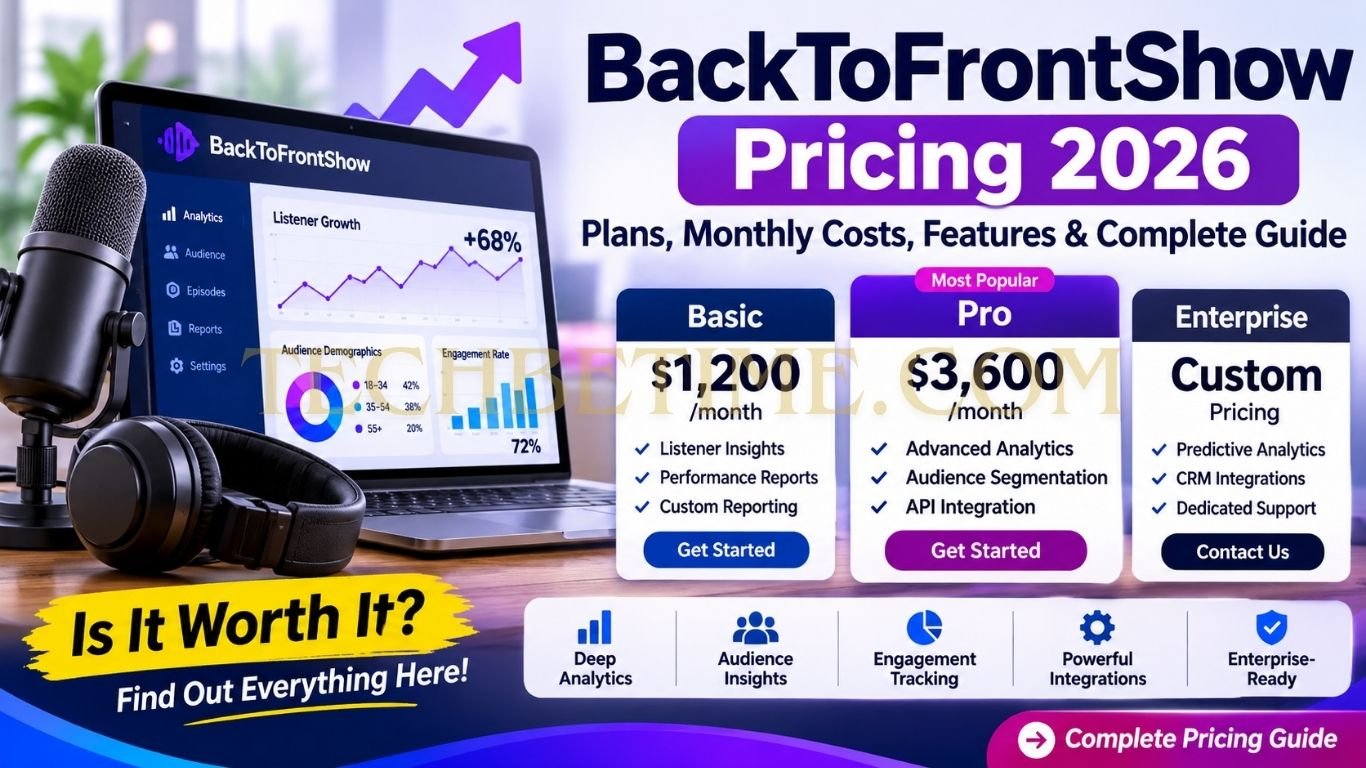
BackToFrontShow is presented as a podcast analytics platform focused on listener demographics, episode performance, audience engagement, and listening behavior. Its advertised subscription structure includes three options: Basic, Pro, and Enterprise. Basic is listed at $1,200 per month, Pro at $3,600 per month, while Enterprise requires a customized quote.
These prices represent a substantial investment, particularly for independent podcasters and smaller content teams. Therefore, choosing a subscription should involve more than comparing monthly figures. Buyers should consider the reporting capabilities, integration requirements, audience size, and potential return on investment.
In this guide, we explore BackToFrontShow pricing, compare its subscription plans, calculate estimated annual expenses, discuss free-trial information, and examine alternatives. We also explain what prospective customers should verify before committing to a paid subscription.
Pricing figures in this article are based on the supplied published-plan information and should be reconfirmed with the provider before purchase. Annual totals are mathematical estimates, not confirmed annual contracts.
What Is BackToFrontShow?
BackToFrontShow is described as a podcast analytics platform designed to help creators and businesses understand how audiences interact with their audio content. Instead of focusing exclusively on download counts, its advertised approach emphasizes listener demographics, episode performance, engagement information, listening trends, and customized reporting.
For a professional podcast business, understanding audience behavior can be just as important as publishing new episodes. Analytics can help a team discover which subjects attract listeners, identify changes in audience interest, and evaluate whether marketing campaigns are reaching the intended people.
The platform’s advertised audience includes professional podcasters, podcast networks, digital marketing agencies, media companies, and corporate content teams. These organizations may need more detailed reporting than the basic statistics supplied by a standard hosting dashboard.
However, the value of any analytics platform depends on the accuracy and usefulness of its data. Prospective customers should verify the provider’s current product documentation, supported hosting services, data sources, and customer references before making a financial commitment.
Understanding BackToFrontShow as a Podcast Analytics Platform
Podcast analytics involves collecting and interpreting information about how people discover, access, and consume podcast episodes. Depending on the data sources and measurement methods, analytics dashboards can display downloads, listening trends, geographic information, device categories, and episode-level performance.
These measurements help podcast publishers understand what is working. For example, if a particular episode consistently attracts more listeners than other episodes, the team can investigate its subject, title, guest, publication timing, and promotional strategy. The findings may influence future editorial decisions.
Audience engagement information can also support marketing activities. A business that understands its audience can develop more relevant sponsorship proposals and communicate its content performance more effectively to potential advertisers. Similarly, agencies can use structured reports to explain campaign outcomes to clients.
BackToFrontShow advertises capabilities related to audience demographics, engagement, and performance reporting. However, buyers should distinguish between features advertised by the provider and capabilities independently demonstrated through product testing. They should request sample dashboards and ask how each metric is collected.
Podcast Analytics vs. Podcast Hosting
Podcast hosting and podcast analytics are related but different services. Hosting provides the infrastructure needed to store audio episodes and distribute them through podcast directories and listening applications. Analytics focuses on measuring and interpreting the activity associated with that content.
A hosting provider generally manages audio files, episode descriptions, RSS feeds, and distribution-related functions. Its dashboard may also provide statistics about downloads and audience activity.
An analytics platform, on the other hand, may combine information from different sources to provide additional reporting, comparisons, or audience insights. The exact capabilities depend on its integrations and measurement methods.
This distinction matters when calculating BackToFrontShow’s total cost. If the platform primarily provides analytics, podcast creators may still need a separate hosting subscription, recording software, editing tools, and distribution services.
Before purchasing, ask whether BackToFrontShow connects directly with your existing hosting provider and whether it requires additional tracking technology. Understanding these requirements helps prevent paying for overlapping services.
BackToFrontShow Pricing at a Glance
The advertised BackToFrontShow pricing structure contains three subscription levels: Basic, Pro, and Enterprise. Each tier appears to target a different level of business complexity, ranging from professional creators needing core reports to larger organizations requiring customized analytics.
The Basic plan is listed at $1,200 per month, while Pro costs $3,600 per month. Enterprise does not have a publicly stated fixed subscription price and requires direct consultation.
| Plan | Monthly price | Estimated 12-month cost | Best suited for |
|---|---|---|---|
| Basic | $1,200 | $14,400 | Professional podcasters |
| Pro | $3,600 | $43,200 | Growing podcast networks |
| Enterprise | Custom quote | Not published | Large organizations |
These figures provide an initial budgeting reference. They do not establish whether the provider offers discounts, annual contracts, or different prices for particular customers.
How Much Does BackToFrontShow Cost Monthly?
The lowest advertised subscription is Basic at $1,200 per month. This makes it a premium-priced option compared with many entry-level podcast analytics services.
The Pro subscription costs $3,600 monthly, which is three times the Basic price. The additional expense may be relevant to businesses that need more detailed audience segmentation, growth analysis, and advanced reporting.
Enterprise follows a different pricing approach. Instead of publishing a fixed monthly amount, the provider offers customized pricing. This is common with business software when implementation, account requirements, integrations, and support arrangements vary between customers.
For budgeting purposes, remember that the subscription amount may not represent the complete invoice. Taxes, onboarding, additional accounts, and integration requirements should be discussed before signing an agreement.
How Much Does BackToFrontShow Cost Annually?
Calculating annual expenses makes it easier to understand the financial commitment behind each plan.
The Basic subscription costs $1,200 monthly. Multiplying this amount by twelve produces an estimated annual expense of $14,400.
The Pro subscription costs $3,600 monthly. Over twelve months, the total becomes $43,200. This represents a significant investment for any podcast business.
Enterprise expenses cannot be calculated without an official quote.
| Plan | Monthly price | Calculation | Annual estimate |
|---|---|---|---|
| Basic | $1,200 | $1,200 × 12 | $14,400 |
| Pro | $3,600 | $3,600 × 12 | $43,200 |
| Enterprise | Custom | Quote required | Unknown |
These totals assume twelve consecutive months at the advertised monthly rate. They are not confirmation of annual billing packages or discounts.
Why Does BackToFrontShow Pricing Look Confusing Online?
People researching BackToFrontShow may encounter different descriptions, feature lists, and historical references. This can make it difficult to determine which information relates to the current analytics service. Understanding these differences is important because a pricing article should not mix information about unrelated products.
The safest approach is to distinguish between the current website’s advertised analytics services, historical podcast content, and third-party descriptions. The official website currently presents podcast analytics plans, but buyers should still verify the company’s business identity, technical capabilities, and contractual terms before making a large payment.
The Connection With the Older Back to Front Show Podcast
One reason for the confusion is that the name Back to Front Show has also been associated with an older technology podcast. Historical references describe a show covering web development, design, online publishing, startups, and technology-related discussions.
The older podcast and the current analytics website should not automatically be treated as the same business. Similar names or shared domain references do not establish common ownership, management, or commercial relationships.
This distinction matters when searching for reviews, company information, or subscription prices. Historical podcast pages may discuss episodes, hosts, sponsorships, and web-industry subjects rather than the current analytics product.
If you are considering a subscription, focus on the current service’s official product and pricing information. Ask the provider to identify the legal business operating the platform and explain its relationship, if any, with the older podcast. This is particularly important when a company requests a substantial upfront or recurring payment.
Differences Between Homepage and Pricing Details
Another source of confusion is the way software companies distribute product information across different website pages. A homepage may highlight general benefits, while a pricing page explains which features belong to each subscription.
BackToFrontShow advertises audience demographics, listening behavior, engagement monitoring, device analytics, geographical insights, and customizable reports. Its Basic, Pro, and Enterprise descriptions do not necessarily assign every advertised capability to a specific plan in the same way.
For example, the homepage lists certain analytics capabilities across its product presentation, while the plan descriptions emphasize different combinations of reporting and audience analysis. Some advanced capabilities, such as integrations and predictive analytics, are associated with higher-level offerings.
This does not automatically mean that the information is incorrect. However, it creates a reason to request a current feature matrix before subscribing.
Ask the provider to identify which features are included in your selected plan, which require additional payment, and whether any usage restrictions apply. A written response is more useful than relying on a general marketing statement.
Why Online Pricing Articles May Repeat Similar Information
Search engines often display multiple articles discussing the same software subscription. When several websites publish identical prices, readers may assume that each article independently verified the information.
That assumption is not always correct. Some articles may use the same original pricing page or repeat information from other publications without conducting independent product testing.
For BackToFrontShow, the $1,200 Basic and $3,600 Pro figures appear in multiple online descriptions. These repeated figures provide useful context, but they do not establish that the service has been independently tested or that every advertised feature works as described.
A careful buyer should prioritize the provider’s current pricing documentation, request a live demonstration, and ask for references from existing customers. This approach provides stronger purchasing evidence than relying on the number of articles repeating the same claims.
BackToFrontShow Basic Plan – $1,200 per Month
The Basic plan is the lowest publicly advertised subscription and is positioned as an entry point for professional podcast analytics. At $1,200 per month, it is still a considerable expense compared with ordinary podcast hosting packages and beginner-friendly reporting tools.
Its advertised capabilities focus on understanding audience characteristics, measuring episode performance, identifying listening patterns, and preparing reports. These functions can be useful for podcast businesses that already have an established audience and need more organized performance information.
However, a lower subscription tier does not necessarily mean that every essential feature is included without restrictions. Customers should investigate the number of shows supported, available reporting periods, data export options, and account permissions before making a decision.
Features Included in the Basic Plan
The Basic plan is advertised with several core reporting capabilities.
1. Listener demographics: Demographic reporting can help creators understand general audience characteristics, such as age groups, geographic locations, and other available audience categories. This information may help publishers develop content that better matches their intended listeners. Buyers should ask how demographic information is collected and whether the figures represent actual platform data or estimates.
2. Episode performance tracking: This capability helps creators compare individual episodes and identify content that attracts more attention. Performance reports may help teams evaluate subjects, guests, episode formats, and publication schedules.
3. Listening trends and patterns: Listening trends can reveal changes in audience activity over time. A publisher might use these patterns to evaluate whether listeners are responding to a new content category or returning to older episodes.
4. Customizable reporting: Custom reporting can help teams organize performance information around specific business questions. For example, a marketing department may need a monthly report showing episode performance, audience locations, and engagement trends.
5. Feedback and interaction analysis: The plan description also mentions feedback and interaction analysis. This may help teams understand how listeners respond to episodes and identify subjects that generate discussion.
6. Accessibility and compliance: Accessibility and compliance are also listed in the Basic plan description. Customers should request details about the actual standards, controls, and documentation provided.
These features should be checked against the latest written subscription agreement rather than assumed to include unlimited reporting or every type of audience measurement.
Who Should Choose the Basic Plan?
The Basic subscription may be relevant to established independent podcasters, small media businesses, and professional content teams that need structured analytics.
For example, a podcast production company might publish several episodes every month and prepare performance reports for its business partners. It may need to understand which episodes attract the strongest audience response and whether its publishing schedule is effective.
A professional creator who earns money through sponsorships may also benefit from organized audience information. If advertisers request performance evidence, a consistent reporting system can make sponsor discussions more structured.
However, the subscription is not automatically suitable for every professional creator. A podcaster who publishes occasionally or receives only a modest number of downloads may not need a premium analytics platform.
Before choosing Basic, consider your current reporting process. Identify which information is missing, how frequently you need it, and whether those insights could improve revenue or reduce administrative work. If your existing hosting dashboard already answers these questions, the additional subscription may provide limited value.
Is the Basic Plan Worth $1,200 Monthly?
The value of the Basic plan depends on measurable business outcomes rather than the number of features advertised. At $1,200 per month, a subscriber spends $14,400 over twelve months before taxes or other possible charges.
For a podcast that generates consistent sponsorship revenue, this expense might be manageable if the platform provides information that improves advertising decisions or saves substantial reporting time.
Consider a media company that uses audience reports to prepare sponsor proposals. If those reports help the company retain clients or secure additional campaigns, the analytics subscription may contribute to its business performance.
On the other hand, an independent creator who only needs download counts, episode comparisons, and basic listener information may find the price difficult to justify.
A practical decision is to compare the subscription cost with the financial value of the problems it solves. Ask for a demonstration using your own reporting requirements, and calculate the expected benefit before agreeing to a long-term contract.
BackToFrontShow Pro Plan – $3,600 per Month
The Pro plan is the more expensive publicly priced subscription. At $3,600 per month, it costs $2,400 more than Basic and represents an estimated annual commitment of $43,200.
This tier is promoted for businesses that require deeper audience intelligence and more advanced analytical capabilities. It builds on the Basic plan by advertising audience growth and churn analysis, segmentation, targeting, and engagement measurement.
For organizations managing multiple shows or marketing campaigns, these capabilities may provide additional insight into how different audience groups interact with their content.
However, the price difference is substantial. Businesses should not upgrade simply because Pro includes more features. They should identify which additional capabilities address a genuine operational or commercial requirement.
Features Included in the Pro Plan
The Pro plan is advertised as including Basic features plus additional audience analysis.
Audience growth and churn rates: Growth analysis helps teams monitor changes in their audience over time. Churn analysis can help identify declining engagement or listeners who stop returning. Buyers should ask how the platform defines an active listener and calculates churn.
Audience segmentation: Segmentation divides an audience into groups based on available characteristics or behavior. A marketing team might compare listeners by location, engagement level, or content preferences. These segments can help businesses develop more relevant promotional campaigns.
Targeting capabilities: Audience targeting uses available audience information to guide marketing decisions. For example, a brand might prioritize a particular audience group when planning a campaign. The exact targeting functionality should be demonstrated because reporting-based targeting is different from directly delivering advertisements.
Advanced engagement metrics: Engagement measurement can help teams understand how listeners interact with episodes. The provider should explain which actions are measured, how they are recorded, and whether data comes from connected listening platforms.
Listening behavior tracking: Listening behavior information may help businesses identify popular episodes, consumption patterns, and changes in audience activity.
The website also promotes device and platform analytics, feedback analysis, and real-time reporting in its broader product descriptions. API integration is another capability that buyers should specifically confirm for their chosen subscription.
Who Should Choose the Pro Plan?
Pro may be worth investigating for established podcast networks, digital marketing agencies, and media companies managing multiple content campaigns.
A podcast network, for example, may operate several shows targeting different audience groups. Its management team might need to compare performance across programs, identify audience growth patterns, and prepare reports for advertisers.
Marketing agencies can also benefit from segmentation when they manage podcast-related campaigns for multiple clients. Rather than relying on basic download statistics, a more detailed reporting system may help them understand audience differences and communicate campaign performance.
Growing media businesses may find advanced reporting useful when making editorial and commercial decisions. However, these organizations should first confirm that the platform supports their actual number of shows, team members, and data requirements.
Pro is best evaluated as a business investment, not simply an upgrade. If the advanced features do not improve reporting quality, save time, or contribute to additional revenue, the extra subscription expense may not be justified.
Is BackToFrontShow Pro Worth the Extra $2,400?
The difference between Basic and Pro is $2,400 per month. Over twelve months, that becomes an additional $28,800.
This is a major financial commitment, so the decision should be based on the specific advantages Pro provides to your organization.
For example, a marketing agency might spend several hours each week preparing audience reports manually. If advanced segmentation and automated reporting reduce this workload, the company may save employee time and improve client service.
Similarly, a podcast network may use audience growth analysis to identify underperforming shows and adjust its content strategy. Better information could support more informed decisions, although analytics alone cannot guarantee audience growth.
Before upgrading, ask the provider to demonstrate the advanced features and explain how they differ from Basic. Request details about API access, reporting limits, data refresh frequency, and the number of supported podcast accounts.
The best choice is the plan that solves your business problems at a sustainable cost. A more expensive subscription is not necessarily a better investment.
BackToFrontShow Enterprise Plan – Custom Pricing
Enterprise is the highest advertised subscription level and is designed for organizations with more specialized analytics requirements. Unlike Basic and Pro, it does not have a fixed public monthly price.
Custom pricing allows a provider to consider the customer’s technical requirements, account structure, integrations, reporting needs, and support expectations. For a large media organization, these requirements may be substantially different from those of an individual podcast creator.
The Enterprise description includes advanced capabilities such as predictive analytics, marketing and CRM integrations, user behavior tracking, and customized reporting. However, organizations should confirm the complete feature list and contractual conditions before purchasing.
Enterprise Features and Capabilities
The Enterprise plan is advertised with several advanced capabilities.
Predictive analytics: Predictive analytics uses historical information and analytical models to identify possible future trends. In podcasting, this might help a team examine audience patterns and identify topics or programs that could deserve further attention. Buyers should ask which predictions are available and how their accuracy is evaluated.
Marketing and CRM integrations: These integrations may help connect podcast reporting with customer relationship management and marketing systems. Businesses can potentially organize audience insights alongside their broader campaign information. The provider should confirm supported platforms and any integration charges.
Advanced user behavior tracking: Behavior tracking can help organizations understand how users interact with content and available features. It is important to ask exactly which actions are measured and whether tracking is limited by the connected platforms.
Custom reporting: Larger organizations may need reports designed around their internal performance indicators, departments, or clients. Enterprise is advertised as providing more customized reporting options.
White-labeling: White-label functionality may allow agencies or media businesses to present reports using their own branding. This can be useful when delivering analytics to external clients.
Dedicated account management and training: Enterprise-level arrangements may include a dedicated account manager, onboarding assistance, and advanced training. Confirm whether these services are included in the quoted price or billed separately.
Who Should Consider Enterprise?
Enterprise may be relevant to large podcast networks, corporate marketing departments, media organizations, and agencies managing multiple clients.
A large network may need centralized reporting across many podcast programs. Its management team could require customized access permissions, consolidated dashboards, and specialized reports for different departments.
An agency might need branded analytics reports for clients and integrations with existing marketing systems. Corporate teams may prioritize data governance, account management, security documentation, and technical support.
However, the Enterprise label alone does not establish that a platform meets an organization’s security or compliance requirements. Large buyers should evaluate technical documentation, data handling policies, service commitments, and implementation procedures.
How to Request an Enterprise Pricing Quote
A useful Enterprise quote starts with a clear explanation of your business requirements.
Before contacting the provider, prepare information about the number of podcast shows, expected users, current hosting services, reporting frequency, and required integrations.
Then request a proposal that separates recurring subscription charges from one-time expenses. Ask whether the quote includes onboarding, technical implementation, custom reports, training, account management, and ongoing support.
It is also sensible to request a demonstration using a realistic business scenario. This allows your team to assess whether the proposed solution addresses its actual reporting requirements.
Finally, obtain the contract terms in writing. Review payment schedules, renewal conditions, cancellation procedures, data ownership, and export rights before approving the purchase.
BackToFrontShow Plans Compared: Basic vs Pro vs Enterprise
Comparing subscription features side by side makes it easier to understand what each BackToFrontShow plan offers. Although all three options focus on podcast analytics, their advertised capabilities differ according to the complexity of the reporting requirements.
Basic concentrates on core audience and episode information. Pro adds audience growth, segmentation, and more detailed engagement analysis. Enterprise is intended for organizations requiring predictive analytics, marketing integrations, and customized reporting.
The following table summarizes the advertised capabilities. It should be treated as a purchasing guide rather than a guaranteed contractual feature list.
| Feature | Basic | Pro | Enterprise |
|---|---|---|---|
| Listener demographics | Included | Included | Included |
| Episode performance | Included | Included | Included |
| Listening trends | Included | Included | Included |
| Audience growth analysis | Not clearly listed | Included | Included |
| Audience segmentation | Not clearly listed | Included | Included |
| Engagement analysis | Included | Included | Included |
| Predictive analytics | Not listed | Not listed | Included |
| CRM integrations | Not listed | Confirm | Advertised |
| API integration | Confirm | Confirm | Confirm |
| Custom reporting | Included | Included | Advertised |
| User behavior tracking | Not listed | Not clearly listed | Included |
| White-labeling | Not listed | Not listed | Confirm |
Feature availability and integration conditions should be confirmed directly with the provider.
When comparing these plans, pay attention to the features that solve your actual problems. A business that only needs episode statistics may not benefit from Enterprise-level functionality. Similarly, an organization that depends on advanced audience segmentation may find Basic insufficient.
It is also important to distinguish between a feature being advertised and its practical limitations. Ask about usage limits, supported data sources, historical reporting, and the number of podcast accounts available under each subscription.
How Much Does BackToFrontShow Cost per Year?
The annual cost of BackToFrontShow is an important consideration because the monthly subscription prices create a substantial long-term commitment. Businesses should calculate their potential expenses before choosing a plan, especially when software is being added to an existing marketing or podcast production budget.
A monthly subscription may initially appear manageable, but multiplying it by twelve reveals the actual yearly financial requirement. This calculation also helps organizations compare the platform with alternative analytics services.
Basic Plan Annual Cost
The Basic subscription is advertised at $1,200 per month. Over twelve months, the estimated cost is $14,400.
This amount does not include potential taxes, additional accounts, technical setup, or other charges that might apply under the provider’s commercial terms.
For a professional podcast business, the annual expense should be compared with the revenue generated by the show and the value of improved reporting. If the platform helps a company make better commercial decisions, the subscription may be easier to justify.
However, businesses with limited podcast revenue should carefully consider whether the additional analytics are necessary.
Pro Plan Annual Cost
The Pro subscription costs $3,600 monthly, producing an estimated yearly expense of $43,200.
Compared with Basic, this represents an additional $28,800 annually. Therefore, customers should carefully examine whether the advanced features provide enough additional value to support the higher price.
A podcast network that manages multiple shows may benefit from more detailed audience reporting and segmentation. A small independent creator, however, may find that the extra capabilities are unnecessary.
The most useful approach is to estimate how much money or staff time the additional functionality could realistically save. Then compare that figure with the subscription difference.
Is There an Annual Subscription Discount?
A publicly confirmed annual discount should not be assumed simply because the provider advertises monthly subscription prices.
Some software companies offer discounted annual contracts, while others charge the same effective monthly rate regardless of the billing cycle. The available BackToFrontShow pricing information does not establish a confirmed annual discount.
Before accepting an annual agreement, ask the provider for both monthly and yearly payment options. Compare the total amounts rather than relying on a promotional percentage.
Also investigate cancellation policies, refund eligibility, renewal dates, and early termination conditions. An annual contract may reduce the effective subscription cost, but it can also create a larger financial commitment if your requirements change.
Does BackToFrontShow Offer a Free Plan or Free Trial?
A free plan and a free trial are two different things. free plan generally provides ongoing access to selected features without requiring a paid subscription. A free trial temporarily allows users to evaluate a product before purchasing it.
BackToFrontShow’s website displays a trial-style access option, but its public information does not clearly establish a guaranteed trial duration or all the conditions attached to it. Its plan descriptions also use a request-access process rather than presenting a straightforward self-service checkout.
This distinction is important because users should not assume that clicking a trial button automatically provides unrestricted access.
How Does the BackToFrontShow Free Trial Work?
The website promotes a trial-related call to action, but prospective users should confirm the actual process with the provider.
A request-access process may require users to submit their contact information, explain their requirements, and select an intended subscription. The provider may then review the request before providing access.
However, the public information does not clearly establish whether every applicant receives a trial, how long access lasts, or whether payment details are required.
Before registering, ask the company:
- How many days does the trial last?
- Are Basic and Pro features available during testing?
- Is a payment card required?
- Does the trial automatically convert into a paid subscription?
- Can access be cancelled without charge?
- Is technical support available during the trial?
Request written confirmation of these conditions. A genuine product evaluation should allow you to understand the reporting system and determine whether it meets your requirements before making a substantial financial commitment.
Is There a Permanent Free Version?
The advertised subscription structure focuses on Basic, Pro, and Enterprise paid plans. A permanent free version is not clearly listed in the available public pricing information.
This means potential customers should not budget on the assumption that they can use the platform indefinitely without paying.
If you are a beginner or independent podcaster, consider using the analytics dashboards already provided by your hosting service and podcast distribution platforms. These tools may provide enough information for ordinary performance tracking.
You can then evaluate whether a premium service solves reporting problems that your existing tools cannot address.
Hidden Costs and Additional Expenses to Consider
Subscription prices are only one part of the total cost of using business software. Depending on the contract and implementation requirements, customers may also need to budget for setup, integration, extra accounts, support, or specialized reporting.
There is no reason to assume that BackToFrontShow charges every additional fee listed below. These are potential expenses to investigate because the publicly advertised monthly prices do not establish every possible billing condition.
Setup and Onboarding Fees
Some business software requires technical configuration before customers can begin using it. This may involve connecting podcast accounts, importing available information, configuring dashboards, and establishing reporting permissions.
Ask whether BackToFrontShow includes onboarding in the subscription or charges a separate implementation fee. Enterprise customers should also clarify whether custom integrations or specialized training create additional expenses.
Additional User Accounts
Organizations often need multiple employees to access analytics dashboards. For example, a marketing manager, content editor, account executive, and reporting specialist may all require separate accounts.
Before subscribing, ask how many users are included in the selected plan. Also check whether additional accounts cost extra and whether administrators can control permissions for different employees.
API Usage and Integration Costs
API access can be important for businesses that want to connect analytics information with internal applications, reporting software, or CRM systems.
However, API availability does not necessarily mean unlimited access. Usage restrictions, technical support, integration development, and third-party services may affect the total cost.
Request documentation covering supported integrations, access permissions, usage limits, and any additional charges.
Custom Reports and Data Exports
Custom reporting can be valuable for agencies and media organizations that prepare regular reports for clients or sponsors.
However, some platforms distinguish between standard reports and specialized reporting services. Buyers should confirm whether report customization is included and whether data exports are available in common formats.
Also ask how much historical data can be accessed and whether information can be downloaded when a subscription ends.
Taxes and Payment Processing
The advertised subscription prices may not represent the final amount charged to every customer. Applicable taxes, currency conversion, and payment processing arrangements can affect the total.
International customers should ask which currency is used for billing and whether the displayed amount excludes applicable taxes.
Cancellation and Contract Fees
Cancellation terms are especially important when software costs thousands of dollars each month.
Before signing, determine whether the agreement is monthly or annual, how much notice is required, whether early cancellation charges apply, and what happens to stored information after termination.
Pre-purchase checklist:
- Confirm the final monthly subscription amount.
- Ask about onboarding and setup charges.
- Check additional user-account costs.
- Confirm API access and usage restrictions.
- Review custom reporting charges.
- Ask about taxes and payment currency.
- Understand cancellation and refund policies.
- Confirm data export and ownership rights.
Is BackToFrontShow Pricing Worth It?
Whether BackToFrontShow pricing represents good value depends on the customer’s business model, audience size, reporting requirements, and ability to use analytics to produce measurable results.
A premium analytics platform may be useful when a business relies on audience information to attract sponsors, manage campaigns, or evaluate multiple podcast programs. Detailed reporting can also reduce manual work and help teams make more informed decisions.
However, paying for advanced analytics does not automatically increase listeners or revenue. The information must lead to better decisions, and those decisions must produce meaningful business outcomes.
For smaller creators, the monthly subscription may be difficult to justify when existing hosting and distribution dashboards already provide sufficient performance information.
A Simple BackToFrontShow ROI Example
Return on investment (ROI) helps businesses evaluate whether the financial benefits of a product justify its cost.
Consider a hypothetical podcast business using the Basic subscription. Suppose improved audience reporting helps it generate an additional $2,000 in monthly sponsorship revenue.
The following example illustrates the calculation:
| Metric | Example amount |
|---|---|
| Additional monthly revenue | $2,000 |
| Basic subscription cost | $1,200 |
| Net benefit before other expenses | $800 |
| Simplified ROI | 66.7% |
The formula is:
\[ ROI = \frac{\text{Financial Benefit – Software Cost}}{\text{Software Cost}}\times100 \]
Using the example:
\[ ROI = \frac{2000-1200}{1200}\times100 \]
\[ ROI = 66.7\% \]
This means the business receives $800 more than its subscription expense in the example, before other operating costs, taxes, and production expenses.
These figures are hypothetical and do not represent verified BackToFrontShow customer results. Additionally, the extra sponsorship revenue must be reasonably attributable to the improved analytics rather than unrelated business activity.
How Podcast Analytics Can Improve Sponsorship Opportunities
Sponsors want to understand whether a podcast reaches the audience they want to target. They may consider listener numbers, geographic reach, engagement, content relevance, and audience characteristics when evaluating advertising opportunities.
Analytics can help podcast publishers prepare more organized sponsorship proposals. Instead of presenting only general download figures, a business may be able to show episode performance, available audience demographics, and changes in listening activity.
For example, a podcast focused on business technology might approach software companies interested in reaching technology professionals. Relevant audience information could make the proposal more useful during sponsorship discussions.
Analytics can also help creators identify episodes that attract stronger engagement and understand which topics deserve additional attention.
Nevertheless, advertisers may request independent measurement or specific advertising standards. Buyers should confirm whether BackToFrontShow provides the reporting and attribution information that their potential sponsors actually accept.
When the Subscription May Not Be Worth the Money
BackToFrontShow may not be a suitable investment for every podcast.
A hobby creator who publishes one episode every few weeks may not need advanced audience segmentation or enterprise reporting. Similarly, a new podcast with a small audience may not generate enough information to make sophisticated analytics useful.
It may also be unnecessary when an existing hosting provider already supplies the reports needed for everyday decisions.
The best approach is to identify your reporting gaps before purchasing. If the platform cannot solve a specific business problem or provide a measurable advantage, its high subscription price may not be justified.
Who Should Use BackToFrontShow?
BackToFrontShow is positioned toward professional users who need more than basic podcast statistics. Its advertised capabilities may be relevant to organizations that regularly analyze audience information and use reports in business decisions.
Professional Podcasters
Established professional podcasters may benefit from detailed episode reporting and audience analysis. These insights can help them evaluate content performance, understand listening trends, and prepare information for potential sponsors.
However, creators should ensure that their audience size and revenue justify the subscription.
Podcast Networks and Media Companies
Networks managing several shows may need consolidated reporting and comparisons between different programs. Advanced analytics could help management teams evaluate content performance and identify changes in audience behavior.
Before purchasing, confirm the number of shows supported and whether centralized reporting is available.
Digital Marketing Agencies
Agencies managing podcast campaigns may need to prepare performance reports for clients. Audience segmentation and customizable reporting could support campaign analysis and client communication.
They should also investigate whether white-labeling, account permissions, and integrations are included in their intended plan.
Corporate Marketing Teams
Businesses using podcasts as part of their marketing strategy may need audience information to evaluate content performance and sponsorship activities.
A more advanced reporting system may be useful when several departments need access to consistent information. Security documentation and data governance should also be reviewed before implementation.
Who Should Avoid BackToFrontShow?
Although advanced analytics can provide business value, the platform’s advertised pricing may be excessive for users with basic reporting requirements.
The following groups should consider more affordable options first:
- Hobby podcasters: Creators who publish occasionally may not need premium reporting.
- Beginners: New podcasters should prioritize building an audience and establishing a publishing schedule.
- Independent creators with limited budgets: A $1,200 monthly subscription can consume a large portion of a small creator’s income.
- Small shows needing basic statistics: Download counts and simple episode comparisons may be sufficient.
- Existing analytics users: Businesses already receiving the information they need from their hosting provider may have little reason to add another platform.
A sensible purchasing strategy is to begin with available free analytics and upgrade only when genuine reporting limitations appear.
BackToFrontShow Pricing: Pros and Cons
Before subscribing, it is useful to evaluate both the potential advantages and limitations of the platform. A software subscription should be judged by its practical capabilities, transparency, and overall cost rather than marketing descriptions alone.
Advantages of BackToFrontShow
Multiple subscription options: The platform advertises three plans, allowing customers to consider different levels of analytics requirements.
Advanced analytics focus: Its advertised features include listener demographics, engagement analysis, and episode performance tracking.
Audience insights: Information about listening patterns and audience behavior may help businesses understand their content performance.
Custom reporting: Customizable reports can be useful for agencies, podcast networks, and media companies that need structured performance information.
Enterprise capabilities: Predictive analytics and marketing integrations are advertised for organizations with more advanced requirements.
Potential business applications: Audience insights may support sponsorship proposals, content planning, and marketing decisions.
Disadvantages of BackToFrontShow
High subscription costs: Basic starts at $1,200 monthly, making it an expensive option for independent creators.
Expensive Pro plan: The $3,600 monthly price creates a substantial annual financial commitment.
No public Enterprise price: Businesses must request a customized quote.
Unclear trial conditions: The available public information does not establish a guaranteed trial period.
Feature confirmation required: Some capabilities need clarification regarding plan availability and technical restrictions.
Limited independent verification: The advertised capabilities and customer testimonials should not be treated as independently verified performance results.
Overall, the platform may be worth investigating for established podcast businesses, but buyers should conduct proper checks before paying for a premium subscription.
Cheaper BackToFrontShow Alternatives
If BackToFrontShow pricing exceeds your budget, comparing other podcast analytics solutions is a sensible step. Many established platforms provide audience and episode information through their existing dashboards.
The right alternative depends on what you need to measure. Some services focus on podcast distribution, while others provide detailed information about listening activity, audience demographics, and video performance.
Podcast Hosting Analytics
Your existing podcast hosting provider is a good starting point. Many hosting services include basic analytics within their subscription packages.
These dashboards may show episode downloads, listening trends, and other performance information. The exact features depend on the provider and hosting plan.
For smaller creators, this may be sufficient without purchasing a separate premium analytics platform.
Apple Podcasts Analytics
Podcast Creators Will Soon Be Able to Access Follower Metrics – MacRumors
Apple Podcasts Connect
Apple’s creator dashboard provides information about followers, listeners, engaged listeners, plays, and geographic audience data. Some metrics require minimum data thresholds.
Official resource: Apple Podcasts Analytics
This is useful for creators who want to understand how audiences interact with their shows on Apple Podcasts. Apple defines engaged listeners using listening-duration criteria and provides comparisons across selected reporting periods. Apple Podcasts for Creators+1
Spotify for Creators Analytics
Bringing deeper insight to know and grow your audience
Spotify for Creators
Spotify provides episode performance, audience demographics, discovery information, and engagement-related metrics.
Official resource: Spotify Audience Analytics
Its audience reporting includes information about new and returning listeners, geographic locations, and available demographic categories. Some metrics update frequently, while others can take longer to refresh. Spotify+1
YouTube Studio Analytics
Everything You Need to Know About Starting a YouTube Podcast
YouTube Studio
YouTube Studio is useful for video podcasts and creators distributing episodes through YouTube.
Official resource: YouTube Analytics Guide
Its analytics dashboard provides views, watch time, traffic sources, audience information, and engagement-related reporting. Podcast creators can also access dedicated podcast performance information. YouTube Help+1
Specialized Podcast Advertising Measurement Tools
Some businesses need more than ordinary listening statistics. They may require advertising attribution, campaign measurement, or information about how podcast promotions influence customer actions.
Specialized advertising measurement services may address these requirements. However, businesses should compare supported platforms, attribution methods, reporting features, and current subscription costs before selecting a provider.
Alternative comparison:
| Alternative | Main purpose | Best suited for |
|---|---|---|
| Podcast hosting analytics | Downloads and episode statistics | Independent creators |
| Apple Podcasts Connect | Apple audience analytics | Apple podcast publishers |
| Spotify for Creators | Listener and episode insights | Spotify creators |
| YouTube Studio | Video and podcast performance | Video podcasters |
| Advertising measurement tools | Campaign and attribution analysis | Advertisers and agencies |
These alternatives do not provide identical features, and some only measure activity within their respective platforms. Nevertheless, they are useful starting points before committing to a premium analytics subscription.
How to Verify BackToFrontShow Pricing Before Purchasing
Because the advertised subscription costs are substantial, buyers should verify the available plans and commercial conditions before making a payment. A few straightforward checks can help prevent misunderstandings and unexpected expenses.
Step 1: Visit the Official Pricing Page
Start with the current BackToFrontShow website and review its advertised plans.
Official website: BackToFrontShow
Check the Basic and Pro prices, Enterprise information, and any updated subscription details. Save a copy of the pricing information for future reference.
Step 2: Review the Available Subscription Plans
Compare the features included in Basic, Pro, and Enterprise. Identify which capabilities are essential for your podcast business.
Do not select a higher-priced subscription simply because it advertises more features. Focus on the reporting requirements that matter to your organization.
Step 3: Request a Written Feature List
Contact the provider and request a complete feature comparison.
Ask about the number of podcast accounts, user permissions, reporting limits, integrations, historical data, and export options.
A written feature list provides a clearer basis for evaluating the subscription.
Step 4: Ask About Free Trial Conditions
If you want to test the platform, ask whether trial access is available.
Confirm its duration, included features, payment requirements, and cancellation conditions before providing financial information.
Step 5: Request a Product Demonstration
A product demonstration can help you understand how the dashboard works.
Ask the provider to demonstrate audience reports, episode comparisons, segmentation, and other features that matter to your business.
Whenever possible, request sample reports based on realistic podcast analytics scenarios.
Step 6: Review Billing and Cancellation Policies
Before agreeing to a subscription, read the payment terms carefully.
Check contract duration, renewal conditions, refund eligibility, cancellation procedures, and additional fees.
Also ask what happens to your data after the subscription ends.
Step 7: Compare Other Podcast Analytics Platforms
Finally, compare BackToFrontShow with your current hosting dashboard and other available analytics solutions.
A premium subscription makes sense only when its additional capabilities provide sufficient value over existing tools.
Final Verdict: Is BackToFrontShow Pricing Worth the Investment?
BackToFrontShow pricing places the platform in the premium podcast analytics category. Its advertised Basic plan costs $1,200 per month, Pro costs $3,600 per month, and Enterprise requires a customized quote.
The platform promotes several analytics capabilities, including listener demographics, episode performance, engagement analysis, audience segmentation, and advanced reporting. These features may interest professional podcasters, media companies, marketing agencies, and established podcast networks.
However, the subscription prices are considerably higher than what many independent creators need to spend on analytics. The annual estimates of $14,400 for Basic and $43,200 for Pro also demonstrate why careful financial planning is essential.
There are several important considerations before purchasing:
- Beginners: Start with free analytics dashboards and build your audience first.
- Independent podcasters: Consider Basic only if its reporting provides measurable value.
- Growing businesses: Evaluate Pro through a demonstration and compare its additional features with the extra $2,400 monthly cost.
- Large organizations: Request an Enterprise proposal with complete technical and commercial details.
- All buyers: Confirm the provider’s business identity, feature availability, trial conditions, and contract terms.
Ultimately, BackToFrontShow may be worth investigating for businesses with advanced podcast analytics requirements. However, its advertised features and pricing alone are not sufficient evidence of commercial value.
The smartest decision is to compare the available tools, verify the claims, and calculate the expected return before committing to a subscription.
Frequently Asked Questions (FAQs) About BackToFrontShow Pricing
1. How much does BackToFrontShow cost per month?
BackToFrontShow advertises two fixed monthly subscription prices. Basic costs $1,200 per month, while Pro costs $3,600 per month. Enterprise pricing is customized according to business requirements.
2. What is the cheapest BackToFrontShow subscription plan?
Basic is the lowest advertised subscription at $1,200 monthly. It focuses on core podcast analytics, including listener demographics, episode performance, listening trends, and customizable reporting.
3. How much does BackToFrontShow cost per year?
Based on twelve monthly payments, Basic costs an estimated $14,400 annually, while Pro costs $43,200. These are calculations rather than confirmed annual billing packages.
4. What features are included in the Basic plan?
The Basic plan advertises listener demographics, episode performance tracking, listening trends, customizable reports, feedback analysis, and accessibility and compliance features.
5. What is the difference between BackToFrontShow Basic and Pro?
Basic focuses on core analytics and reporting. Pro adds audience growth and churn analysis, segmentation, targeting, and advanced engagement information. Pro costs an additional $2,400 per month.
6. Does BackToFrontShow offer Enterprise pricing?
Yes. The Enterprise plan uses customized pricing rather than a publicly advertised fixed monthly amount. Interested organizations should contact the provider for a detailed quote.
7. Does BackToFrontShow have a free plan?
A permanent free version is not clearly listed in the available public subscription information. Users should confirm current access options directly with the provider.
8. Can I try BackToFrontShow before purchasing?
The website promotes a trial-style access option, but the trial duration, eligibility, payment requirements, and conditions are not clearly established. Ask the company for written confirmation.
9. Are there any hidden BackToFrontShow fees?
The public monthly prices do not establish whether additional charges apply. Buyers should ask about setup, onboarding, additional accounts, API usage, taxes, customization, and cancellation conditions.
10. Is BackToFrontShow worth $1,200 per month?
It may be worth considering for professional podcast businesses that can use advanced reporting to improve revenue or reduce operational costs. Smaller creators may find more affordable analytics tools sufficient.
11. Who should use BackToFrontShow?
Professional podcasters, podcast networks, digital marketing agencies, and corporate marketing teams may benefit from its advertised analytics capabilities, provided the features meet their actual requirements.
12. What are the cheaper alternatives to BackToFrontShow?
Potential alternatives include podcast hosting analytics, Apple Podcasts Connect, Spotify for Creators, YouTube Studio, and specialized advertising measurement platforms. Their features and pricing vary.