Introduction
A Heuwolf is agricultural equipment designed to make hay and forage handling easier. In the Seeber range, it is associated with machines that pick up forage and move it in a controlled direction. This makes the equipment useful for farmers who want to reduce manual work and handle hay more efficiently.
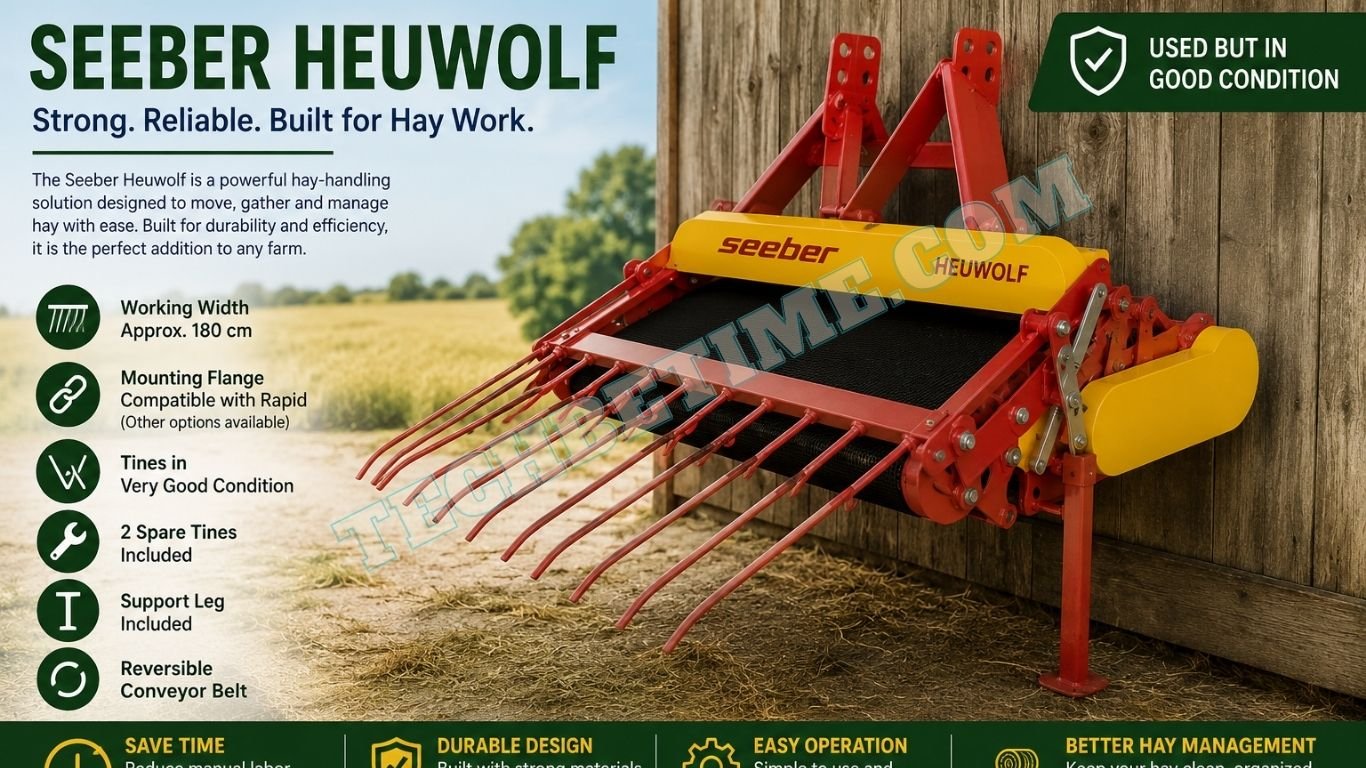
For buyers researching a Seeber Heuwolf, it is important to look beyond the name and examine the machine’s working width, mounting flange, tine condition, conveyor system, support equipment, and overall mechanical condition. A used Seeber Paul Heuwolf/Heuschieber 180 cm zu Rapid listing describes a used machine in good condition with an approximately 180 cm working width, a Rapid-compatible mounting flange, good-condition tines, two spare tines, a support leg, and a reversible conveyor belt.
This guide explains the Seeber Heuwolf in simple language. It covers its purpose, main features, specifications of the supplied used 180 cm example, maintenance, safety, buying tips, advantages, limitations, and common questions. Because different models can have different dimensions and attachments, buyers should always check the exact machine before purchasing.
What Is a Heuwolf?
In agricultural use, Heuwolf refers to Seeber forage-handling equipment associated with collecting and moving hay or other forage. A typical design uses tines to pick up material and a conveyor to move it sideways. This gives the operator more control over where the forage is placed and can reduce the need for repeated manual handling.
The basic idea is simple. The pickup system collects forage from the ground, while the conveyor moves it toward the required side. This can save time and physical effort, especially when a farm handles large amounts of forage or works on terrain where manual movement is difficult. Good pickup is also important because clean forage is valuable for feeding livestock.
Online listings may use related German terms such as Heuwolf and Heuschieber. These names can describe related hay-handling equipment, but they should not automatically be treated as identical machines. The safest approach is to compare the actual specifications, working width, mounting system, tine arrangement, and conveyor design.
What Is the Seeber Heuwolf Used For?
Hay Handling
The main purpose of a Seeber Heuwolf is efficient forage pickup and movement. A current listing for the Heuwolf 180 explains that tines gently pick up the forage from the ground and a transverse conveyor moves it away from the slope. The same listing notes that left-right switching allows the machine to be used in both driving directions.
This design can be valuable when hay or other forage needs to be moved without repeatedly stopping to handle it manually. Gentle pickup is also important because unnecessary contact with soil can introduce contamination and reduce forage quality. Seeber’s current Heuschieber information specifically emphasizes controlled pickup designed to collect forage while leaving stones, soil, and contaminants on the ground.
Farm and Barn Work
A Heuwolf can be useful in different parts of forage-handling operations, particularly where a compact machine is needed to gather or shift material. Its usefulness depends heavily on the exact model, terrain, attachment system, and material being handled. A machine designed for one type of forage or working condition should not automatically be assumed to perform identically in another.
For farms using motor mowers or compatible carriers, the ability to mount a hay-handling attachment can reduce the need for separate manual operations. Dealer information also describes Seeber Heuschieber equipment as suitable for forage collection and processing and positions the machines as tools for making agricultural work easier while maintaining feed quality.
Efficient Forage Management
Efficiency comes from combining pickup, movement, and directional control in one operation. Rather than repeatedly collecting material and moving it by hand, the operator can use the machine’s working system to transport forage toward a chosen side. This can be particularly useful when working on slopes, although the exact suitability depends on the machine and operating conditions.
Seeber’s current range includes different Heuschieber configurations with different working widths and conveyor arrangements. For example, the AllroundMax uses a conveyor and allows its direction to be reversed during operation, demonstrating how conveyor-based forage handling can provide directional flexibility.
Seeber Paul Heuwolf Specifications
The supplied used Seeber Paul Heuwolf/Heuschieber 180 cm zu Rapid listing provides the clearest specification set for the example discussed in this guide. The machine is listed as used and in good condition, with the following details:
- Working width: approximately 180 cm
- Mounting flange: compatible with Rapid
- Other mounting options: stated as available
- Tines: described as being in very good condition
- Spare tines: two included
- Support leg: included
- Conveyor belt: reversible/switchable
- Listed engine requirement: 9 PS / 7 kW in the marketplace specification
These details apply to the specific used listing and should not be treated as universal specifications for every Seeber Heuwolf. Seeber’s own used listing, for example, shows a different Heuwolf configuration with a 220 cm working width.
That distinction matters when researching agricultural machinery online. A product family can include multiple versions, and equipment can also be adapted with different mounting systems. Buyers should therefore request the exact model information and confirm dimensions and compatibility before making a purchase.
Key Features of the Seeber Heuwolf
Approximately 180 cm Working Width
A working width of approximately 180 cm means the machine covers about 1.8 metres across its operating area in the configuration described by the used listing. This provides a useful balance between coverage and maneuverability for operators who need a relatively compact forage-handling attachment.
Working width should never be evaluated in isolation. A wider machine can cover more ground in one pass, but the best choice depends on field layout, access routes, terrain, carrier size, and the operator’s ability to maneuver safely. A compact working width may be particularly useful where fields are irregular, access is restricted, or the equipment must work around farm buildings and other obstacles.
For comparison, Seeber’s current Heuschieber range offers several widths. The LightMax and PowerMax are available in working widths from 1.50 to 3.00 metres, while the AllroundMax is offered in widths from 1.75 to 2.60 metres. This demonstrates why buyers should select a machine based on their actual operating environment rather than assuming that the largest available width is automatically best.
Rapid-Compatible Mounting Flange
The mounting flange is one of the most important details to verify before buying a Heuwolf. The used Seeber Paul listing specifically states that its flange fits Rapid, with other options also available. Seeber’s own used listing likewise identifies Rapid as the attachment flange for another Heuwolf configuration.
Compatibility affects whether the machine can be safely and practically attached to the intended carrier. Buyers should confirm the exact Rapid model, connection dimensions, drive arrangement, and any required adapter or flange before completing a purchase. A statement that a machine is “Rapid compatible” is useful, but it should be verified against the actual machine and carrier.
This is especially important with used machinery because equipment may have been modified during its working life. Asking the seller for photographs of the mounting point and the machine’s identification information can help prevent an expensive compatibility problem.
High-Condition Tines
The tines are fundamental to the machine’s ability to pick up forage. The used listing describes its tines as being in very good condition. For a used machine, this is an important point because worn, bent, cracked, or missing tines can affect pickup quality and increase maintenance costs.
Before buying, inspect the tine arrangement carefully. Look for uneven wear, bending, cracks, loose mounting points, and signs of previous repairs. It is also useful to ask whether replacement tines are readily available and whether the machine uses standard or model-specific components.
Seeber’s current Heuschieber range uses steel spring tines and emphasizes controlled pickup designed to collect forage while minimizing unwanted soil and stone pickup. This highlights why tine design and condition matter not only for collection efficiency but also for forage cleanliness.
Two Spare Tines
The supplied used listing includes two spare tines. Spare components are a small but practical advantage because agricultural work often has to continue during narrow weather windows. If a tine becomes damaged during operation, having a replacement immediately available can reduce downtime.
However, buyers should verify that the spare tines are actually included and are suitable for the machine being purchased. It is also worth checking their condition rather than assuming that “spare” means new or unused. Keeping replacement parts organized and protected from corrosion can make future maintenance easier.
Support Leg
A support leg is included with the used Seeber Paul Heuwolf described in the listing. Although a support leg may seem like a minor component, it can make the machine easier to park, store, attach, and disconnect.
When inspecting a used machine, check that the support leg is structurally sound and that its locking or adjustment mechanism works correctly. A damaged or unstable support system can make handling the attachment more difficult and may create unnecessary safety risks during storage or connection. The support leg should be treated as part of the machine’s overall condition rather than as an insignificant accessory.
Reversible Conveyor Belt
The supplied listing states that the conveyor belt can be switched or reversed. Directional control is valuable in forage handling because the operator may need to move collected material toward different sides depending on field layout and travel direction.
Seeber’s current product range provides a useful example of this design principle. The AllroundMax has a conveyor driven by its own hydraulic system, and the manufacturer/dealer information states that its direction can be reversed using a lever while driving. The exact system on an older or different Heuwolf model may differ, so buyers should confirm how the particular machine’s conveyor operates.
Used Seeber Heuwolf: What Does “Good Condition” Mean?
When a seller describes a used agricultural machine as being in good condition, buyers should treat this as a starting point for inspection rather than a complete mechanical assessment. The specific Seeber Paul listing says the Heuwolf is used and in good condition and separately identifies the tines as being in very good condition.
A careful inspection should cover the complete machine. Start with the frame and look for cracks, significant corrosion, distorted metal, poor-quality weld repairs, or signs of impact. Then inspect the mounting flange and connection points for excessive wear. These areas transfer working loads between the attachment and carrier, so their condition is especially important.
Next, inspect the tine system and conveyor. Check whether the tines are evenly aligned and whether any appear bent or damaged. Run the conveyor, where safe and appropriate, and confirm that it moves smoothly and that the directional switching mechanism works as described. Examine belts, rollers, bearings, guards, and drive components for visible wear.
Finally, ask about service history, previous operating conditions, storage, repairs, and included parts. Photographs are useful, but an in-person inspection or demonstration can reveal problems that photographs cannot. For a used machine, the phrase “good condition” should therefore be supported by evidence rather than accepted without verification.
Advantages of Choosing a Seeber Heuwolf
Reduced Manual Labor
One of the main reasons to use mechanical forage-handling equipment is to reduce repetitive manual work. Picking up, moving, and repositioning hay can require considerable physical effort, particularly across large areas or uneven terrain. A machine that combines pickup and directional movement can make these operations more efficient.
Seeber and its dealers position the Heuschieber range around efficient forage pickup and handling. The current product information emphasizes controlled pickup, forage cleanliness, maneuverability, and low power requirements on relevant models. The precise labor-saving benefit will depend on the machine, field conditions, operator skill, and type of forage being handled.
Practical Working Width
The 180 cm working width of the used example can be attractive for operators looking for a balance between coverage and maneuverability. A machine does not need to be the widest available to be productive; it needs to match the size and layout of the areas where it will actually work.
Durable Construction
Agricultural machinery has to operate in demanding environments involving dust, moisture, uneven ground, vibration, and repeated loading. Robust construction can therefore contribute to long service life, provided the machine is maintained correctly. Seeber describes its current Heuschieber products using characteristics such as load resistance, adaptability, and longevity.
Replacement Parts Included
Two spare tines can provide immediate practical value on the used machine. Although they do not eliminate future maintenance requirements, having replacements available can make it easier to deal with minor damage without waiting for parts.
Flexible Operation
A reversible conveyor and compatible mounting system can provide operational flexibility. The used listing specifically identifies a switchable conveyor and Rapid-compatible flange. Buyers should still confirm that these features meet their particular operating needs.
Seeber Heuwolf and Traditional Hay Handling
Hay handling has historically involved significant manual labor. Farmers have long needed to collect, move, dry, and store forage efficiently, and agricultural machinery developed to reduce the amount of repetitive physical work involved in these tasks. Modern forage-handling attachments continue this basic goal while adding improved pickup, control, and maneuverability.
The Seeber Heuwolf fits into this broader development of mechanized hay handling. Instead of treating hay movement as a purely manual job, the machine uses mechanical pickup and conveyor movement to transport forage. Current Seeber information shows that the company’s Heuschieber range has evolved with features such as controlled pickup systems, different working widths, optional equipment, and conveyor-based movement.
This connection between traditional agricultural needs and modern machinery is important. The goal has not fundamentally changed: farmers still need to move forage efficiently while protecting its quality. What has changed is the equipment available to accomplish that work with less manual effort and greater control.
How to Choose the Right Heuwolf
Check Working Width
Start by measuring the areas where the machine will operate. The 180 cm example may be appropriate for some farms, while another operation may benefit from a wider or narrower configuration. Seeber offers multiple working widths across its current Heuschieber range. Consider field size, access, slopes, turning space, and the capacity of the carrier.
Confirm Mounting Compatibility
Never assume that a visually similar attachment will fit your machine. Confirm the exact flange, carrier, drive system, and any adapter requirements. The example discussed here is listed as Rapid compatible, but the seller also notes that other mounting options may be available.
Inspect Tines
Tines should be checked for cracks, bending, excessive wear, missing parts, and uneven alignment. Since they directly interact with the forage and ground surface, their condition can influence pickup quality and maintenance costs.
Inspect the Conveyor Belt
Check the belt surface, rollers, bearings, guards, drive components, and reversing mechanism. If the conveyor direction can be changed, verify that the control operates correctly. Do not test moving machinery without following appropriate safety procedures.
Evaluate Overall Condition
Inspect the frame, mounting points, joints, support leg, guards, and other moving components. Ask for maintenance records where available and request a demonstration if practical. The purchase decision should be based on the complete condition of the machine rather than one attractive specification.
Maintenance Tips for a Heuwolf
Regular maintenance is essential for keeping agricultural equipment reliable. After use, clean the machine to remove accumulated hay, dust, mud, and moisture. A clean machine is easier to inspect and makes it easier to identify developing problems before the next working period.
Inspect the tines frequently, especially after working in rough or stony conditions. Replace damaged components rather than continuing to operate with badly worn or cracked parts. Check the conveyor belt and related components for wear, correct tension, damage, and smooth movement. Mounting points should also be inspected regularly for looseness or abnormal wear.
Lubrication should be carried out only at points and intervals specified by the relevant manufacturer or service documentation. Avoid assuming that every visible joint requires the same lubricant or service interval. Seeber’s current equipment information emphasizes low maintenance requirements on its modern Heuschieber designs, but even low-maintenance machinery still requires inspection and proper care.
When the machine is not being used, store it in a suitable protected area where practical. Keeping equipment dry and protected can help reduce corrosion and preserve belts, bearings, and other components. For a specific Heuwolf model, the manufacturer’s operating and maintenance instructions should take priority over generic advice.
Safety Considerations When Using a Heuwolf
Safety should be considered before every operation. First inspect the machine and make sure the attachment is securely connected to the carrier. Check the mounting system, guards, tines, conveyor, and other components before starting work. Never operate equipment with a known structural or mechanical defect.
Moving tines and conveyor systems can create serious pinch, entanglement, and impact hazards. Keep people away from the working area and never place hands or tools near moving components. If the machine needs adjustment, cleaning, or repair, stop the equipment and follow the appropriate shutdown procedure before approaching it.
Particular care is needed when working on slopes. Seeber’s current equipment information highlights the maneuverability and slope suitability of certain models, but safe operation still depends on the specific machine, carrier, terrain, weather, and operator. Operators should follow the manufacturer’s instructions and applicable agricultural machinery safety requirements rather than relying solely on general online guidance.
Seeber Heuschieber and Heuwolf: Understanding the Terminology
The German term Heuschieber is commonly used in listings for Seeber hay-handling equipment. The terminology can overlap with other agricultural terms, which can make online research confusing. Dealer listings use terms such as Heuschieber and describe Seeber machines as equipment for forage pickup and handling.
Other listings may use words such as Heuraupe, Heugreifer, Heuschaufel, Heuverteiler, or Heuräumer as alternative or related search terms. One dealer product page even lists several of these terms as alternative search descriptions for agricultural hay-handling equipment. However, similar terminology does not mean that every machine has the same design or function.
For this reason, buyers should focus on measurable specifications: working width, mounting system, drive type, pickup design, conveyor arrangement, dimensions, and intended application. This approach is more reliable than selecting equipment solely because two listings use similar names.
Buying a Used Seeber Heuwolf
Buying used agricultural machinery can provide value, but the decision should be based on inspection and compatibility. Start by requesting the exact model, working width, identification number, mounting configuration, and available documentation. Ask for clear photographs of the frame, tines, conveyor belt, mounting flange, support leg, and drive components.
The used Seeber Paul listing discussed in this article provides a useful example: it identifies approximately 180 cm working width, Rapid compatibility, two spare tines, a support leg, and a reversible conveyor. Buyers should confirm that these features are present on the actual machine before completing a transaction.
Ask about operating history and maintenance. Find out whether the machine has been used mainly on flat ground or slopes, whether components have been replaced, and whether any modifications have been made. If possible, inspect the machine in person and see it operating. Listen for unusual noises and observe whether the conveyor, tines, and attachment system work smoothly.
Finally, consider transportation. Confirm the machine’s dimensions and weight, how it will be loaded, and whether the seller provides loading assistance. Compare the total purchase cost—including transport, adapters, repairs, and expected maintenance—with the price of comparable machines.
Where to Find Seeber Heuwolf Equipment
Seeber Heuwolf equipment can appear through specialist agricultural machinery dealers, used-equipment marketplaces, and Seeber-related sellers. Landtechnik Hohenwarter currently lists Seeber Heuschieber equipment and offers both new and used agricultural machinery through its marketplace. Its listings include current Seeber models as well as a used Heuwolf 220.
Seeber Paul also maintains a used-equipment listing for a Heuwolf with a 220 cm working width and Rapid mounting flange. These sources show that model specifications can vary, so buyers should verify the exact listing rather than assuming that all Heuwolf machines have the same configuration.
Availability and prices can change as machines are sold or replaced. For that reason, current availability, price, mounting options, documentation, and service support should be confirmed directly with the seller before making a purchase decision.
Pros and Cons of a Used Seeber Heuwolf
Pros
A used Seeber Heuwolf can offer several practical advantages. The 180 cm example provides a relatively compact working width, while its Rapid-compatible mounting flange may make it suitable for compatible equipment. The listing also reports very good tine condition, includes two spare tines, and provides a support leg and reversible conveyor. These features can make the machine attractive to a farmer looking for a specialized forage-handling attachment without purchasing a new machine.
Cons
The main disadvantage of buying used equipment is uncertainty about wear and previous use. Even when a machine is advertised as being in good condition, buyers should inspect the frame, mounting points, conveyor, bearings, tines, and drive components. Compatibility must also be verified before purchase. A low purchase price can become less attractive if the machine requires an adapter, major repair, or expensive replacement parts shortly after acquisition.
Is a Seeber Heuwolf Worth Buying?
Whether a Seeber Heuwolf is worth buying depends on the relationship between the machine’s condition, price, compatibility, and the work it needs to perform. There is no single answer that applies to every farm. A well-maintained used attachment can be a sensible choice when it fits the existing carrier and solves a genuine forage-handling problem.
The first question should be compatibility. If the machine cannot be safely mounted and driven by the equipment already available, even an excellent price may not represent good value. Next, examine the mechanical condition. Tines, conveyor components, mounting points, frame, bearings, and drive parts can all affect the true cost of ownership.
The 180 cm used example has several appealing features, including Rapid compatibility, good-condition tines, spare tines, a support leg, and a reversible conveyor. But these advertised features should be confirmed during inspection. Buyers should also compare the used machine with current alternatives, including newer Seeber Heuschieber models that offer different widths and configurations.
Heuwolf vs. Manual Hay Handling
Manual hay handling remains possible for small quantities and certain farm tasks, but it becomes increasingly demanding as the amount of forage, distance, or terrain increases. A mechanical Heuwolf can combine pickup and movement, reducing repetitive lifting and carrying.
The greatest potential advantage is workflow. Instead of manually gathering forage and repeatedly transporting it, the operator can use a pickup and conveyor system to move material in a controlled direction. This can be especially useful when the machine is properly matched to the terrain and carrier. Seeber’s current equipment information emphasizes forage pickup, directional conveyor movement, maneuverability, and reduced physical effort as important characteristics of its Heuschieber designs.
Manual handling, however, has advantages in situations where only a very small quantity of hay needs to be moved or where machinery access is impossible. Mechanical equipment also introduces purchase, maintenance, fuel or power, storage, and safety considerations. The right choice therefore depends on workload, farm size, terrain, available equipment, and budget.
Future of Hay-Handling Equipment
The future of hay-handling machinery is likely to continue emphasizing efficiency, versatility, maneuverability, forage cleanliness, and reduced maintenance. Current Seeber equipment already demonstrates this direction through different working widths, controlled pickup systems, reversible conveyor arrangements, adjustable equipment, and multiple attachment options.
Modern agricultural operators increasingly need equipment that can perform several tasks while remaining compact and easy to maintain. This is particularly relevant for farms working on uneven terrain or with smaller motor-mower systems, where machine weight, balance, and maneuverability can be as important as raw capacity.
Traditional concepts such as the Heuwolf can therefore remain relevant even as machinery evolves. The underlying need—collecting and moving forage efficiently—continues, while manufacturers can improve the pickup system, controls, attachment design, and maintenance characteristics. Buyers considering used equipment should look not only at the purchase price but also at whether the machine’s design remains suitable for their current working methods.
Frequently Asked Questions
What is a Heuwolf?
A Heuwolf is a Seeber agricultural forage-handling machine used to pick up and move hay or other forage. Current listings show Heuwolf configurations with tine pickup and conveyor-based lateral movement.
What is the working width of the listed Seeber Paul Heuwolf?
The used Seeber Paul Heuwolf/Heuschieber listing discussed in this guide has an approximate working width of 180 cm. Other Heuwolf configurations can have different widths, including a 220 cm example listed by Seeber Paul.
Is the Seeber Heuwolf compatible with Rapid?
The specific used Seeber Paul 180 cm listing states that its mounting flange is compatible with Rapid and notes that other mounting options are available. Compatibility should still be confirmed for the exact carrier and attachment before purchase.
Are spare tines included?
Yes. The used 180 cm Seeber Paul listing states that two spare tines are included.
Does the Heuwolf have a support leg?
Yes. The same used listing specifies a support leg.
Is the conveyor belt reversible?
Yes. The used listing describes the conveyor belt as switchable/reversible. Seeber’s current AllroundMax range also uses a reversible conveyor arrangement, although the exact mechanism can vary by model.
Is the Seeber Paul Heuwolf new or used?
The specific 180 cm machine discussed here is listed as used and in good condition.
What should I check before buying a used Heuwolf?
Inspect the tines, frame, mounting flange, conveyor belt, bearings, moving components, support leg, and visible repairs. Confirm the exact working width and mounting system, ask about maintenance and previous use, and verify that the advertised spare parts and accessories are included.
Conclusion
The Seeber Heuwolf is practical agricultural equipment for picking up and moving hay and other forage. Its main purpose is to make forage handling easier, faster, and less dependent on manual labor. Depending on the model, features can include tine pickup, a conveyor system, different working widths, and mounting options for compatible agricultural carriers.
The used Seeber Paul Heuwolf 180 cm is a useful example. Its supplied listing states an approximately 180 cm working width, Rapid-compatible mounting flange, very good-condition tines, two spare tines, a support leg, and a reversible conveyor belt. These features may make it attractive to a buyer whose existing equipment is compatible.
For anyone considering a used Heuwolf, the most important step is to inspect the complete machine. Check compatibility, tines, conveyor, frame, mounting points, support equipment, and maintenance history. Also compare the purchase price with transport, repairs, and alternative machines. With the right setup and regular care, a Seeber Heuwolf can be a useful addition to a farm’s forage-handling equipment.






2 Comments