Table of Contents
- Introduction
- Begin with Reliable Drone Detection
- Optimise The System According to Threat Level
- Stack Multiple Technology Layers For Optimal Coverage
- Use Better Portability To Deal With Mobile Assets
- Core Components of an Effective Counter-UAS Strategy
- Conclusion
- Frequently Asked Questions
- Key Takeaways
Introduction
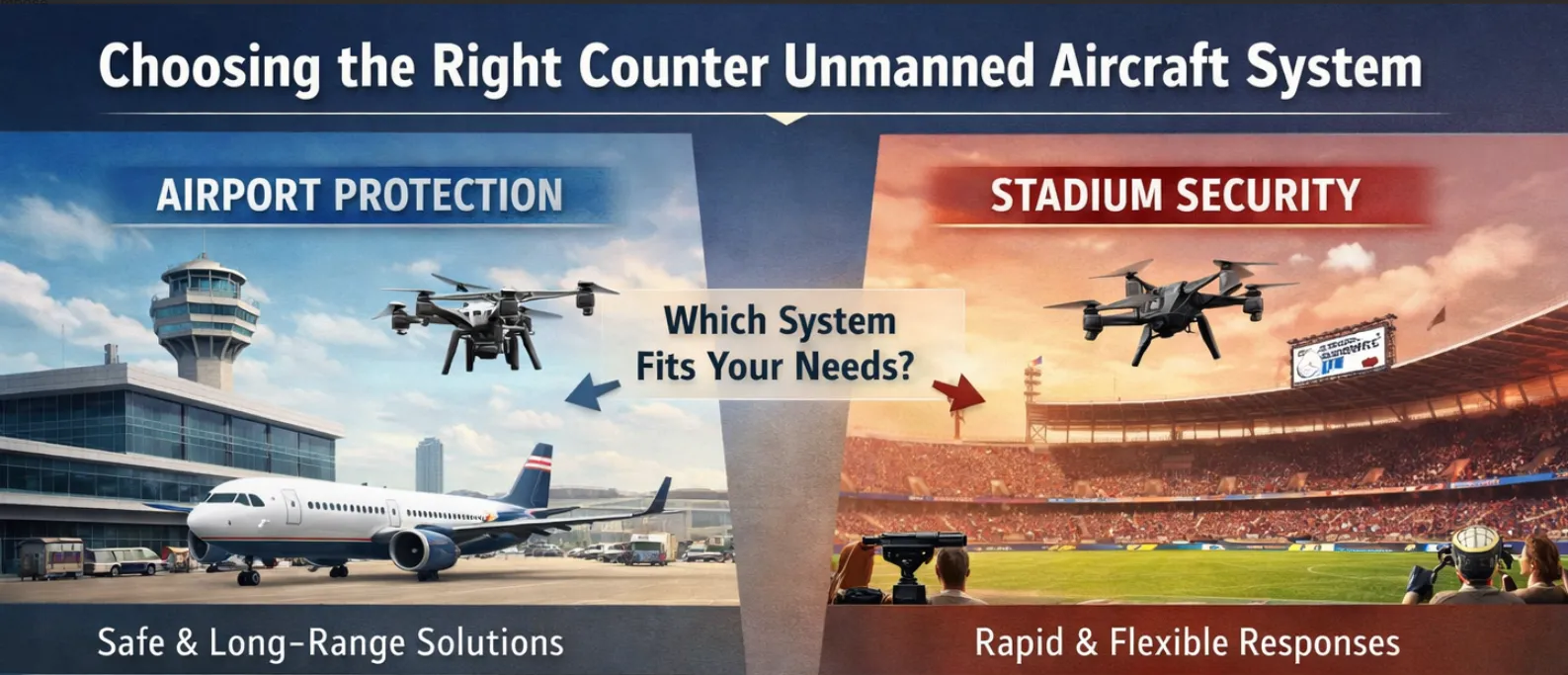
Counter drone measures are incredibly diverse depending on the threat. Which counter unmanned aircraft system matches the requirements of an airport and which one is more suitable for a stadium? And how should security teams balance detection, tracking, and neutralization before making procurement decisions?
These questions matter because every protected location faces different operational demands. The urgency is clear, with authorities seizing more than 300 unauthorized drones near 2026 FIFA World Cup stadiums and fan zones during the tournament’s opening two weeks. (Source) Selecting the right counter drone solutions depends on understanding how each technology contributes to complete airspace security. Here are the essential system components and deployment options designed for airspace drone defense operations.
Begin with Reliable Drone Detection
Drone detection is the first step for a timely reaction. Without quick detection, any action taken will be ineffective. Anti-drone radars offer complete airspace surveillance and detect, track, and evaluate drones with great precision. Advanced intelligent algorithms can increase detection efficiency and make sure of reliable detection in the most complex environment conditions.
Finding a drone is only the beginning. Security teams also need continuous tracking to understand movement and direction. Reliable tracking supports better response planning while reducing unnecessary actions. Multi-target detection capability further improves operational awareness whenever several aerial objects appear within the protected airspace simultaneously.
Optimize the Drone Defense System According to Threat Level
Large facilities use a combination of anti-drone protection systems. The management of each individual system can cause delay in making decisions at crucial moments. The centralized command and control platform enables operators to monitor various systems through a single window. Coordination enhances the efficiency of reactions without losing oversight of protected sites.
Public sites need permanent protection and cannot settle for temporary security measures. Sites like airports and stadiums need round the clock protection during their entire deployment lifetime. Stationary anti-drone systems are designed specifically for continuous fixed-site deployment, providing automated monitoring alongside long-range drone detection and warning capabilities.
Stack Multiple Technology Layers for Optimal Coverage
Stationary anti-drone systems combine several defensive technologies into one integrated platform. Long-range detection identifies approaching threats early. Dual-mode cameras operating in visible light and thermal spectrums support visual tracking. Drone jamming, UAV jamming, and GPS spoofing techniques help neutralize unauthorized drone intrusions after detection.
Critical infrastructure rarely closes for the day. Security drone defense systems must therefore remain operational throughout changing weather and lighting conditions. Fixed installations deliver uninterrupted surveillance with automated threat response while maintaining comprehensive perimeter security for sensitive low-altitude airspace around important facilities.
Use Better Portability to Deal with Mobile Assets
Not every deployment is around permanent infrastructure. Event security personnel frequently operate across changing locations. Portable or handheld anti-drone equipment allows operators to respond wherever protection becomes necessary without depending on permanent installations or complicated infrastructure.
Handheld anti-drone systems combine detection and immediate countermeasure capabilities inside lightweight equipment. Integrated RF scanning detects drone activity before the jammer disrupts its communication and navigation signals, allowing mobile teams to respond quickly.
Core Components of an Effective Counter-UAS Strategy
A reliable counter-drone strategy depends on more than one technology. Each component plays a specific role, from detecting threats early to enabling quick and effective response.
| Focus Area | Why It Matters |
| Reliable Drone Detection | Advanced anti-drone radar detects, tracks, and assesses drones accurately. Intelligent algorithms improve detection performance, even in complex environments. |
| Centralized System Control | Command and control software manages multiple anti-drone systems through one interface, improving coordination and enabling faster decision-making across protected locations. |
| Layered Fixed Protection | Stationary anti-drone systems combine radar, cameras, jamming, and GPS spoofing for continuous monitoring and automated response at critical sites. |
| Portable Response Capability | Handheld anti-drone systems combine RF detection and precision jamming, allowing rapid deployment during temporary operations. |
Conclusion
Together, several integrated technologies strengthen countermeasures for drones while supporting authorized organizations protecting critical infrastructure, airports and sensitive facilities. Entities seeking professional airspace protection can explore the complete portfolio from NovoQuad Group to identify solutions aligned with specific operational requirements.
Frequently Asked Questions
- Why is anti-drone radar important?
It detects and tracks drone threats with high accuracy over long distances.
2. Where are stationary anti-drone systems commonly deployed?
They protect airports, public facilities, and critical infrastructure.
3. When should handheld anti-drone systems be used?
They suit patrols, VIP security, large events and temporary deployments.
4. Why is a layered anti-drone approach recommended?
It combines detection, tracking, and neutralization for stronger protection.
Key Takeaways
- Choose a counter unmanned aircraft system based on operational requirements, not features alone.
- Anti-drone radar provides accurate drone detection, tracking, and threat assessment.
- Stationary anti-drone systems deliver continuous protection for critical infrastructure and public facilities.
- Handheld anti-drone systems support rapid response during mobile security operations.
- Multi-layer protection improves overall airspace security and operational efficiency.
- Centralized command and control software simplifies managing multiple anti-drone systems.
- Integrated anti-drone systems reduce deployment complexity and improve operational reliability.
- Professional counter drone solutions should match the mission and deployment environment.